- Should You Rent a Car in Korea? 5 Rules for Deciding
- Can You Eat on KTX? 5 Rules Tourists Should Know
- Korean Express vs Intercity Bus: 5 Rules for Booking the Right Bus
- Last Subway in Seoul? 5 Rules for Getting Home After Midnight
- Climate Card vs T-Money: 5 Rules for Choosing the Right Transit Card in Seoul
Walking in Korea: 7 Street Rules Tourists Should Know
Walking is one of the best ways to explore Korea.
In cities like Seoul, you may spend a lot of time walking between subway stations, cafés, markets, palaces, shopping streets, and neighborhoods.
Most streets are easy to navigate, but a few things may feel unfamiliar on your first trip.
Here are seven simple street rules and features worth knowing before you start walking around Korea.

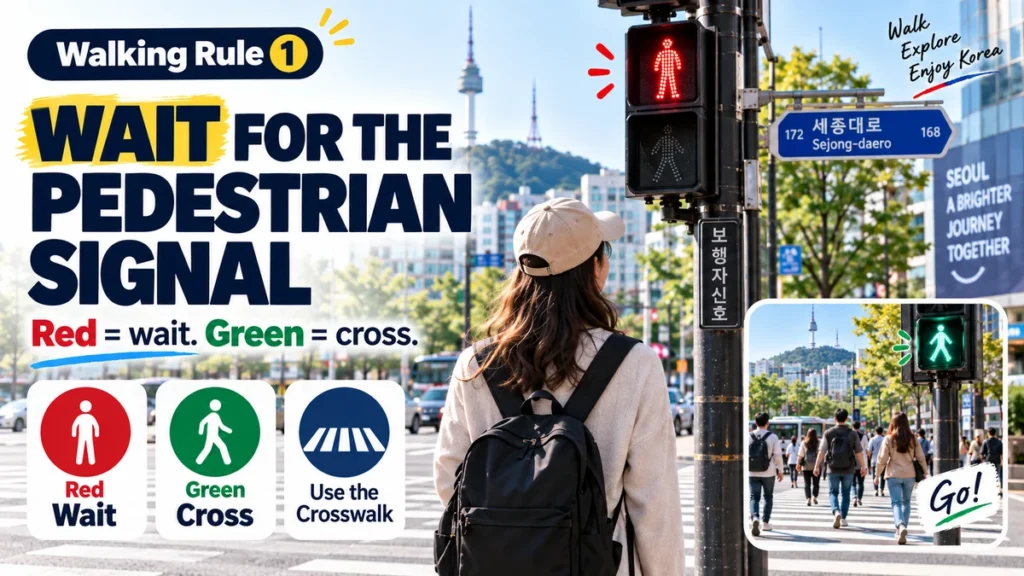
1. Wait for the Pedestrian Signal
At signal-controlled crosswalks, follow the pedestrian light.
Red = wait.
Green = cross.
Even if the road looks empty, it is better not to cross against a red pedestrian signal. Large Korean intersections can have several lanes, turning vehicles, buses, bicycles, and different signal phases operating at the same time.
You may also see diagonal crosswalks at some busy intersections, where pedestrians can cross in several directions during a dedicated pedestrian phase.
The safest habit is simple:
Stop at the curb and check the pedestrian signal before crossing.
Do not cross just because someone else starts walking first.
Green means go.
2. Green Light? Still Watch for Turning Cars
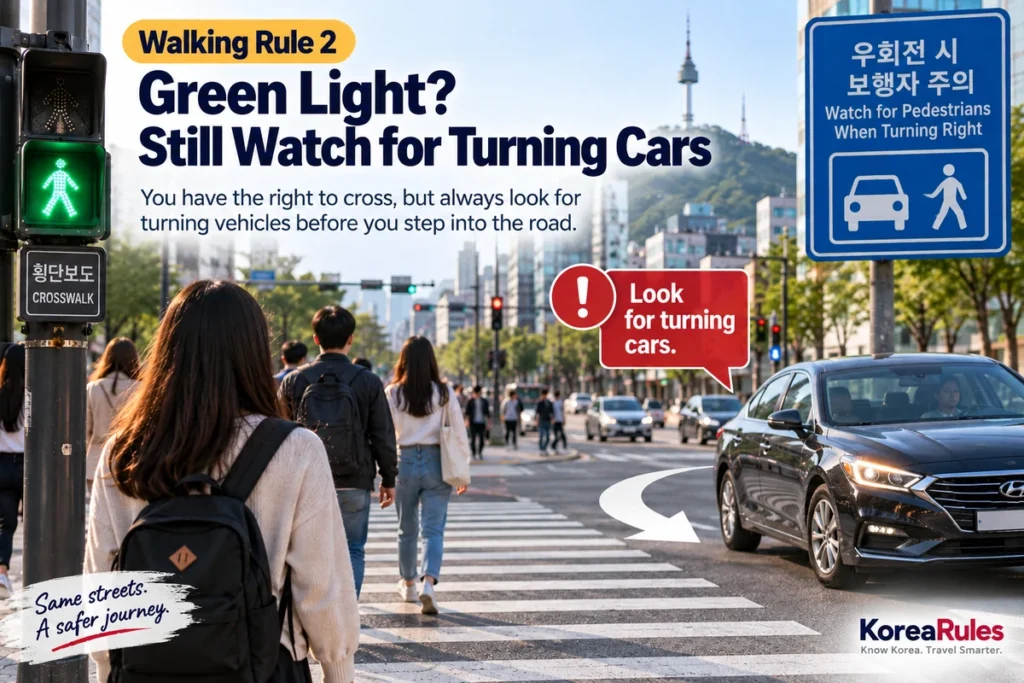
A green pedestrian light means you may cross, but you should still look for turning vehicles.
Korean traffic rules require drivers to protect pedestrians at crosswalks, including during right turns.
As a pedestrian, however, it is still worth checking that the driver has actually seen you.
Be especially careful when a large vehicle blocks your view, when it is raining or dark, or when a car is approaching the corner as you begin crossing.
And try not to look only at your phone while stepping into the road.
Having the right of way does not mean you should stop watching the traffic around you.
Green light? Still look.
3. Don’t Walk in the Bike Lane
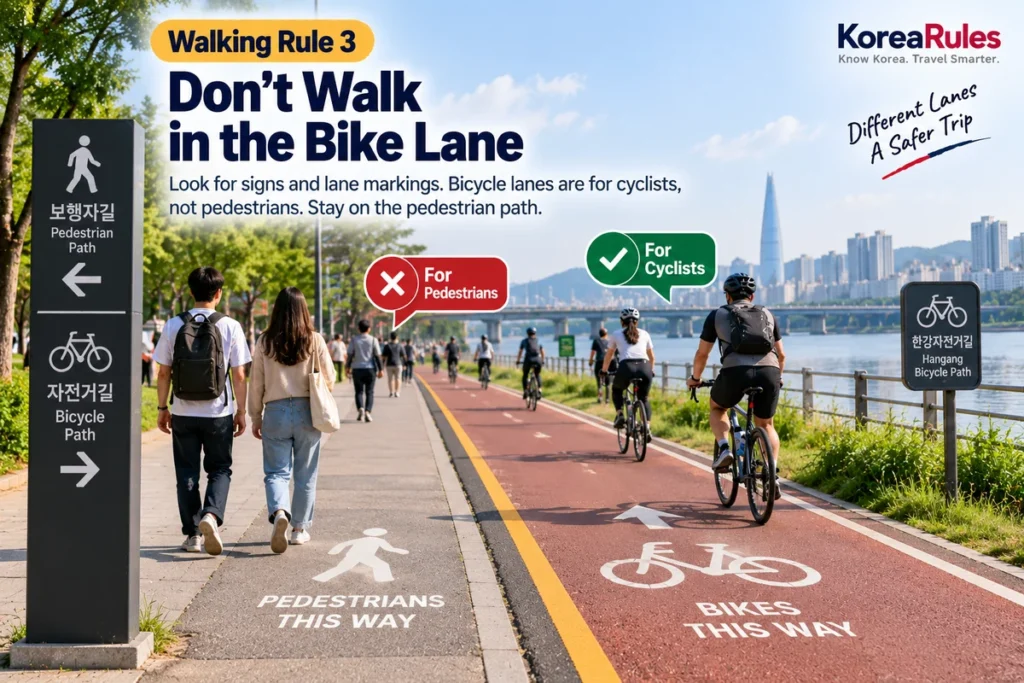
In some parts of Korea, pedestrian paths and bicycle lanes run very close together.
This is particularly noticeable around parks and the Han River.
To a first-time visitor, a bike lane can look like another wide walking path. But bicycles can approach much faster than you expect.
Look for:
- Bicycle symbols
- Lane markings
- Different pavement colors
- Signs showing separate pedestrian and bicycle paths
Before crossing a bicycle path, look both ways just as you would before crossing a small street.
If you realize you are walking in a bike lane, move back to the pedestrian side when it is safe.
Bike lane ≠ sidewalk.
4. Small Streets Still Have Traffic
Not every Korean street has a clearly separated sidewalk.
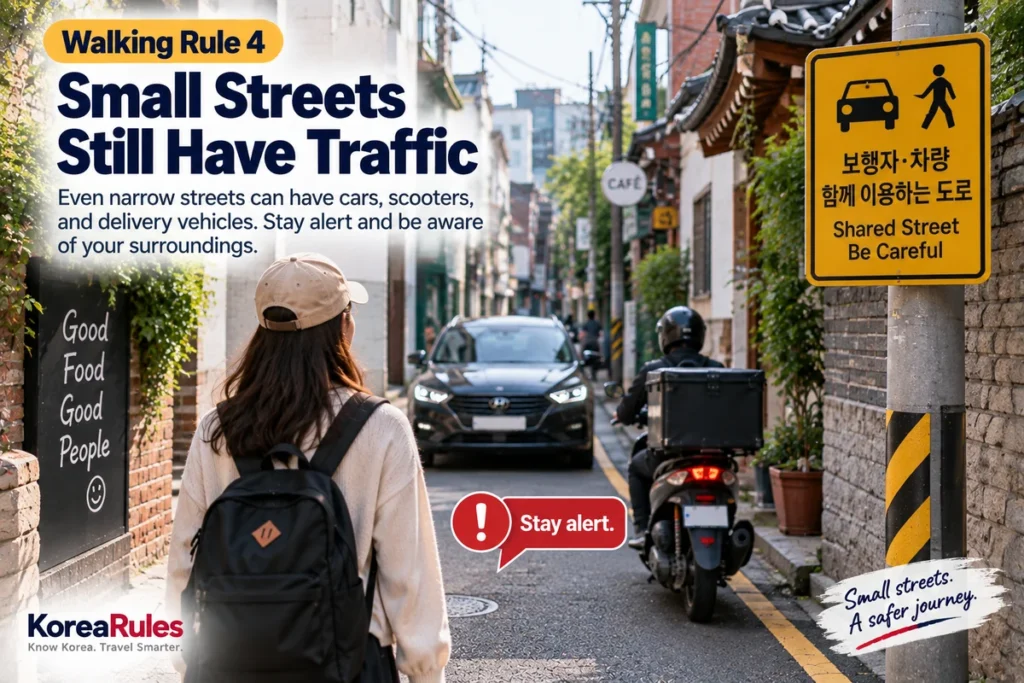
In older neighborhoods, markets, residential areas, and narrow alleys, pedestrians and vehicles may use the same space.
These streets can feel quiet, but they are not necessarily pedestrian-only.
Cars, delivery scooters, motorcycles, bicycles, and trucks can appear from behind you or turn into the street with little space to spare.
If there is no sidewalk, stay aware of your surroundings and avoid blocking the middle of the road.
Also remember that electric vehicles and bicycles can be surprisingly quiet.
When entering a narrow street from behind a building or parked vehicle, take a quick look both ways.
Small street. Stay alert.
5. Keep the Yellow Tactile Path Clear
You will see yellow textured paving throughout Korea.
It appears on sidewalks, near crosswalks, inside subway stations, and around bus stops and public facilities.
These are tactile paving blocks designed to help people with visual impairments navigate safely.
You may notice two common patterns:
Raised lines help guide the direction of travel.
Raised dots usually warn of a crossing, stairs, platform edge, or another change ahead.
You do not need to memorize the full system.
Just remember not to block it.
Avoid leaving luggage, bags, bicycles, or scooters on the yellow path. If you notice you are standing on it while waiting, simply move slightly to the side.
Keep the yellow path clear.

6. You May See Pedestrian Signals on the Ground
This is one street feature that often catches first-time visitors’ attention.
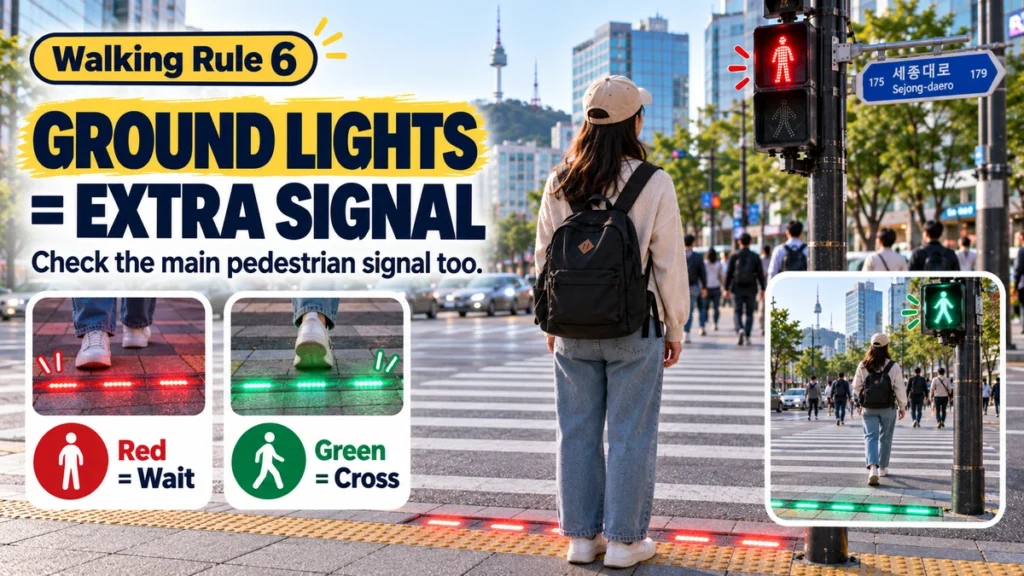
At some Korean crosswalks, you may see a straight line of LED lights built into the ground near the curb.
These are floor-type pedestrian signal lights.
They work together with the regular pedestrian signal, so you may see:
Red ground lights → Wait
Green ground lights → Pedestrian crossing phase
They are used as an additional visual safety aid, making the signal easier to notice near ground level.
But remember:
The ground lights are only a supplement.
They do not replace the regular pedestrian signal, and they are not installed at every crosswalk.
So if you see the pavement suddenly glowing red or green, there is no need to wonder what it means.
Check the main pedestrian signal too, then cross normally.
Ground lights = extra signal.
7. At Busy Crossings, Follow the Flow
This last rule is more about practical street etiquette than traffic law.
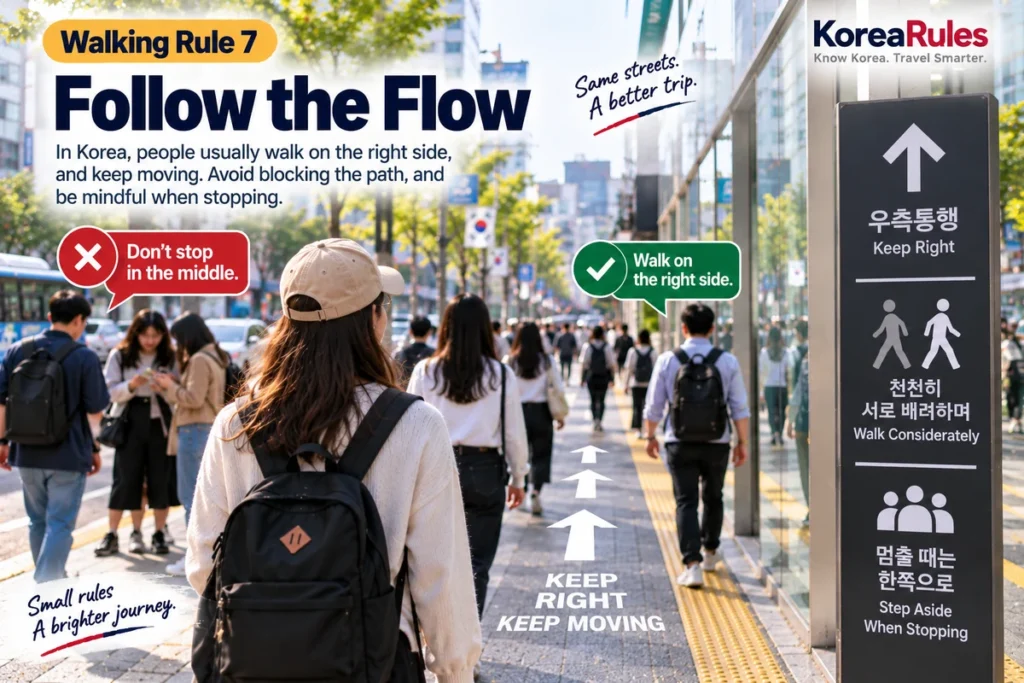
Places such as Myeongdong, Hongdae, Gangnam, major subway exits, and popular shopping streets can become very crowded.
When many people are walking in the same direction, try not to stop suddenly in the middle of the flow.
If you need to:
- Check your map
- Take a photo
- Search through your bag
- Wait for someone
move toward the side first.
You do not need to rush or copy everyone around you.
Just avoid blocking a narrow walkway or crowded crossing when a small step to the side will give you plenty of space.
Move with the flow. Stop at the side.
Before You Start Walking
A few habits are enough to make walking around Korea easier:
- Wait for the pedestrian signal.
- Check for turning vehicles even when the light is green.
- Watch for separate bicycle lanes.
- Stay alert on narrow streets without sidewalks.
- Keep yellow tactile paving clear.
- Treat ground-level LED signals as an extra safety aid.
- Move to the side if you need to stop in a crowded area.
Walking around Korea is generally straightforward.
You do not need to learn an entirely new set of street rules.
The useful part is simply recognizing a few features that may look unfamiliar at first.
Once you do, Korean streets become much easier to navigate.
Frequently Asked Questions
Can I cross if the pedestrian light is red but there are no cars?
At signal-controlled crosswalks, wait for the pedestrian signal.
Large intersections may have traffic movements that are difficult to see from where you are standing.
Do cars turn while pedestrians are crossing?
Traffic arrangements vary by intersection, and drivers are required to protect pedestrians.
Still, check for turning vehicles before stepping into the crosswalk.
What are the yellow blocks on Korean sidewalks?
They are tactile paving for people with visual impairments.
Avoid standing on them or blocking them with luggage or other objects.
Why do some Korean crosswalks have red and green lights on the ground?
They are floor-type pedestrian signal lights used as an additional visual aid.
They work with the regular pedestrian signal but do not replace it.
Does every Korean crosswalk have ground lights?
No.
You will see them at some intersections, but many crosswalks do not have them.
Always check the normal pedestrian signal.
Sources
National Law Information Center — Road Traffic Act
Official traffic law covering pedestrian signals, crosswalk safety, turning vehicles, and pedestrian protection.
Seoul Metropolitan Government — Diagonal Crosswalks and Pedestrian Safety
Official information on diagonal crosswalks and safer pedestrian signal operation at busy intersections.
Seoul Metropolitan Government — Bicycle and Pedestrian Infrastructure
Official information on bicycle lanes, pedestrian separation, and related urban walking infrastructure in Seoul.
Seoul Metropolitan Government — Accessible and Smart Pedestrian Infrastructure
Official information on tactile paving, accessible sidewalks, and ground-level LED pedestrian signals used as additional safety aids.