Korean Convenience Store Rules Tourists Should Know: 7 Things That Make Your Visit Easier
Korean convenience stores are much more than places to grab a bottle of water or a quick snack.
During your trip, you may use them for breakfast, late-night food, instant ramen, drinks, transportation cards, and other everyday needs.
They are easy to use, but a few things can be confusing if it is your first time in Korea.
Here are seven simple rules that will make your Korean convenience-store experience much easier.
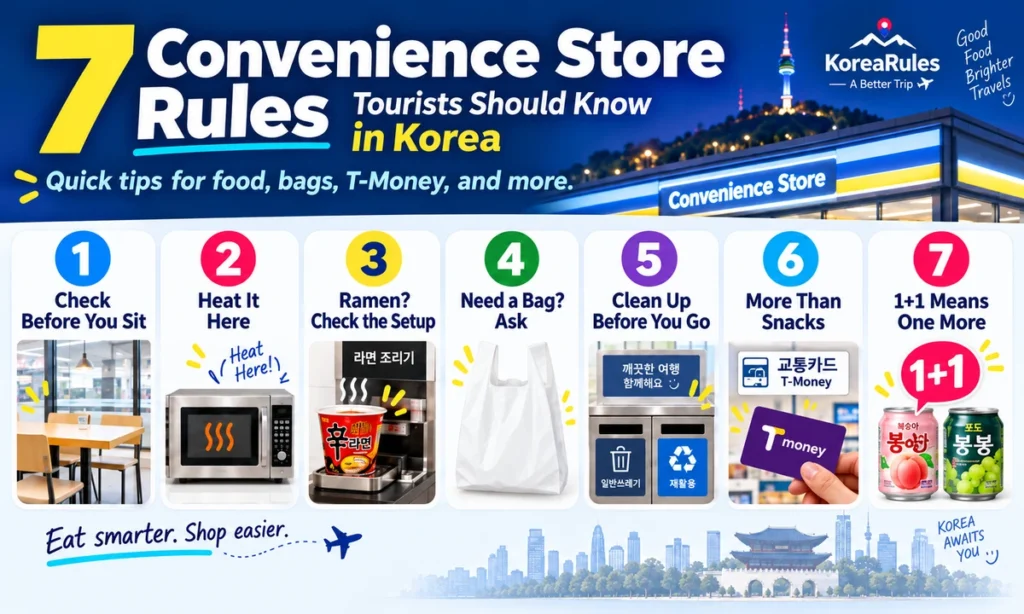
1. Check the Store Setup Before You Eat
Buying food at a Korean convenience store and eating it right away is completely normal.
Many stores sell ready-to-eat meals such as lunch boxes, gimbap, sandwiches, instant noodles, sausages, and snacks that are designed to be eaten immediately.
Some convenience stores also have tables, counters, outdoor seats, or separate eating areas.
But do not assume that every store has a place to sit.
Stores can be very different depending on their size and location. A large convenience store near a university or tourist area may have plenty of seating, while a small neighborhood location may have none at all.
Before opening your food, take a quick look around.
If you see tables, stools, or a clearly designated eating space, you can generally use that area after purchasing your food.
If there is no seating area, it is better to take your food with you rather than trying to eat somewhere that is not intended for customers.
The easiest rule is:
Check the store setup before you sit down and start eating.

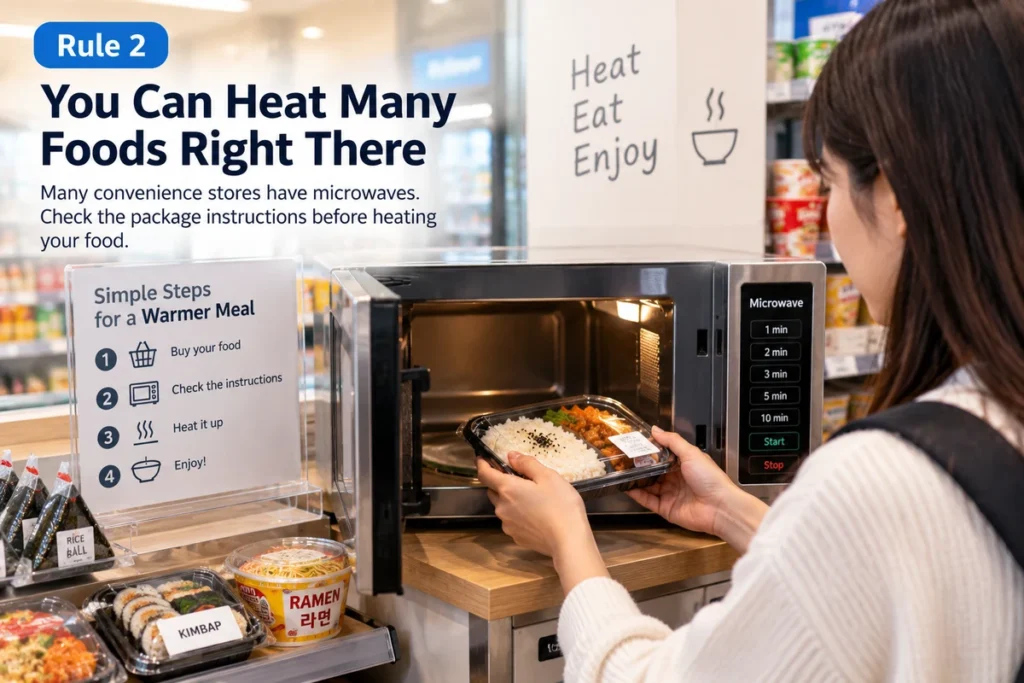
2. You Can Heat Many Foods Right There
One of the most useful things about Korean convenience stores is that many foods can be prepared inside the store.
Microwave ovens are common, and many locations also provide hot water for instant noodles.
That means you can buy a refrigerated lunch box, rice dish, sausage, dumplings, or another prepared meal and eat it warm only a few minutes later.
But there is an important detail:
Check the package before heating it.
Different products have different cooking instructions.
Some foods need only a short microwave time. Others may require you to remove part of the packaging, open a lid, add water, or take out a sauce packet first.
Do not simply put every package into the microwave exactly as you bought it.
Look for the cooking instructions printed on the package. Even if the instructions are mostly in Korean, the microwave time and wattage are often easy to recognize.
And if you are unsure, asking the staff is perfectly fine.
A simple gesture toward the product and the microwave will usually make your question clear.
Buy it. Heat it. Eat it.
That is part of the convenience-store experience in Korea.
3. Instant Ramen May Have Its Own Cooking Setup
Instant ramen is one of the most popular things travelers want to try at a Korean convenience store.
Cup noodles are the simplest option.
Many stores provide hot water, so you can buy a cup of ramyeon, add the soup powder, fill it with hot water, and wait for it to cook.
You may also see something more elaborate.
Some larger convenience stores — especially those in popular areas — have special self-service ramen cooking machines.
These machines are famous among travelers because you can cook bagged instant noodles in a disposable cooking container right inside the store.
But there is one thing to remember:
Not every convenience store has the same setup.
A store may have:
- Hot water for cup noodles
- A microwave
- A dedicated ramen cooker
- A larger self-service food area
- Or only basic facilities
So do not walk into every Korean convenience store expecting the same “Han River ramen” experience you may have seen online.
Look at what the store actually provides.
If there is a ramen cooking station, follow the instructions posted near the machine.
If there is only hot water, cup noodles are usually the easiest choice.
Ramen? Check the setup first.

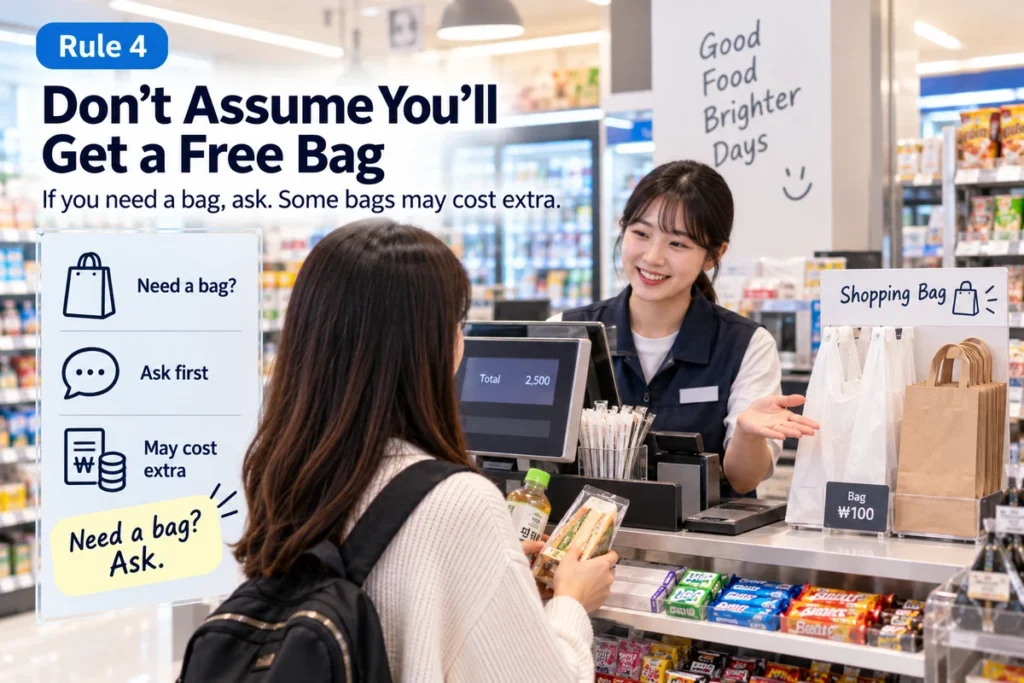
4. Don’t Assume You’ll Get a Free Bag
If you buy several things at a convenience store, you may expect the cashier to automatically put everything into a shopping bag.
That is not always how it works in Korea.
Depending on the store and the type of bag, a bag may cost extra or may not be automatically provided.
So if the cashier finishes the transaction and your items are still sitting on the counter, do not assume something went wrong.
If you need a bag, simply ask.
You can say:
“Bag, please.”
In most situations, that is enough to communicate what you want.
If you are only buying one or two small items, you may also see local customers simply carry them out by hand.
Reusable bags are useful if you expect to visit convenience stores or supermarkets often during your trip.
The important thing is simply not to expect a free plastic bag to appear automatically.
Need a bag? Ask.
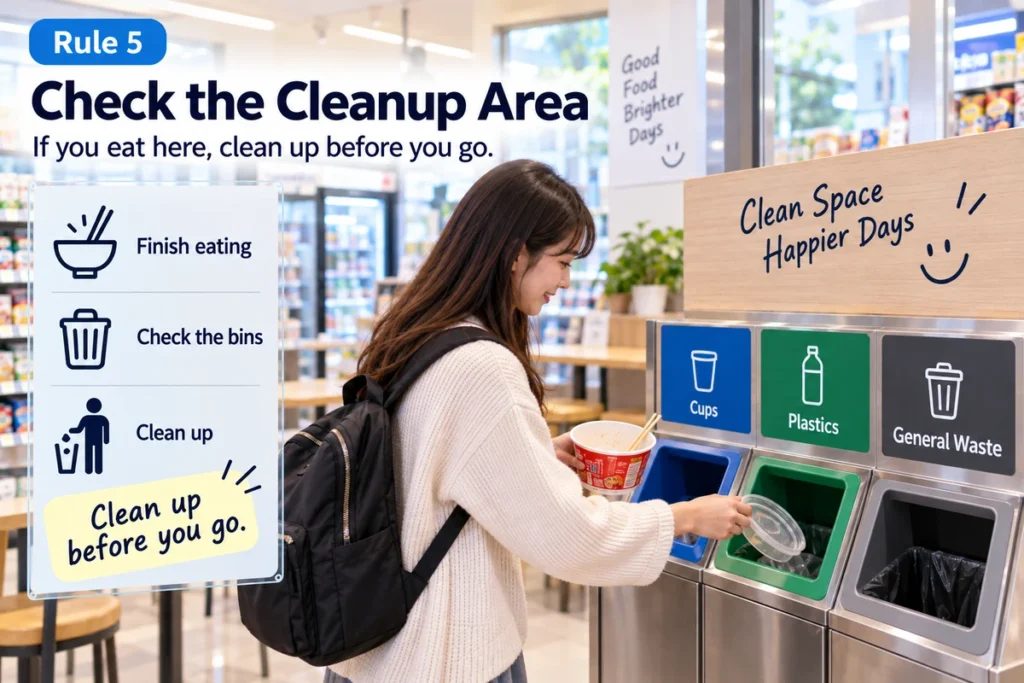
5. If You Eat There, Check the Cleanup Area
If you eat inside a convenience store, do not leave your cups, food containers, chopsticks, or packaging on the table when you finish.
Look for the store’s cleanup area.
Depending on the location, you may find separate bins for:
- General waste
- Recyclables
- Plastic bottles or cans
- Food waste
- Leftover liquids
Other stores may have a much simpler setup.
The exact system is not identical everywhere, so there is no need to memorize one universal sorting rule before your trip.
Just look at the signs and follow the system used by that store.
For example, if you finish instant noodles and still have soup left, there may be a place to dispose of the liquid separately rather than pouring everything into a general trash bin.
If you are not sure where something goes, take a moment to look around instead of leaving it on the table.
This is a small habit, but it helps keep shared eating areas clean for the next customer.
Eat there? Clean up before you go.
6. Convenience Stores Do More Than Sell Snacks
A Korean convenience store can be surprisingly useful during your trip.
Depending on the chain and location, convenience stores may offer services beyond food and drinks.
One of the most useful for tourists is transportation-card service.
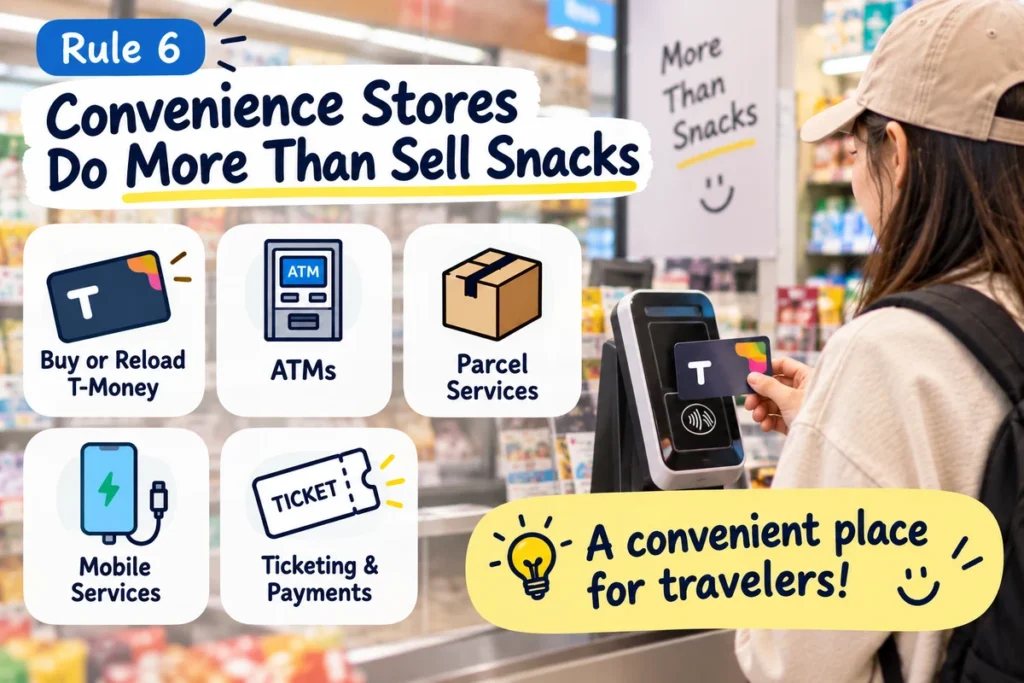
Major convenience-store chains commonly sell or reload transportation cards such as T-Money.
That means if your T-Money balance gets low while you are exploring the city, a nearby convenience store can often be an easy place to top it up.
Some locations may also have services such as:
- ATMs
- Parcel or delivery services
- Mobile charging or prepaid services
- Ticketing or payment services
But these extra services vary.
A large downtown store may offer things that a small neighborhood branch does not.
So think of Korean convenience stores as useful mini service hubs, but do not assume every branch provides exactly the same things.
For most travelers, the key thing to remember is:
If you need snacks, drinks, or help with your transit card, a convenience store is often a good place to check first.
Using T-Money during your trip? Read 7 T-Money Rules First-Time Visitors Get Wrong in Korea for more information about buying, topping up, tapping, transfers, and refunds.
7. Understand the 1+1 and 2+1 Signs
You will probably notice signs like these on convenience-store shelves:
1+1
or
2+1
They are common promotional offers in Korea, but first-time visitors sometimes misunderstand what they mean.
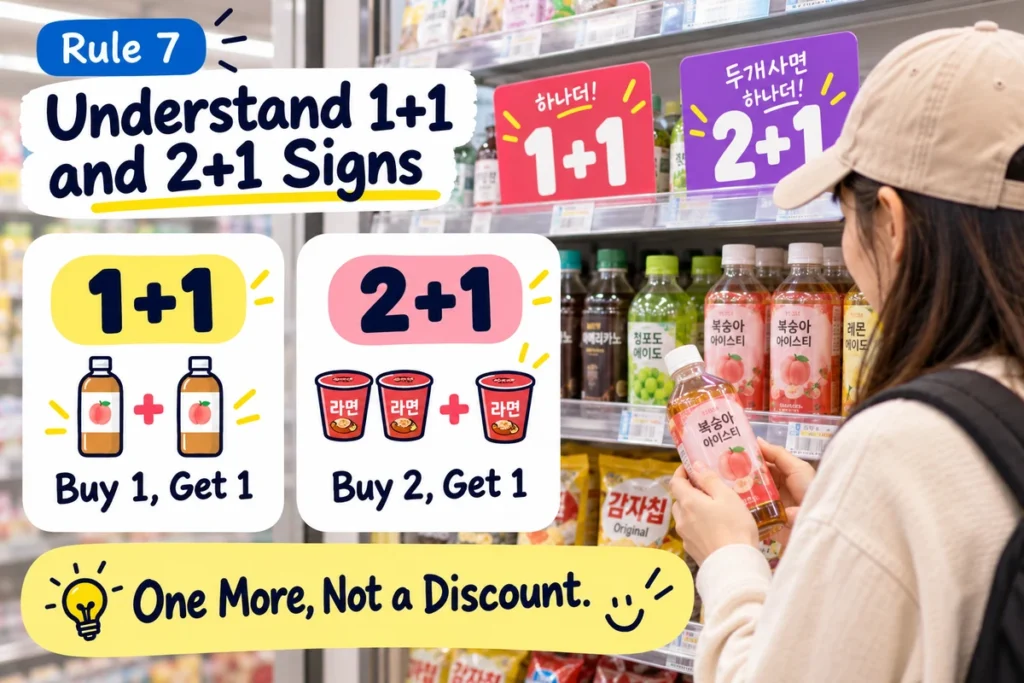
1+1
Buy one qualifying product and receive one additional item as part of the promotion.
In simple terms:
Buy 1 → Get 1 more
2+1
Buy two qualifying products and receive one additional item.
In simple terms:
Buy 2 → Get 1 more
These promotions can be a good deal if you are buying drinks, snacks, ice cream, or other everyday items.
But make sure the exact product is part of the promotion.
Two products that look almost identical may have different sizes or flavors, and only certain ones may qualify.
Promotions also change over time, and availability can differ by store.
So if you see a 1+1 or 2+1 label, check that your product matches the promotional sign before heading to the register.
If you are traveling with someone, these deals can be particularly useful because you can easily split the extra item.
1+1 does not mean a discount on one item. It means one more.
Before You Leave the Convenience Store
A quick check can save you from small misunderstandings:
- Did you check whether the store has an eating area?
- Did you follow the heating instructions on your food?
- Did you check what ramen facilities the store actually has?
- Do you need to ask for a bag?
- Did you clean up after eating?
- Do you need to reload your transportation card?
- Did you understand the
1+1or2+1promotion correctly?
You do not need to memorize complicated convenience-store etiquette.
Just look at how the store is set up, follow the signs, and remember that each location can be a little different.
Once you understand those basics, Korean convenience stores are incredibly easy — and useful — to enjoy.
Frequently Asked Questions
Can I eat inside Korean convenience stores?
Sometimes.
Many stores have tables, counters, or designated eating areas, but not every location does. Check the store setup before opening and eating your food.
Can I use the microwave in a Korean convenience store?
Many convenience stores provide microwaves for customers who purchase prepared food.
Always check the heating instructions on the package before using the microwave.
Can I cook instant ramen inside the store?
Often, yes.
Cup noodles can commonly be prepared using hot water. Some stores also have special ramen cooking machines, but these are not available at every location.
Do convenience stores give free shopping bags?
Do not assume a bag will automatically be provided for free.
If you need one, ask the cashier. Bag policies and available bag types can vary.
Can I recharge T-Money at a convenience store?
Major convenience-store chains commonly support T-Money purchases and top-ups, although individual services can vary by location.
For more detailed transit-card information, see our [7 T-Money Rules First-Time Visitors Get Wrong in Korea] guide.
What does 1+1 mean in a Korean convenience store?
It generally means:
Buy one qualifying item and receive one additional item.
2+1 generally means:
Buy two qualifying items and receive one additional item.
Always check the promotional label and qualifying product.
Are all Korean convenience stores basically the same?
No.
Major chains may feel similar, but individual locations differ in size, seating, food facilities, ramen equipment, available services, and promotions.
That is why one of the best KoreaRules habits is simple:
Look around first. Then follow the store.
Sources
VISITKOREA — Keeping Up with the Convenience Stores in Korea
Convenience-store food culture, ready-to-eat meals, and common ways travelers use Korean convenience stores.
Visit Seoul — Convenience Store Food Course
Convenience-store meals, microwave and hot-water use, and practical food preparation inside Korean convenience stores.
VISITKOREA — A Guide to CU Ramyun Library
Instant ramyeon, self-cooking machines, and eating ramyeon inside a Korean convenience store.
VISITKOREA — Transportation Cards
T-Money purchase and top-up locations, including major convenience-store chains.
Easy Law Korea — Restrictions on Disposable Shopping Bags
Rules on free disposable bags and shopping bags at retail businesses, including relevant exceptions.
GS25 — Event Products
Official examples of 1+1 and 2+1 convenience-store promotions and the note that some stores may be excluded from promotions.