Tipping in Korea: 5 Rules Tourists Should Know
Should you tip at a restaurant in Korea?
What about a taxi driver, hotel staff, or café worker?
For travelers from countries where tipping is expected, Korea can feel surprisingly simple:
Tipping is generally not customary or expected.
VISITKOREA states that tipping is not required or expected at Korean restaurants, while its official taxi guide says taxi drivers do not require tips. Seoul’s official tourism guide also describes tipping as not being a Korean custom.
There are, however, a few situations where you should check the bill before paying.
Here are five simple rules.
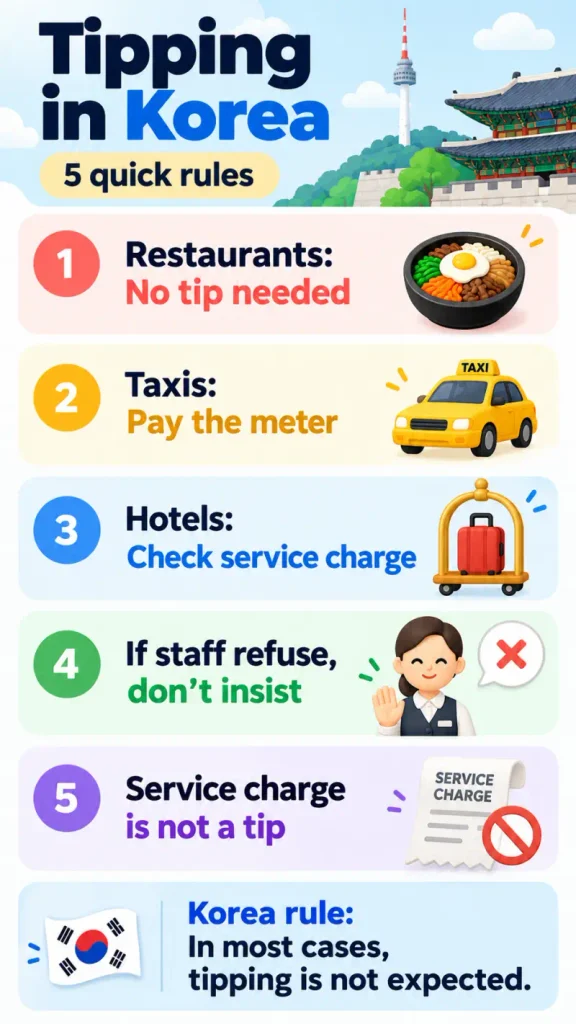
Rule 1 — At Restaurants, Pay the Bill — No Tip Required
At an ordinary Korean restaurant, you generally don’t need to calculate an extra 15%, 20%, or 25% after your meal.
VISITKOREA’s official Korean food guide states clearly that tipping is not required or expected in Korea.
If your bill is ₩28,000, you normally pay ₩28,000.
You don’t need to leave cash on the table after paying.
The same principle applies whether you ordered at the table, used a kiosk, or paid at the counter.
This can feel unusual if you come from a country where restaurant staff rely heavily on gratuities, but in Korea the listed price is generally what customers expect to pay unless an additional charge is clearly stated.
The KoreaRule: At a normal restaurant, pay the listed bill. You don’t need to add a tip.
Rule 2 — In Taxis, Pay the Metered Fare
Korean taxi drivers do not normally expect a tip.
VISITKOREA’s official taxi guide says most taxis charge according to the taximeter and do not require tips. Payment can usually be made by cash, credit card, or transportation card.
So if the meter shows:
₩18,700
you pay the fare shown.
You don’t need to calculate an additional percentage.
Visit Seoul notes that some passengers may voluntarily let a driver keep small change, but that is a personal choice rather than a tipping requirement.
When paying through a taxi-hailing app, simply check the fare shown in the app and any applicable surcharge.
The KoreaRule: Pay the taxi fare shown. A separate tip is not expected.
Rule 3 — At Hotels or Upscale Restaurants, Check for a Service Charge
This is where travelers sometimes get confused.
Tipping and a service charge are not the same thing.
Visit Seoul notes that some major hotels and upscale restaurants may add a 10% service charge to the bill, in addition to VAT.
If a service charge is already included, you normally don’t need to add another percentage as though you were paying an American-style tip.
Before paying, look for wording such as:
- Service charge
- Service fee
- VAT included
- Tax and service included
Policies vary by property, so check the actual bill rather than assuming every hotel uses the same system.
The KoreaRule: If a service charge is already included, don’t automatically add another tip.
Rule 4 — If Someone Refuses Your Tip, Don’t Insist
Because tipping is not a standard Korean custom, a staff member may accept an offered tip—or may feel unsure about taking it.
Visit Seoul’s etiquette guide specifically notes that tipping is not customary and that some people may accept it while others may refuse.
If someone politely refuses your money, don’t keep trying to hand it back.
A sincere:
감사합니다.
Gamsahamnida — Thank you.
is enough.
You can also show appreciation by leaving a positive review, thanking the staff directly, or returning to the business.
The KoreaRule: If your tip is refused, simply say thank you and move on.
Rule 5 — Know the Difference Between a Tip and a Service Charge
A tip is usually a voluntary extra payment chosen by the customer.
A service charge is a fee determined by the business and added to the bill.
That distinction matters in Korea.
Quick comparison
| Tip | Service charge |
|---|---|
| Voluntary extra payment | Added by the business |
| Generally not expected in Korea | May appear at some hotels or upscale restaurants |
| Customer decides amount | Amount is stated on the bill |
| May be accepted or refused | Paid as part of the bill |
If you see an additional charge, check what it actually is before assuming the restaurant is asking for a tip.
And don’t confuse VAT with gratuity either. Taxes and service charges are separate billing items.
The KoreaRule: Read the bill. A service charge is not the same thing as a tip.
The KoreaRule
PAY THE BILL → CHECK SERVICE CHARGE → NO TIP REQUIRED → DON’T INSIST
In most everyday situations in Korea, tipping isn’t expected.
Pay the stated price, check whether a service charge is included, and don’t feel obligated to add a percentage.
Quick Tipping Guide
| Situation | Tip expected? |
|---|---|
| Casual restaurant | No |
| Café | No |
| Taxi | No |
| Hotel | Usually not; check service charges |
| Upscale restaurant | Check the bill for service charge |
| Someone provides exceptional help | Optional gesture, but may be refused |
The first three are supported directly by official tourism guidance; hotel and upscale-restaurant billing can vary by property.
Continue Planning Your Korea Trip
Want to understand cards, cash and restaurant payments?
→ The Real Rules of Paying in Korea: 7 Things Tourists Should Know
First time eating at a Korean restaurant?
→ The Unwritten Rules of Korean Restaurants: 7 Things Tourists Should Know
Planning to take a taxi?
→ 7 Korea Taxi Rules Tourists Should Know Before Riding
Before You Pay
- Don’t automatically add a tip at restaurants.
- Pay the metered fare in a taxi.
- Check hotel and upscale-restaurant bills for service charges.
- Don’t confuse VAT with gratuity.
- If someone refuses a tip, don’t insist.
FAQ
Do you tip at restaurants in Korea?
Generally, no. VISITKOREA states that tipping is not required or expected at Korean restaurants.
Do you tip taxi drivers in Korea?
No tip is required. Korean taxis generally use a meter, and passengers pay the displayed fare.
Do you tip hotel staff in Korea?
Tipping is not generally a Korean custom. Some major hotels may already apply a service charge, so check your bill or the property’s policy.
What is a service charge in Korea?
It is an additional fee set by the business rather than a voluntary gratuity chosen by the customer. Visit Seoul notes that some major hotels and upscale restaurants may apply a 10% service charge.
What if a Korean staff member refuses my tip?
Don’t insist. Official Visit Seoul etiquette guidance notes that some people may accept tips while others may refuse them because tipping is not customary.
Is it rude to tip in Korea?
It isn’t accurate to say that offering a tip is automatically rude. Tipping simply isn’t normally expected, and the person may accept or decline it.
Should I tip at cafés in Korea?
A standard gratuity is generally not expected. Pay the listed price unless the business clearly states an additional charge.
Sources
VISITKOREA — About Korean Food
Official Korea Tourism Organization restaurant guide stating that tipping is not required or expected in Korea.
VISITKOREA — Taxi
Official Korea Tourism Organization transportation guide stating that Korean taxis use metered fares and do not require tips.
Visit Seoul — Money
Official Seoul tourism information explaining that tipping is not expected, while some major hotels and upscale restaurants may add a service charge.
Visit Seoul — Etiquette
Official Seoul tourism etiquette guide explaining that tipping is not customary and that some people may accept it while others may refuse.