- Unwritten Rules for Shopping at Olive Young in South Korea
- How to Use a Coin Laundry in Korea: 5 Rules Tourists Should Know
- ATM vs Currency Exchange in Korea: 5 Rules for Getting Korean Won
- Sick in Korea? 5 Rules for Choosing a Pharmacy, Clinic or ER
- Hotel vs Guesthouse vs Hanok: 5 Rules for Choosing Where to Stay in Korea
The Real Rules of Paying in Korea: 7 Things Tourists Should Know
Paying for things in Korea is usually easy. Credit cards are widely accepted, even for small purchases.
But there are a few situations that can confuse first-time visitors — especially when it comes to cash, transportation, foreign cards, mobile payments, and tax refunds.
Here are seven payment rules worth knowing before your trip.
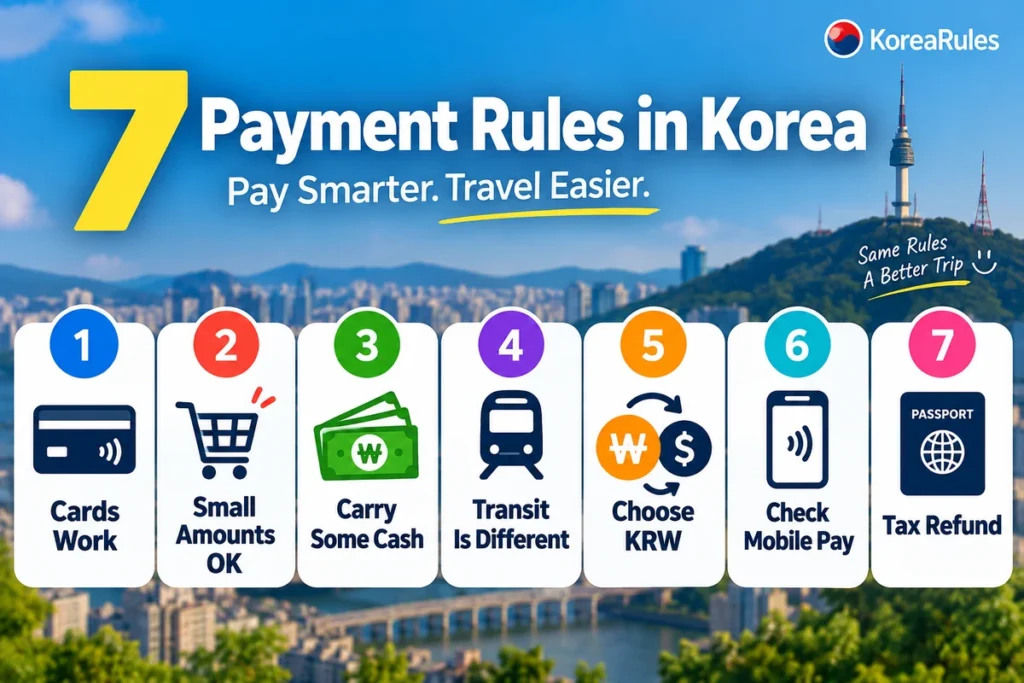
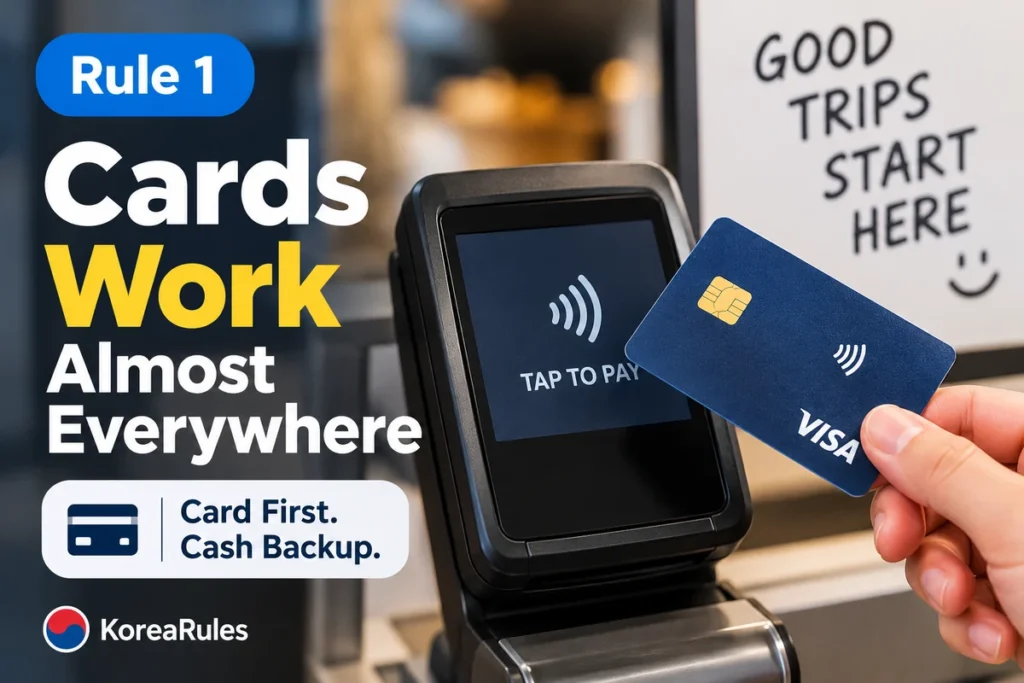
1. Cards Work Almost Everywhere — But Not Literally Everywhere
Korea is very card-friendly.
International credit cards such as Visa, Mastercard, and American Express are accepted at most stores, restaurants, hotels, and tourist attractions.
Still, “almost everywhere” does not mean everywhere. Some traditional markets, street vendors, and small businesses may prefer or require cash.
Simple rule: Card first. Cash backup.
2. Paying a Small Amount by Card Is Normal
You do not need to save your card for expensive purchases.
In Korea, paying by card for a coffee, convenience-store snack, or other small purchase is completely normal. Seoul’s official visitor information says cards can generally be used regardless of whether the amount is small or large.
So if your purchase is only a few thousand won, using a card is usually fine.

3. Still Carry a Little Korean Cash
Korea may feel almost cashless, but carrying a small amount of Korean won is still useful.
Cash can help at some traditional markets, street stalls, and certain transportation-related situations. Some subway machines used for topping up transit cards may also be cash-only.
You do not need to carry a large amount.
A little cash is usually enough as a backup.

4. Paying for Transit Is Different From Paying in a Store
Just because your foreign credit card works at a convenience store does not mean you can simply tap that same card at every subway gate or bus reader.
For most first-time visitors, a T-Money card remains one of the simplest ways to pay for subways and buses around Korea. It can be used across multiple cities and topped up when needed.
Seoul is expanding international-card support at ticket machines, including for Climate Card short-term passes and single-journey tickets, but that does not mean every transit payment works like a normal store purchase.
Using public transportation? Read our guide: 7 T-Money Rules First-Time Visitors Get Wrong in Korea

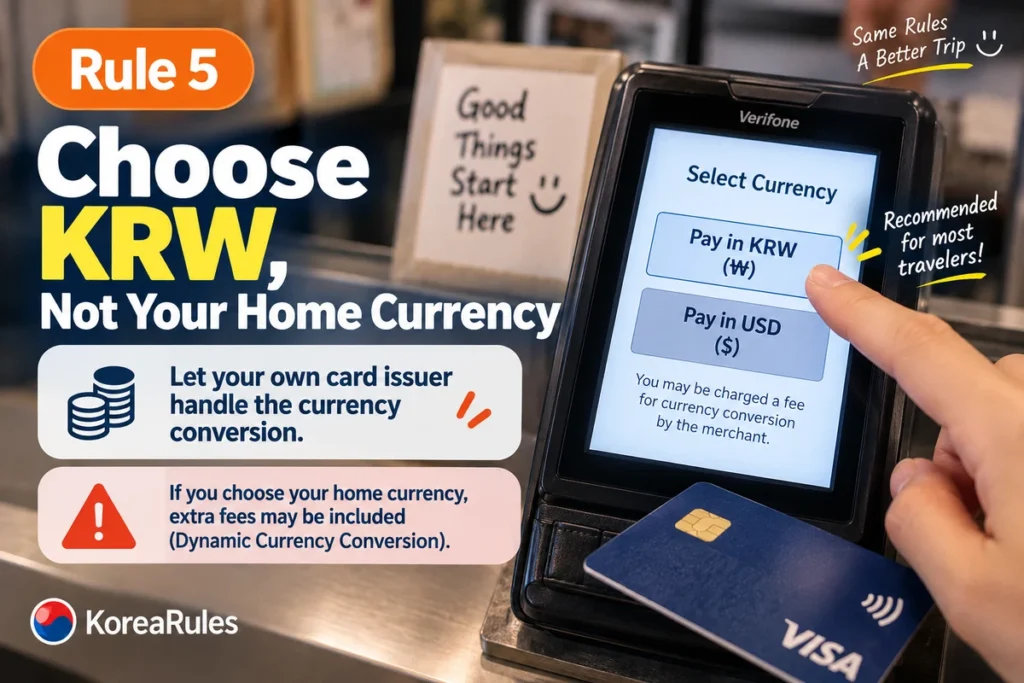
5. If You’re Asked KRW or Your Home Currency, Look Carefully
When paying with a foreign card, a payment terminal may sometimes offer a choice:
KRW
or
your home currency
This is called Dynamic Currency Conversion (DCC).
If you choose your home currency, the merchant’s conversion rate and additional markup may be included. Visa requires the exchange rate and additional fees to be shown and says customers must be given a choice to accept or decline the conversion.
For many travelers, choosing KRW lets their own card issuer handle the currency conversion instead.
However, your own bank may charge foreign transaction fees, so check your card terms before traveling.
When in doubt, look carefully before choosing a currency.
6. Don’t Assume Every Mobile Wallet Works Everywhere
Mobile payments are common in Korea, but not every foreign wallet or QR payment service works at every store.
Services such as Alipay, WeChat Pay, UnionPay, and participating international wallets can be used at compatible ZeroPay and other affiliated merchants. The important word is compatible.
Look for the payment logo at the entrance, counter, or payment terminal before relying on your phone.
Keeping a physical card or some cash as backup is still a good idea.

7. See “Tax Refund”? Have Your Passport Ready
Eligible international visitors may be able to receive a tax refund when shopping at participating stores.
For an immediate tax refund, Korea Tourism Organization guidance currently says a single purchase must be at least ₩15,000 and under ₩1,000,000, with total eligible purchases during the trip not exceeding ₩5,000,000 under this refund method. Passport verification is required.
Other tax-refund methods have different procedures and limits.
So if you see a Tax Refund or Tax Free sign, have your passport available and ask the store what procedure applies.

Before You Pay
Remember these basics:
- Cards are accepted almost everywhere
- Small card payments are normal
- Keep a little Korean cash as backup
- Transit payments work differently from store payments
- Check carefully before choosing KRW or your home currency
- Look for supported mobile-payment logos
- Keep your passport handy when shopping at tax-refund stores
Once you know these rules, paying in Korea is usually simple.
Frequently Asked Questions
Do I need cash in Korea?
Not much, but carrying some Korean won is useful for certain markets, small vendors, and transportation-related situations.
Can I use a foreign credit card in Korea?
Usually, yes. Major international cards are accepted at most stores, restaurants, hotels, and tourist facilities.
Should I pay in KRW or my home currency?
If a terminal offers Dynamic Currency Conversion, check the exchange rate and fees before choosing. Paying in KRW allows your own card issuer to handle the currency conversion, but your issuer may charge its own fees.
Do tourists need a passport for tax refunds in Korea?
Passport verification is required for Korea’s immediate tax-refund process, so having your passport available when shopping at participating stores can make the process easier.
Sources
Seoul Metropolitan Government — Currency Exchange
Credit-card acceptance in Korea and the use of cards for both small and large purchases.
Korea Tourism Organization — International Visitors’ Use of Public Transportation and Booking/Payment Services
Foreign-card availability for transportation, T-Money payment limitations, and transit-ticket payment options.
Visa — Dynamic Currency Conversion
How Dynamic Currency Conversion works and the choice between paying in KRW or the cardholder’s home currency.
VISITKOREA — Shopping in Korea
International credit cards and supported mobile and QR payment options at participating Korean merchants.
VISITKOREA — Comprehensive Tax Refund Guide
Passport verification, immediate tax-refund requirements, purchase limits, and refund procedures.