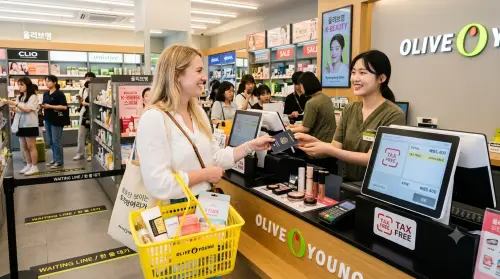
- Unwritten Rules for Shopping at Olive Young in South Korea
- How to Use a Coin Laundry in Korea: 5 Rules Tourists Should Know
- ATM vs Currency Exchange in Korea: 5 Rules for Getting Korean Won
- Sick in Korea? 5 Rules for Choosing a Pharmacy, Clinic or ER
- Hotel vs Guesthouse vs Hanok: 5 Rules for Choosing Where to Stay in Korea
ATM vs Currency Exchange in Korea: 5 Rules for Getting Korean Won
How much Korean won should you exchange before your trip?
Do you even need much cash in Korea?
And if you do, is it better to use an ATM or exchange foreign currency?
Credit cards are widely accepted across Korea, including at hotels, department stores, restaurants, and many ordinary shops. However, not every business necessarily accepts every foreign-issued card, so carrying a small amount of cash is still useful.
Here are five simple rules for getting and using Korean won without carrying more cash than you need.

Rule 1 — Use Cards for Most Everyday Purchases
You probably don’t need to arrive in Korea carrying a large stack of won.
VISITKOREA says credit cards are widely accepted at major hotels, department stores, and general shops, including cards such as Visa, Mastercard, and American Express. It also notes that travelers should still check availability because some businesses may not accept a particular card.
A practical approach is to use your card for larger and routine purchases, then keep some cash for situations where card payment is inconvenient or unavailable.
Before traveling, check whether your bank charges:
- Foreign transaction fees
- Currency conversion fees
- Overseas ATM fees
- Additional cash-withdrawal fees
Your own card issuer’s charges can matter just as much as the Korean ATM or merchant.
The KoreaRule: Use cards as your main payment method, but keep a small cash backup.
Rule 2 — Need Cash? Compare ATM vs Currency Exchange
There are two straightforward ways to get Korean won after arriving:
ATM withdrawal
Use an overseas-issued card at an ATM that supports international cards.
This can be convenient because you don’t need to carry large amounts of foreign cash into Korea.
Shinhan Bank’s foreign-customer guide states that overseas-issued cards can be used for cash withdrawals at Global ATMs. It also notes that many Korean ATMs provide an English interface.
Currency exchange
Bring foreign cash and exchange it at a bank or authorized exchange office.
VISITKOREA recommends using banks or authorized exchange service centers for foreign-currency exchange.
Which option is cheaper depends on your bank, card, ATM, currency, and the exchange rate offered.
So rather than assuming ATM is always cheaper—or exchange booths are always better—compare the actual cost available to you.
The KoreaRule: Compare the total cost, not just the advertised exchange rate.
Rule 3 — Look for an ATM That Accepts Foreign Cards
Not every ATM should be assumed to work with your overseas-issued card.
Look for machines marked for international or global card use and check for card-network logos that match your card.
If the machine offers an English-language menu, choose English before beginning the transaction.
Before confirming the withdrawal, check:
- Withdrawal amount
- Any ATM fee shown on screen
- Your card’s available overseas withdrawal limit
- Whether your bank may add its own fee
ATM transaction limits can also vary by machine and card issuer.
If one machine rejects your card, don’t assume the card is unusable everywhere in Korea. Try an ATM from another major bank or contact your card issuer.
Incheon Airport has ATMs operated by major Korean banks in both passenger terminals, so travelers can access banking facilities soon after arrival.
The KoreaRule: Use an international-compatible ATM and review the fee before confirming the withdrawal.
Rule 4 — Exchange Cash at a Bank or Authorized Exchange Office
If you prefer bringing cash, use an established bank or authorized currency exchange office.
Seoul Metropolitan Government says foreign currency can be exchanged at airport exchange counters, downtown banks, and private currency exchange offices. It also says travelers need to present a passport or residence card when exchanging currency.
VISITKOREA notes that ordinary bank exchange counters are generally open during weekday banking hours, while operating times vary by bank and location.
Airport exchange counters are convenient when you first arrive. At Incheon Airport, standard money-exchange counter hours are generally around 6 AM to 10 PM, with some locations operating 24 hours, although individual hours vary.
So if you land very late or early, check the current airport information before assuming a particular counter will be open.
The KoreaRule: Use banks or authorized exchange offices, and keep your passport available.
Rule 5 — Don’t Carry More Won Than You Need
Korea’s widespread card acceptance means you don’t necessarily need to exchange your entire travel budget into cash on arrival.
A simpler strategy is:
- Keep one main payment card.
- Carry a second card as backup.
- Keep a modest amount of won in cash.
- Withdraw or exchange more only when necessary.
This reduces the amount of cash you could lose and avoids ending your trip with a large amount of unused won.
Keep your cards and cash in separate places rather than storing everything in one wallet.
If you exchange cash, keep the receipt until you’ve checked that the amount is correct.
The KoreaRule: Carry enough cash for backup—not your entire travel budget.
The KoreaRule
CARD FIRST → NEED CASH? → ATM OR EXCHANGE → CHECK FEES → KEEP A BACKUP
Use cards for most purchases, compare your cash options, and keep only the amount of won you’re likely to need.
Quick Comparison: ATM vs Currency Exchange
| ATM Withdrawal | Currency Exchange | |
|---|---|---|
| What you need | International-compatible card | Foreign cash + identification |
| Convenience | Often available beyond bank hours | Depends on exchange-office hours |
| Cost | ATM + card-issuer fees may apply | Exchange spread / rate varies |
| Exchange amount | Withdraw when needed | Exchange the cash you bring |
| Best for | Travelers who prefer cards | Travelers already carrying foreign cash |
There is no universal cheapest option. Your card issuer’s fee schedule and the actual exchange rate matter.
Continue Planning Your Korea Trip
Want to understand how cards and cash are actually used in Korea?
→ The Real Rules of Paying in Korea: 7 Things Tourists Should Know
Need transportation money after arriving?
→ Climate Card vs T-Money: 5 Rules for Choosing the Right Transit Card in Seoul
Just landed at Incheon Airport?
→ Landing in Korea: 7 Things to Do Before You Leave the Airport
Before You Arrive
- Check your card’s overseas transaction fees.
- Confirm overseas ATM withdrawals are enabled.
- Bring a second payment card if possible.
- Keep some emergency cash separate.
- Don’t exchange your entire travel budget automatically.
- Keep your passport available if exchanging foreign cash.
FAQ
Do I need cash in South Korea?
Not for most everyday purchases. Credit cards are widely accepted, but some businesses or situations may still make cash useful. A small backup amount is sensible.
Can I use a foreign credit card in Korea?
International cards such as Visa, Mastercard, and American Express are widely accepted, according to VISITKOREA. However, acceptance can vary by merchant and card, so keep another payment option available.
Can I withdraw Korean won with a foreign card?
Yes, at compatible ATMs. Official Korean bank guidance notes that overseas-issued cards can be used for cash withdrawal at Global ATMs.
Are Korean ATMs available in English?
Many are. Shinhan Bank’s foreigner guide notes that many ATMs provide English-language service, although interface options vary by bank and machine.
Should I exchange money at Incheon Airport?
Airport exchange counters are convenient, especially if you need won immediately after arrival. You can also exchange additional money later at banks or authorized exchange offices. Compare the rate and convenience rather than assuming one location is always best.
Do I need my passport to exchange money?
Seoul Metropolitan Government states that a passport or residence card is required for currency exchange.
Are exchange counters at Incheon Airport open 24 hours?
Some may be, but not all. VISITKOREA says standard exchange-counter hours are generally 6 AM–10 PM and some locations operate 24 hours. Individual hours vary, so check before your trip.
Sources
VISITKOREA — Korean Currency & Exchange Info
Official Korea Tourism Organization information covering Korean won, international credit cards, banks and authorized exchange centers.
Seoul Metropolitan Government — Currency Exchange
Official Seoul guidance covering banks, private exchange offices, credit-card use and passport requirements for currency exchange.
VISITKOREA — Foreign Exchange Banks in Airports
Current official guide to currency exchange facilities and operating hours at Incheon and Gimpo airports. The page was updated in September 2026.
Shinhan Bank — Financial Transactions Guide for Foreigners
Official bank guide explaining Global ATM use with overseas-issued cards and foreign-language ATM interfaces.