Korean Street Food Rules Tourists Should Know: 7 Things Before You Order
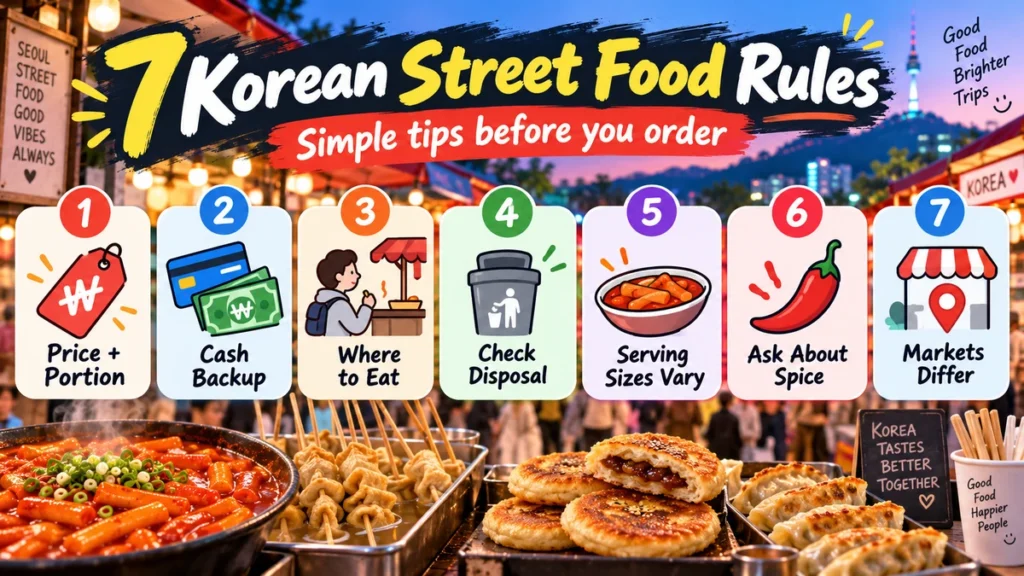
Korean street food is one of the easiest ways to experience local food culture.
Tteokbokki, eomuk, hotteok, fried snacks, dumplings, skewers, and market specialties are everywhere — but the way you order, pay, eat, and clean up can vary from stall to stall.
If it is your first time visiting a Korean market, a few simple habits can make the experience much easier.
Here are seven things to know before you order.
1. Check the Price and Portion Before You Order
Street food does not always come in the same kind of serving.
One stall may sell food:
- By the piece
- By the skewer
- By the cup
- By the plate
- By the serving
So before pointing at something and ordering, take a quick look at the price board.
You may see Korean words such as:
1개 — one piece
1꼬치 — one skewer
1인분 — one serving
Even when two stalls sell the same food, the portion and price may be different.
This matters even more in busy tourist markets where there may be many similar stalls next to each other.
A five-second check can prevent confusion later.
Check price + portion first.

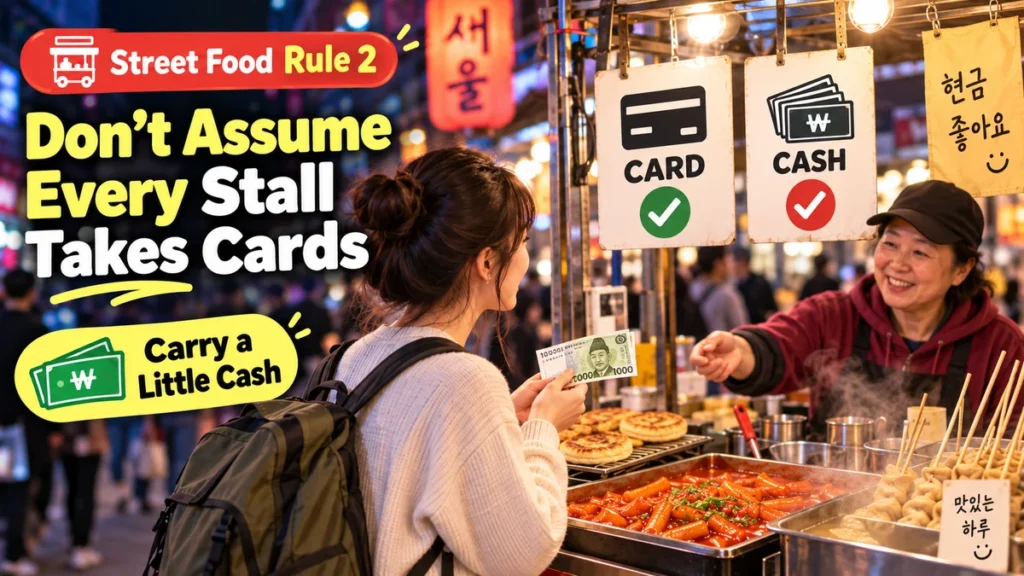
2. Don’t Assume Every Stall Takes Cards
Korea is very card-friendly.
Restaurants, cafes, convenience stores, and many market shops accept cards without a problem.
But street-food stalls can be different.
Some accept:
- Credit or debit cards
- Korean mobile payments
- Cash
Others may only accept certain payment methods.
So even if you normally travel without cash, carrying a small amount of Korean won can still be useful when visiting traditional markets or street-food areas.
You do not need to carry a large amount.
Just think of cash as a backup.
If you are not sure whether a stall accepts cards, you can simply show your card and ask:
“Card?”
The seller will usually understand what you mean.
Carry a little cash.
Want more payment tips? Read The Real Rules of Paying in Korea: 7 Things Tourists Should Know.
3. Check Where People Eat
“Korean street food” does not always mean walking down the street while eating.
At some stalls, people eat standing right in front of the counter.
At others, there may be:
- Small stools
- A narrow eating counter
- A shared seating area
- Takeaway only
The easiest way to understand the setup is to watch other customers for a few seconds.
If everyone is eating beside the stall, it is usually better to do the same rather than immediately walking away with the dish.
This is especially useful with foods that come with soup, sauce, bowls, or reusable utensils.
For something simple like hotteok or a skewer, takeaway may be much easier.
There is no single rule for every stall.
Watch where people eat.

4. Finished? Follow the Stall’s Setup
What happens after you finish eating?
That depends on the stall.
You may have:
- An eomuk skewer
- A paper cup
- A bowl
- A plastic tray
- Chopsticks
- Food scraps
Do not assume everything goes into the nearest public trash bin.
Look around first.
Some stalls may have their own:
- Skewer container
- Tray-return area
- Trash bin
- Recycling bin
- Food-waste container
If you cannot tell where something goes, it is better to ask the seller than to guess.
The same principle applies throughout Korea:
Follow the disposal system of the place you are using.
Finished? Check where it goes.

For more on waste and disposal, see Trash and Recycling in Korea: 7 Things Tourists Should Know.
5. “One Serving” Can Mean Different Things
One of the easiest mistakes is assuming that every “one serving” is a full meal for one person.
Street food does not always work that way.
For example:
- Eomuk may be sold one skewer at a time.
- Tteokbokki may be served as one small portion.
- Dumplings may come in a fixed number.
- Fried snacks may be sold individually or as a set.
So 1인분 is better understood as the seller’s standard portion, not necessarily “enough food for one hungry traveler.”
This is actually useful if you are visiting a market to try several foods.
Instead of ordering a large amount from the first stall, start small.
You can always order more later.
Serving sizes vary.

6. Spicy Can Vary More Than You Expect
Tteokbokki is famous for its red sauce, but the level of heat can vary a lot.
Some versions are:
- Mild and sweet
- Medium spicy
- Very spicy
And color alone does not always tell you exactly how hot something will taste.
If the stall offers different spice levels, check before ordering.
Useful Korean words include:
안 매운맛 — not spicy / mild
보통맛 — regular
매운맛 — spicy
아주 매운맛 — very spicy
If you are unsure, start with a small portion.
And remember that Korean spicy food can sometimes feel much hotter to travelers who are not used to chili-heavy dishes.
There is nothing wrong with choosing the mild version.
The goal is to enjoy the food.
Not sure? Ask about spice.

7. Every Market Can Work Differently
One of the most important things to know is that Korean markets are not all the same.
Different markets may have different:
- Payment systems
- Seating arrangements
- Food specialties
- Portion sizes
- Opening hours
- Return systems
- Tourist services
Some markets are highly organized and tourist-friendly.
Others feel more local and informal.
Some even have unique market-specific systems.
For example, one market may accept cards almost everywhere, while another may have more cash-only stalls.
Another may use special tokens or coins for a food experience.
So do not assume:
“I already visited one Korean market, so I know how all of them work.”
Instead, treat each market as its own environment.
Look at signs, watch local customers, and follow the stall’s setup.
Follow the market, not a universal rule.

Before You Order
Korean street food is usually easy to enjoy once you understand the rhythm.
Before you order, remember:
- Check the price.
- Check the portion.
- Keep some cash as backup.
- Watch where other customers eat.
- Follow the stall’s cleanup system.
- Do not assume one serving equals one full meal.
- Ask about spice if you are unsure.
- Expect different markets to work differently.
A little observation goes a long way.
You do not need to know every Korean word or every local custom.
Just watch what is happening around you and follow the stall’s system.
That is usually enough.
Frequently Asked Questions
Do Korean street-food stalls take credit cards?
Many do, but not every stall accepts the same payment methods.
Carrying a small amount of cash is useful as a backup.
Can I eat while walking in Korean markets?
Sometimes.
But many street-food stalls are designed for customers to eat beside the stall or in a nearby eating area.
Check what other customers are doing.
Do I need to return eomuk skewers?
It depends on the stall.
Some stalls may have a specific skewer container or return area. Do not assume there is one universal system.
Is one serving enough for one person?
Not necessarily.
Street-food portions are based on the stall’s own serving size and may be smaller than a full meal.
Is all tteokbokki very spicy?
No.
The heat level varies by recipe and stall. Some versions are much sweeter or milder than others.
Is every Korean market similar?
No.
Payment methods, eating areas, specialties, and stall systems can vary widely between markets.
Sources
VISITKOREA — Traditional Market Service Improvement Information
Official tourism information related to pricing transparency and traveler-friendly services in Korean traditional markets.
VISITKOREA — Money & Payments in Korea
Guidance on payment methods in Korea, including the usefulness of carrying some cash for traditional markets and street vendors.
VISITKOREA — Gwangjang Market
Official travel information on one of Seoul’s major traditional markets, including visitor facilities and payment information.
VISITKOREA — Mangwon Market
Practical information on market food, payment methods, seating, and how visitors commonly eat at stalls.
VISITKOREA — Korean Street Food
Information on popular Korean street foods such as tteokbokki and eomuk, including common serving styles.
VISITKOREA — Tongin Market
Official information on Tongin Market’s unique lunchbox and token-based food experience.