Drinking Water in Korea: 7 Things Tourists Should Know
Staying hydrated in Korea is usually easy.
You can buy bottled water almost anywhere, restaurants commonly provide drinking water, and you may also come across water dispensers or public drinking fountains.
Still, first-time visitors often have a few questions:
Can I drink the tap water? Is restaurant water free? Where can I refill my bottle?
Here are seven simple things worth knowing about drinking water during your trip to Korea.
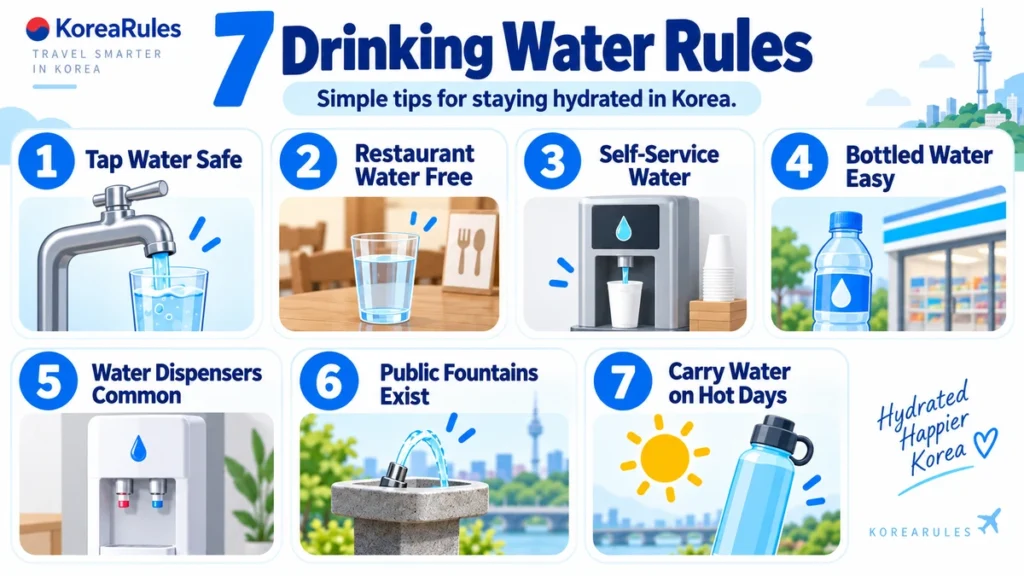
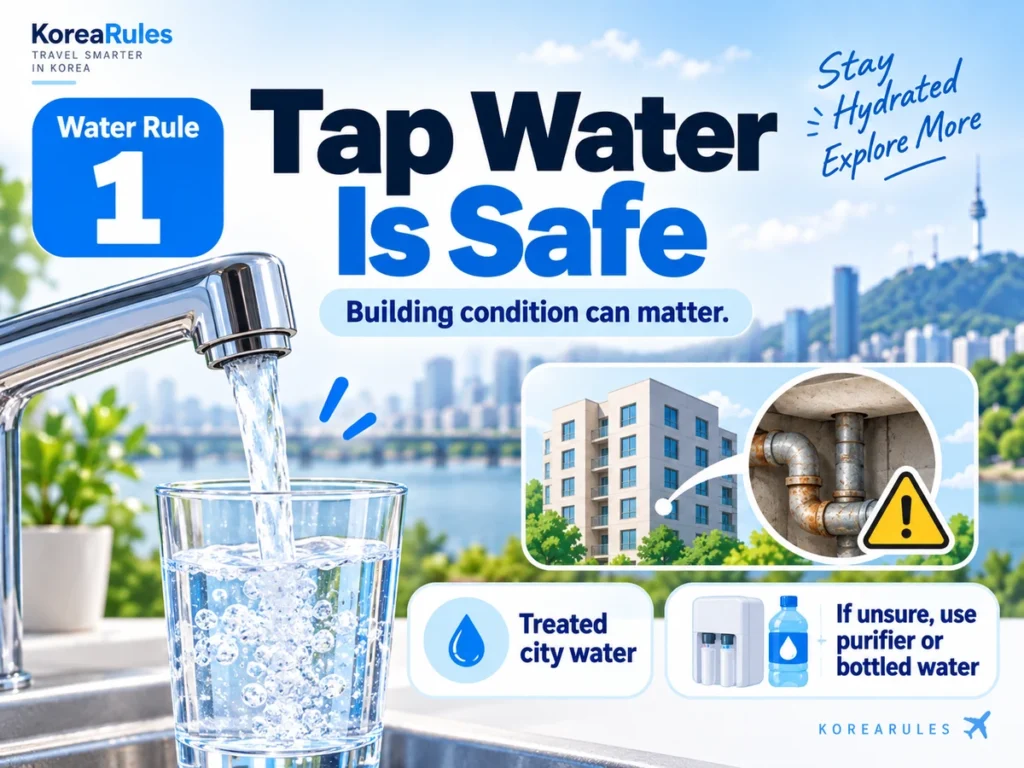
1. Tap Water Is Safe to Drink — But the Building Can Matter
Korea’s municipal tap water is treated and monitored as drinking water.
In Seoul, the city’s tap-water system is known as Arisu, and water quality is regularly tested from treatment plants through the distribution system.
So Korean tap water should not be thought of as unsafe by default.
However, there is one practical detail worth knowing.
The water that finally comes out of a faucet also passes through the building’s own pipes and, in some cases, water-storage facilities.
That means an older building with aging plumbing may affect the taste, smell, or condition of water at the tap.
If you are staying in a modern hotel or building and are comfortable with the tap water, it is generally fine to drink.
If the water looks, smells, or tastes unusual, use the accommodation’s water purifier or bottled water instead.
The important distinction is:
The municipal water is treated for drinking.
The building itself can still matter.
Tap water? Generally safe.
2. Restaurant Water Usually Doesn’t Cost Extra
At Korean restaurants, regular drinking water is commonly provided without an extra charge.
You may receive:
- A bottle or jug of water
- Cups at the table
- Water brought by the staff
- Access to a self-service water dispenser
If you finish the water, asking for more normally does not mean another item will be added to your bill.
This applies to the ordinary drinking water provided by the restaurant.
It does not mean every bottled mineral water, sparkling water, or beverage on the menu is free.
So if a restaurant brings you its normal table water, there is usually no need to worry about an extra charge.
Regular water? Usually free.

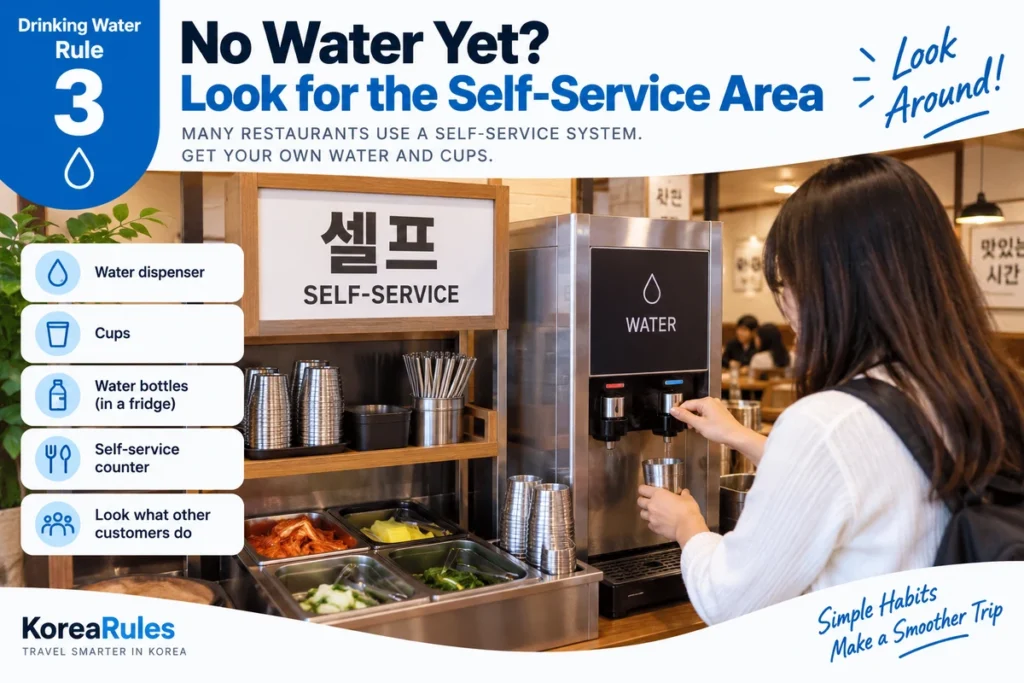
3. No Water Yet? Look for the Self-Service Area
Sometimes you sit down at a Korean restaurant and nobody brings you water.
That does not necessarily mean the staff forgot.
Many restaurants use some form of self-service.
Look around for:
- A water dispenser
- Cups
- A refrigerator with water bottles
- A self-service counter
- A sign marked
셀프
You may be expected to get your own water and sometimes your own side dishes as well.
If you are not sure, simply watch what other customers are doing.
This small habit can save you from waiting several minutes for something that was available just a few steps away.
No water? Look around.
Eating out in Korea for the first time? See The Unwritten Rules of Korean Restaurants: 7 Things Tourists Should Know for more tips on service, ordering, banchan, and paying.
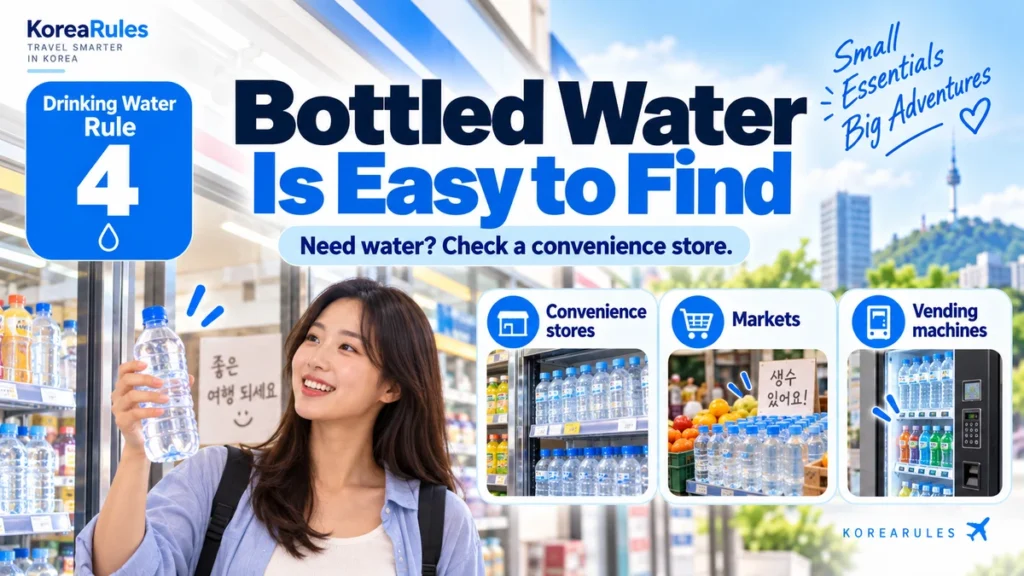
4. Bottled Water Is Easy to Find
If you prefer bottled water, finding it in Korea is simple.
Convenience stores are everywhere in major cities and almost always carry several kinds and sizes of bottled water.
You can also find bottled water at:
- Supermarkets
- Small neighborhood markets
- Vending machines
- Transportation facilities
- Tourist attractions
So if you leave your hotel without water, you usually do not need to plan a special stop.
A nearby convenience store is often the easiest solution.
This is particularly useful before a long walk, hiking trip, palace visit, or summer sightseeing day.
Need water? Check a convenience store.
Using convenience stores during your trip? Read Korean Convenience Store Rules Tourists Should Know: 7 Things That Make Your Visit Easier for more practical tips.
5. Water Coolers and Purifiers Are Common
Another thing you may notice in Korea is the number of water dispensers and purifiers.
You can encounter them in places such as:
- Restaurants
- Hotels
- Hospitals
- Offices
- Public facilities
- Waiting areas
Many provide cold water, and some also provide hot water.
You may see disposable paper cups nearby or a place to fill your own cup.
However, simply seeing a water purifier does not automatically mean it is available for anyone passing by.
A dispenser inside a restaurant, hotel, office, or private facility may be intended for customers, guests, or staff.
So check the surroundings before using it.
If it is clearly part of a public or customer self-service area, it is usually obvious.
See a water dispenser? Check first.

6. Public Drinking Fountains Exist — But Not Everywhere
Korea also has public drinking fountains.
In Seoul, you may find Arisu drinking fountains at places such as parks, schools, public facilities, and some popular outdoor areas.
If you carry a reusable bottle, these can be useful when you come across one.
But do not plan your entire day assuming that a refill fountain will always be nearby.
Unlike bottled water from convenience stores, public drinking fountains are not something you will necessarily see on every street.
So think of them as a useful bonus rather than your only water plan.
If you see a clearly marked public drinking fountain or refill point:
Use it when you need it.
But if you are heading somewhere for several hours, it is still smarter to carry some water with you.
Refill when you see one.

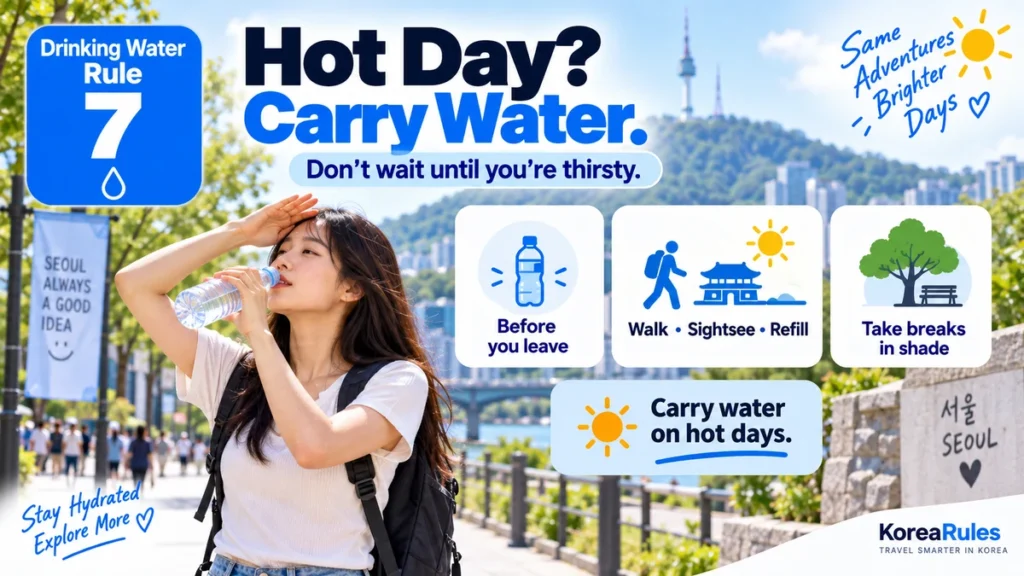
7. Hot Day? Don’t Wait Until You’re Thirsty
Korean summers can be hot and humid.
If you are walking around Seoul for hours, visiting outdoor attractions, hiking, or spending time near the Han River, you can lose more water than you realize.
During hot weather, health authorities recommend drinking water regularly rather than waiting until you feel extremely thirsty.
A simple travel habit helps:
Take water with you when you leave your accommodation.
This is especially useful if you plan to:
- Visit a palace or outdoor attraction
- Walk through large markets
- Spend time at the Han River
- Hike
- Explore neighborhoods on foot
- Stay outside during the hottest part of the day
If your bottle runs out, convenience stores are usually the easiest place to replace it.
And on especially hot days, take breaks indoors or in shaded areas as well.
Hot day? Carry water.
If you will be exploring the city on foot, our [Walking in Korea: 7 Street Rules Tourists Should Know] guide has more practical street tips.
Before You Head Out
You do not need to worry much about finding drinking water in Korea.
Just remember:
- Korean municipal tap water is treated for drinking.
- The condition of an individual building’s plumbing can still matter.
- Regular restaurant water is usually provided without an extra charge.
- Restaurant water may be self-service.
- Bottled water is easy to buy at convenience stores.
- Water dispensers are common, but check whether they are for public or customer use.
- Public drinking fountains exist, but you will not find one everywhere.
- Carry water on hot days before you start sightseeing.
For most travelers, the easiest routine is simple:
Drink what your restaurant provides, carry a bottle when you are outside, and refill or buy more when you need it.
Frequently Asked Questions
Is tap water safe to drink in Korea?
Yes. Municipal tap water is treated and monitored as drinking water.
However, the condition of pipes or water-storage systems inside an individual building can affect the water at the final faucet.
Is restaurant water free in Korea?
Regular drinking water provided by restaurants is usually free.
Bottled mineral water, sparkling water, and other beverages listed on the menu may cost extra.
Why didn’t the restaurant bring me water?
The restaurant may use a self-service system.
Look for a water dispenser, cups, or a self-service area before calling the staff.
Where can I buy bottled water?
Convenience stores are one of the easiest options.
You can also find bottled water at supermarkets, markets, vending machines, and many transportation or tourist facilities.
Can I use water purifiers I see in Korea?
It depends on where they are located.
If a purifier is clearly part of a restaurant, hotel, or public self-service area, follow the facility’s instructions. Do not assume every dispenser is for unrestricted public use.
Are there public water fountains in Seoul?
Yes.
Public drinking fountains are available at some parks and public facilities, but they are not located everywhere.
Sources
Seoul Water — Merits of Arisu
Official information from the Seoul Metropolitan Government on Arisu tap water, including water quality testing and its suitability for drinking.
Seoul Water — Arisu Quality Verification System
Official guidance explaining how water quality can also be affected by a building’s internal pipes and water-storage facilities.
VISITKOREA — About Korean Food
Information on common Korean restaurant practices, including complimentary drinking water and self-service areas for water and side dishes.
Visit Seoul — Water Information
Practical travel information on tap water, bottled water, and water dispensers commonly found in Korea.
Seoul Water — Where Can You Find Arisu?
Official information on public Arisu drinking fountains located in parks, public facilities, and other areas around Seoul.
Seoul Metropolitan Government — Heat Wave Safety Guidance
Official heat-wave safety advice, including recommendations to drink water regularly during hot weather.