Korea eSIM vs SIM Card vs Pocket Wi-Fi: Which Is Best for Travelers?
Staying connected in Korea is easy — but choosing the right option before your trip can be confusing.
Should you use an eSIM, buy a physical SIM card, or rent a pocket Wi-Fi router?
All three are available to travelers in Korea. The best choice depends on your phone, whether you need calls or SMS, how many people are traveling, and whether you want to arrange everything before arrival.
Here’s the simple comparison.
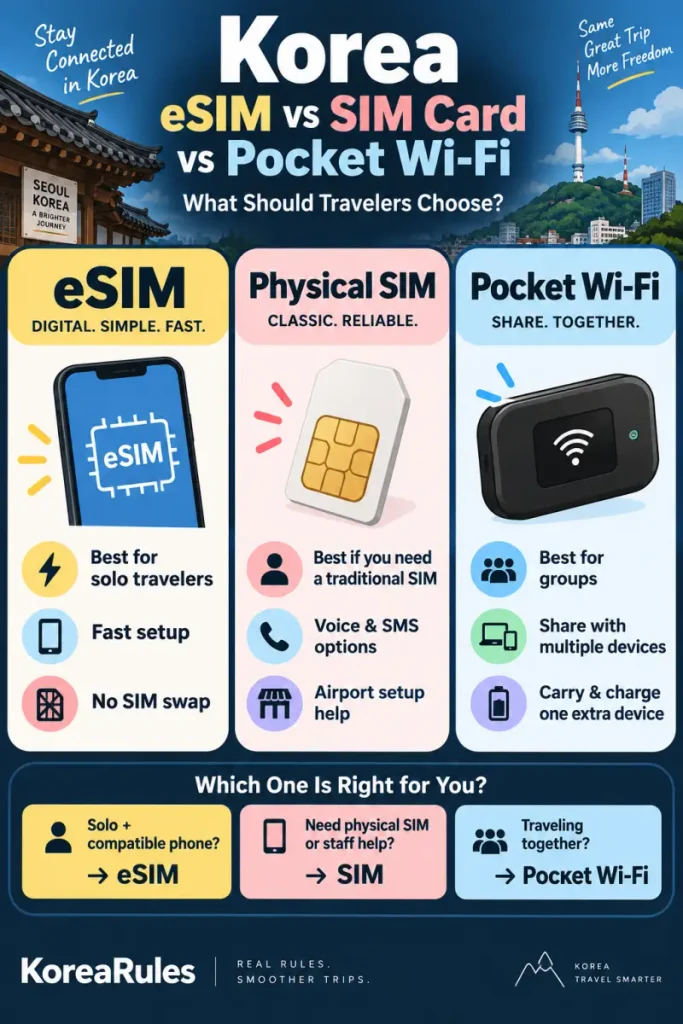
Quick Comparison
| Option | Best For | Main Advantage | Main Drawback |
|---|---|---|---|
| eSIM | Solo travelers with compatible phones | No SIM swap or airport pickup | Requires an eSIM-compatible, unlocked phone |
| Physical SIM | Travelers who prefer a traditional SIM | Familiar setup and voice/SMS options | Requires inserting or replacing a SIM |
| Pocket Wi-Fi | Families, groups, and multiple devices | Several devices can share one connection | Extra device to carry and charge |
1. eSIM: The Simplest Choice for Many Travelers
An eSIM is a digital SIM installed directly on a compatible smartphone.
VISITKOREA explains that prepaid eSIM plans can be purchased online and installed by scanning a QR code, so travelers can prepare connectivity without visiting a store after arrival.
eSIM is a good choice if:
- you are traveling alone
- your phone supports eSIM
- your phone is carrier-unlocked
- you do not want to remove your regular SIM
- you mainly need mobile data
- you want to arrange internet access before landing
Some Korean carrier eSIM products are data-only, while others support calls and SMS after identity verification. KT currently offers both data-only and voice-capable tourist eSIM options.
Important: Do not assume every eSIM includes calls, SMS, or the same phone-number functions. Check the exact plan before buying.
2. Physical SIM: Still a Good Option
A physical prepaid SIM works like a regular SIM card.
VISITKOREA says travelers can buy prepaid SIM cards for mobile data and, depending on the product, a Korean phone number. SIM cards are available online, at airports, and at selected convenience stores.
A physical SIM may be better if:
- your phone does not support eSIM
- you prefer a traditional SIM
- you want staff assistance during setup
- you specifically want a plan with voice or SMS
- you do not mind changing SIM cards
If you remove your regular SIM, keep it somewhere safe until the end of your trip.
3. Pocket Wi-Fi: Useful for Groups
Pocket Wi-Fi is a portable router that creates a private Wi-Fi network using a Korean mobile connection.
KT currently offers Wi-Fi routers for foreign visitors, and Incheon International Airport lists both telecom counters and portable Wi-Fi rental facilities in its passenger terminals.
Pocket Wi-Fi may work well if:
- several people will travel together
- you want to connect multiple phones
- you also use a tablet or laptop
- some group members cannot use eSIM
The trade-off is convenience.
You have another device to carry and charge, and anyone relying on it needs to stay close enough to the router.
If your group often splits up, separate SIMs or eSIMs are usually easier.
Still planning what to do right after landing?
See our guide to the first things to do before leaving the airport.
Landing in Korea: 7 Things to Do Before You Leave the Airport
Once you’re connected, transportation is the next thing to sort out.
Learn the T-Money rules first-time visitors often get wrong.
7 T-Money Rules First-Time Visitors Get Wrong in Korea
Which One Should You Choose?
Choose an eSIM if:
You have a compatible unlocked phone and want the easiest setup with the least equipment.
Choose a physical SIM if:
Your phone does not support eSIM, or you prefer a traditional SIM and in-person setup.
Choose pocket Wi-Fi if:
Several people will stay together and want to share one connection across multiple devices.
There is no single best option for every traveler.
Do You Need a Korean Phone Number?
Maybe not.
If you mainly use:
- Naver Map or Google Maps
- KakaoTalk or other messaging apps
- translation apps
- web browsing
- social media
a data-only plan may be enough.
But if you need to make or receive Korean calls or SMS, choose a product that clearly supports those features.
For KT tourist products, voice/SMS service requires identity verification for certain functions, which can be completed at an airport roaming center.
So check the plan details instead of assuming every tourist SIM works the same way.
Should You Buy Before Arriving or at the Airport?
Both are possible.
Buy before your trip if:
- you want to prepare everything in advance
- you are using an eSIM
- you do not want to spend time at an airport counter
Buy or collect at the airport if:
- you want staff help
- you need a physical SIM
- you need identity verification for voice/SMS
- you want to rent a pocket Wi-Fi router
KT operates traveler counters at Incheon International Airport, including 24-hour service locations, and the airport also lists other carrier and Wi-Fi rental counters in both terminals.
Check These Before Buying an eSIM
1. Does your phone support eSIM?
Not every phone does.
2. Is your phone carrier-unlocked?
A locked phone may not accept another provider’s SIM or eSIM.
3. Is the plan data-only?
If you need calls or SMS, check whether those functions are included.
4. When does the plan start?
Activation rules can differ by provider.
5. Can the eSIM be reinstalled?
Some providers restrict QR-code reuse. KT, for example, states that its tourist eSIM QR code is single-use and should not be deleted after installation.
The KoreaRule
For many solo travelers with a compatible unlocked phone, an eSIM is the simplest option.
But choose based on your actual trip:
eSIM for convenience.
Physical SIM for a traditional setup or specific phone features.
Pocket Wi-Fi for sharing between people and devices.
Before You Buy
Ask yourself:
- Does my phone support eSIM?
- Is my phone unlocked?
- Do I need only data?
- Do I need calls or SMS?
- Do I need a Korean phone number?
- Will my travel group stay together?
- Do I want everything ready before I land?
- How many days will I stay in Korea?
Once you answer those questions, the choice becomes much easier.
FAQ
Is eSIM available for tourists in Korea?
Yes. VISITKOREA lists prepaid eSIM as a connectivity option for travelers, and Korean carriers such as KT currently offer short-term tourist eSIM products.
Is eSIM better than a physical SIM in Korea?
Not always. eSIM is usually more convenient if your phone supports it, while a physical SIM can be better if you prefer in-person setup or your device does not support eSIM.
Does a Korea eSIM include calls and SMS?
It depends on the plan. Some are data-only, while some carrier products offer voice and SMS after the required verification process.
Is pocket Wi-Fi good for families?
It can be useful if everyone stays together and wants to share one connection. If family members split up often, individual SIMs or eSIMs may be more convenient.
Can I buy a SIM after arriving in Korea?
Yes. VISITKOREA lists airport and convenience-store purchase options, and major Korean carriers operate airport service counters.
Sources
VISITKOREA — Electricity & Communications
Official Korea Tourism Organization information about SIM cards, prepaid eSIM, roaming, and internet access for travelers.
KT Roaming — Korea eSIM, SIM Card & Wi-Fi Router
Official KT traveler service covering tourist eSIM, physical SIM, Wi-Fi routers, airport pickup, and service counters.
KT Roaming — eSIM Usage Information
Official KT instructions for installing tourist eSIM products using QR codes.
Incheon International Airport — Telecom & Internet Facilities
Official airport listing for roaming centers and Wi-Fi rental facilities in Terminals 1 and 2.