- Sick in Korea? 5 Rules for Choosing a Pharmacy, Clinic or ER
- Google Maps in Korea? 5 Rules for Using NAVER Map & KakaoMap
- Korean Pharmacy Rules: 5 Things Tourists Should Know
- Incheon Airport to Seoul: 5 Rules for Choosing AREX, Bus or Taxi
- Korea eSIM vs SIM Card vs Pocket Wi-Fi: Which Is Best for Travelers?
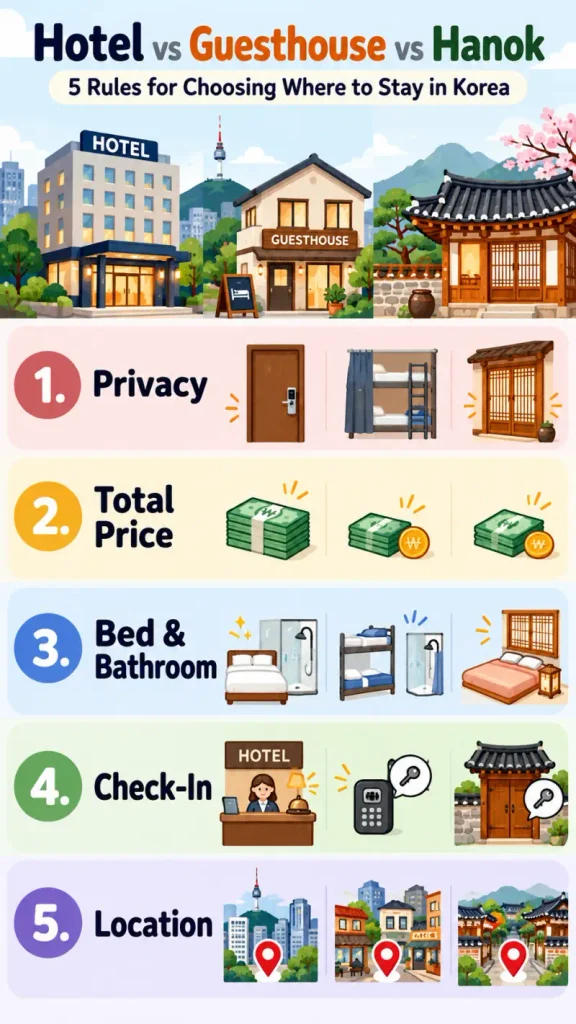
Hotel vs Guesthouse vs Hanok: 5 Rules for Choosing Where to Stay in Korea
Finding a place to stay in Korea involves more than choosing a hotel with good reviews.
You might find a budget-friendly guesthouse where you can meet other travelers, a traditional hanok with beautiful wooden architecture, or a modern hotel with familiar amenities.
But which one actually suits your trip?
Korea offers all three accommodation types, with different room arrangements, facilities, and travel experiences.
Before booking, use these five rules to choose accommodation that matches your budget, comfort preferences, arrival schedule, and itinerary.
Quick Comparison: Hotel vs Guesthouse vs Hanok
| Hotel | Guesthouse | Hanok Stay | |
|---|---|---|---|
| Room types | Usually private rooms | Dormitories and private rooms | Private rooms or entire properties |
| Bathroom | Usually private | Private or shared | Private or shared |
| Sleeping style | Usually beds | Beds or bunk beds | Floor bedding or beds |
| Atmosphere | Conventional hotel stay | Social or quiet, depending on property | Traditional Korean architecture |
| Check-in | Hotel reception or self-check-in | Staff or host arrangements | Host or property-specific arrangements |
| Key consideration | Included services | Shared facilities and house rules | Bedding and modern amenities |
Guesthouse and hanok facilities vary considerably, so check the individual property’s room details rather than relying on the accommodation type alone.
Rule 1 — Choose Your Privacy Level First
The first question isn’t how much the room costs. It’s how much privacy you want.
If you prefer a private bedroom and bathroom, a hotel is one option. However, you can also find guesthouses and hanok stays offering private rooms with their own bathrooms.
Guesthouses in Korea range from shared dormitories to one- and two-person rooms. Some encourage social activities, while others focus on providing a quiet place to rest.
Before booking a guesthouse, check whether you’re reserving an entire private room or just one bed in a shared dormitory.
Also look at the bathroom arrangement, whether the property has shared living spaces, and any quiet-hour rules.
The KoreaRule: Choose your room and bathroom arrangement before choosing an accommodation type.
Rule 2 — Compare the Total Price, Not Just the Nightly Rate
A guesthouse dormitory might have an attractive nightly price, particularly when you’re traveling alone.
But the calculation can change when you’re traveling as a couple, family, or group.
For example, two separate dormitory beds may cost nearly as much as a private room elsewhere. A traditional hanok booked as an entire property may have a very different price structure from a single hanok guest room.
When comparing properties, check the final price for your entire stay, including applicable taxes, cleaning charges, additional guest fees, and other mandatory costs.
Also compare what’s actually included. Breakfast, towels, luggage storage, and laundry facilities may be included at one property and cost extra at another.
What to check before booking
| Cost | What to confirm |
|---|---|
| Room price | Per person, per room, or entire property? |
| Additional fees | Cleaning, extra guests, or other required charges |
| Included services | Breakfast, towels, Wi-Fi, luggage storage |
| Cancellation | Refund deadline and non-refundable conditions |
| Total stay | Final cost for all guests and nights |
The KoreaRule: Compare the final cost for your whole stay, not the advertised price per night.
Rule 3 — Booking a Hanok? Check the Bed and Bathroom
Spending a night in a hanok can be one of the most memorable parts of a trip to Korea.
A hanok is a traditional Korean house, often featuring wooden architecture, a courtyard, and traditional room layouts.
However, not every hanok offers the same sleeping experience.
Some use traditional floor bedding, while renovated hanok stays may provide regular beds and modern conveniences. The Korea Tourism Organization specifically advises travelers to check the bedding and available facilities before booking.
If you aren’t comfortable sleeping on the floor, look carefully at the room photos and confirm that a bed is provided.
You should also check whether your room has a private bathroom, air conditioning, heating, and the other facilities you’ll need.
Hanok booking checklist
A hanok stay doesn’t necessarily mean sacrificing modern comfort. Some renovated properties combine traditional design with hotel-style amenities. Others preserve a more traditional experience.
Follow the property’s rules for shoes, noise, food, and the use of its facilities. Older wooden buildings and heritage properties may require extra care.
The KoreaRule: Book a hanok for the experience, but confirm that its sleeping arrangements and facilities meet your needs.
Rule 4 — Arriving Late? Confirm Check-In and Luggage Storage
Your arrival schedule can be just as important as the room itself.
Imagine landing at Incheon Airport late in the evening, reaching Seoul after midnight, and discovering that your guesthouse’s reception has already closed.
Hotels, guesthouses, and hanok stays can all have different check-in arrangements. Some offer self-check-in, while others require you to meet a staff member or host.
Before booking, confirm the property’s check-in hours, late-arrival policy, and how you’ll receive your room key or entry instructions.
If your flight arrives late, contact the property in advance rather than assuming someone will be available when you get there.
Luggage storage matters, too. If you reach Seoul before check-in or plan to explore after checking out, ask whether the property can hold your bags.
The KoreaRule: If your arrival time is unusual, confirm your check-in arrangements before booking.
Rule 5 — Check the Exact Location Before Booking
Two accommodations in the same Seoul neighborhood can offer very different travel experiences.
One might be just a short walk from a subway station. Another could be farther away, up a steep hill, or along narrow streets that are difficult to navigate with large suitcases.
Before booking, search for the property’s exact address in NAVER Map or KakaoMap.
Need help checking your hotel location in Korea?
→ Google Maps in Korea? 5 Rules for Using NAVER Map & KakaoMap
Check the route from the nearest station, your airport arrival route, and the journey to the places you plan to visit.
Don’t forget to look at the station exit. Some exits have stairs, while others provide elevator access. An accommodation described as being near a subway station may still require a longer walk than you expect.
If you’re traveling to several Korean cities, also consider how easily you can reach your train station or intercity bus terminal.
The KoreaRule: Check the entire journey to your accommodation, not just its neighborhood.
The KoreaRule
PRIVACY → PRICE → COMFORT → CHECK-IN → LOCATION
The right accommodation is the one that fits how you actually travel—not just how good it looks in photos.
Continue Planning Your Korea Trip
Still deciding which Seoul neighborhood to stay in?
→ Where to Stay in Seoul: 5 Rules for Choosing the Right Area
Booked your accommodation and preparing for arrival?
→ Korean Hotel Check-In Rules Tourists Should Know: 7 Things Before You Stay
Need somewhere to leave your bags before check-in?
→ Where to Store Luggage in Seoul: 5 Rules Travelers Should Know
Before You Book
- Choose the privacy level and bathroom arrangement you need.
- Compare the total price for all guests and nights.
- For hanok stays, confirm the bed and available amenities.
- Check late check-in and luggage storage arrangements.
- Review the exact location and transport route.
FAQ
Are guesthouses cheaper than hotels in Korea?
Guesthouses often offer budget-friendly dormitory beds and private rooms, but prices depend on the property, location, season, and number of guests. Compare the total booking cost rather than assuming one accommodation type will always be cheaper.
Do Korean guesthouses have private rooms?
Yes. Many guesthouses offer private rooms as well as shared dormitories. Check whether the bathroom is private or shared before booking.
Do you have to sleep on the floor in a hanok?
No. Some hanok stays offer traditional floor bedding, while others provide regular beds. Check the exact room description and photos before making a reservation.
Do hanok stays have private bathrooms?
Some do, while others have shared facilities. Modernized hanok accommodations can provide private bathrooms and other contemporary amenities. Always check the particular room you’re booking.
Can I check into a Korean guesthouse late at night?
It depends on the property. Some offer self-check-in or late-arrival arrangements, while others have restricted reception hours. Contact the property before booking if you expect to arrive late.
Is a hanok stay suitable for an entire trip to Korea?
It can be, depending on your preferences and the property. If you want to experience traditional Korean architecture but are unsure about its facilities or location, you can also consider combining a hanok stay with other accommodation during your trip.
Sources
Accommodations in Korea- VISITKOREA
Official Korea Tourism Organization overview of hotels, guesthouses, hanok stays, and other accommodation types available in South Korea.
Hanok Accommodations- VISITKOREA
Official guide to hanok accommodation, including traditional floor bedding, modern amenities, and considerations before booking.
Guesthouses- VISITKOREA
Official guide to Korean guesthouses, explaining dormitories, private rooms, social activities, and different guesthouse environments.