No Chopsticks? Check the Table Drawer at Korean Restaurants
You sit down at a Korean restaurant and the food starts arriving.
But something seems to be missing.
Where are the chopsticks?
Where is the spoon?
Before calling the staff, check the table itself.
At many Korean restaurants, spoons, chopsticks, and napkins are stored in a small drawer built into the side or underside of the table.
VISITKOREA even lists the silverware drawer as one of the convenient features travelers may notice in Korean restaurants.
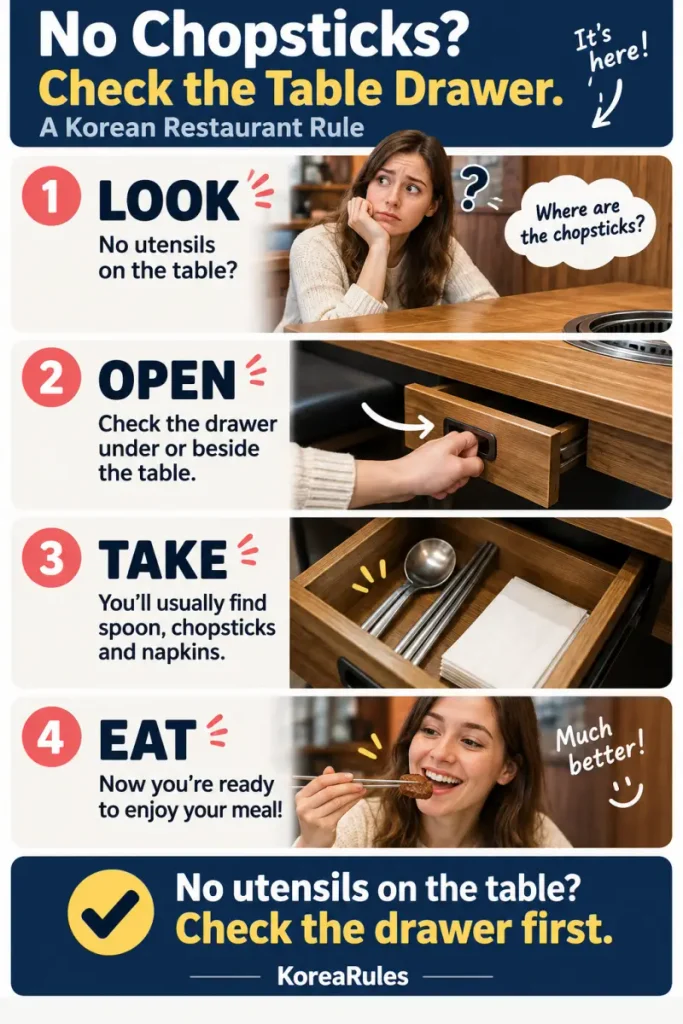
Rule 1 — No Utensils? Look Around the Table First
If there are no utensils laid out in front of you, that does not necessarily mean the staff forgot them.
Look along the edge of the table.
You may find a small handle or drawer underneath.
That is often where the utensils are stored.
Rule 2 — Open the Drawer
The drawer may be:
- directly under the tabletop
- along the side of the table
- slightly hidden below the edge
Pull it open and take a look.
VISITKOREA describes these drawers as containing neatly organized spoons, chopsticks, and napkins.
Rule 3 — Take What You Need
You will often find:
- metal chopsticks
- metal spoons
- napkins
Take one set for each person at your table.
There is no need to empty the drawer onto the table.
Just take what you need and leave the rest inside.
Rule 4 — No Drawer? Then Ask the Staff
Not every restaurant uses this system.
Some restaurants set utensils on the table in advance, while others bring them with the food.
So if you cannot find a drawer, just ask the staff.
You can say:
수저 주세요.
Sujeo juseyo.
Meaning:
“Please give me a spoon and chopsticks.”
Why Do Korean Restaurants Use Table Drawers?
It keeps the tabletop uncluttered and puts utensils within easy reach of customers.
For regular Korean diners, opening the drawer can feel completely automatic.
That is exactly why first-time visitors may miss it.
Nobody explains the drawer because locals already know where to look.
What Is “Sujeo”?
In Korean, 수저 (sujeo) refers to the traditional spoon-and-chopsticks set.
A Korean table setting commonly includes both a spoon and chopsticks, and VISITKOREA notes that the spoon plays an important role in Korean dining, including for rice and soup.
So if you see both in the drawer, take both.
The KoreaRule
No spoon or chopsticks on the table?
Before calling the server:
Look → Open → Take → Eat
Check the drawer under or beside the table first.
Quick Check
- No utensils visible? → Check the table
- Small drawer underneath? → Open it
- Spoon, chopsticks and napkins inside? → Take what you need
- No drawer? → Ask the staff
- Not sure what to take? → One spoon + one pair of chopsticks per person is usually enough
The table drawer is just one of those small Korean restaurant habits nobody explains.
→ See more unwritten Korean restaurant rules tourists should know.
Found the utensils? There’s another restaurant rule worth knowing.
→ Learn how banchan refills usually work in Korea.
Still wondering how to call the server after finding your utensils?
→ See the unwritten rules of Korean restaurants.
FAQ
Do all Korean restaurants have utensil drawers?
No. They are common in many restaurants, but not universal. Some restaurants place utensils on the table or provide them separately.
What is usually inside the drawer?
VISITKOREA specifically mentions spoons, chopsticks, and napkins.
Are the utensils in the drawer for customers to use?
Yes. The drawer is there so diners can take the utensils they need.
Why are Korean chopsticks often metal?
Metal chopsticks are common in Korea and are traditionally paired with a metal spoon as part of the Korean sujeo set.
What should I say if I cannot find any utensils?
Say:
수저 주세요.
Sujeo juseyo.
“Please give me a spoon and chopsticks.”
Sources
VISITKOREA — About Korean Food
Official Korea Tourism Organization guide to Korean dining. Its restaurant section specifically explains that Korean restaurant tables may have a small silverware drawer containing spoons, chopsticks, and napkins.
VISITKOREA — About Korean Food (Restaurant Guide)
Official tourism guidance also explains common Korean restaurant features including call bells, silverware drawers, built-in grills, and storage chairs.