KTX vs Bus vs Flight in Korea: 5 Rules for Choosing How to Travel
Traveling between Korean cities is easy once you know one important thing:
the fastest vehicle is not always the easiest trip.
KTX can be extremely convenient between major cities.
Long-distance buses reach many places the railway does not.
And for Jeju — or certain trips where airports work well at both ends — flying may make more sense.
Instead of asking:
“Which one is best?”
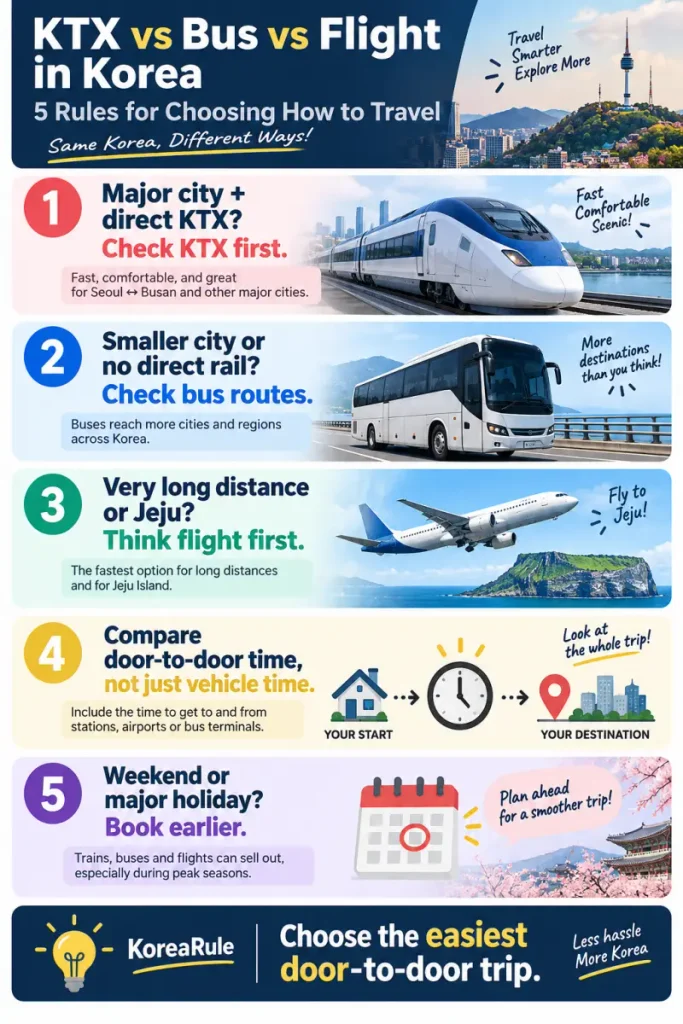
Use these five decision rules.
Quick Comparison
| Option | Best For | Main Advantage | Main Trade-off |
|---|---|---|---|
| KTX | Major cities with convenient rail stations | Fast city-to-city travel | Not every destination has a useful KTX station |
| Express / Intercity Bus | Smaller cities and direct regional routes | Wide destination coverage | Traffic can affect travel time |
| Domestic Flight | Jeju and selected long-distance trips | Useful when rail is impractical | Airport transfers and procedures add time |
VISITKOREA notes that Korea’s long-distance buses reach destinations that trains do not, while intercity buses in particular connect a broad range of smaller regional cities.
Rule 1 — Major City + Direct KTX? Check KTX First
If both ends of your trip have convenient KTX stations, start by checking the train.
KORAIL’s official reservation system covers KTX and other national rail services and lets travelers search both direct and transfer journeys.
For routes between major cities, KTX can be especially convenient because you avoid airport check-in and security procedures and often arrive closer to the city itself.
The rule
Major city + direct KTX connection? Check the train first.
That does not automatically mean KTX is always the right answer.
The important question is where the station is compared with your actual hotel or destination.
Decided that KTX fits your trip?
→ Read the KTX rules tourists should know before boarding.
Rule 2 — Smaller City or No Direct Train? Check the Bus
This is where Korea’s bus network becomes extremely useful.
VISITKOREA explains that long-distance buses serve areas trains cannot reach. Intercity buses cover an especially wide range of regional cities and can provide direct connections that might otherwise require rail transfers.
So if the train route looks awkward, do not assume you have to make several transfers.
Check whether a direct bus exists.
The rule
No convenient direct train? Search the bus routes before building a complicated rail journey.
One detail matters:
Express buses and intercity buses are different.
Express buses generally use expressways on longer routes, while intercity buses may make intermediate stops and serve a wider range of destinations. They can also depart from different terminals.
Rule 3 — Going to Jeju? Think Flight First
Jeju is the easy case.
It is an island, so ordinary rail and long-distance buses cannot take you there.
Korea Airports Corporation currently operates 14 regional airports around Korea, including Jeju, Gimpo, Gimhae, Daegu, Cheongju, Ulsan, Gwangju and several others.
The rule
Going to Jeju? Start by checking flights.
For mainland travel, however, do not automatically assume flying is faster just because the time in the air is shorter.
That brings us to the most important rule.
Rule 4 — Compare Door-to-Door Time, Not Vehicle Time
Imagine this comparison:
Train: 2 hours
Flight: 1 hour
The flight appears faster.
But that is not the full trip.
Flying also means getting to the airport, checking in, going through identity and security procedures, boarding, and then traveling from the arrival airport to your final destination. Korea Airports Corporation’s passenger process includes check-in, identity verification, security screening and boarding before departure.
The same principle applies to trains and buses.
Ask:
How long does it take from my hotel door to my next hotel door?
The rule
Compare the whole journey — not just the time printed beside the train, bus, or flight.
Sometimes a slower vehicle produces an easier overall trip.
Rule 5 — Weekend or Holiday? Book Earlier
If your travel date is fixed, waiting until the last moment is not always a good idea.
This matters especially around major Korean holiday periods.
KORAIL operates dedicated reservation procedures during high-demand holiday travel periods, which shows how different holiday booking can be from an ordinary weekday.
Long-distance bus tickets can also be booked in advance. VISITKOREA currently lists online booking options for both express and intercity buses.
The rule
Busy weekend or major Korean holiday? Check availability and book earlier than you normally would.
When KTX Usually Makes Sense
KTX deserves a strong look when both cities have convenient stations, time matters, you want a predictable trip, and you would rather avoid airport procedures or road traffic.
For example, VISITKOREA currently describes Seoul–Gyeongju KTX travel as roughly two hours, compared with about three and a half hours by bus, although schedules can change.
The important point is not the exact number.
It is that a direct high-speed rail connection can dramatically change the decision.
When the Bus Usually Makes Sense
Check express or intercity buses when your destination is a smaller city, there is no nearby KTX station, the rail route requires transfers, or the bus terminal is much closer to where you actually need to go.
VISITKOREA specifically notes that intercity buses connect many smaller cities directly.
And remember:
check the exact terminal before leaving your hotel.
Seoul has several different long-distance bus terminals, and buses to different regions may depart from completely different parts of the city.
When a Flight Usually Makes Sense
Flights are the obvious choice for Jeju.
For mainland trips, they are worth comparing when the distance is long and both the departure and arrival airports are convenient for your itinerary.
But always include:
airport transfer + check-in + security + boarding + onward transport
before deciding.
A one-hour flight is not necessarily a one-hour trip.
One Bus Rule Tourists Often Miss
If your ticket says Express Bus, make sure you go to the express-bus terminal.
If it says Intercity Bus, confirm the intercity terminal.
VISITKOREA warns that the two types may operate from separate terminals, even when traveling toward the same region.
Before you leave, check:
destination + terminal name + departure time
not just the city name.
The KoreaRule
Don’t ask:
“Which transportation is fastest?”
Ask:
Is there a direct route?
Where is the station, terminal, or airport?
How much travel happens at both ends?
Is my travel date busy?
Then choose the option that gives you the easiest door-to-door trip.
Before You Book
- Major city + direct KTX → Check KTX first
- Smaller regional city → Check bus routes
- Jeju → Check flights
- Flight looks fastest → Add airport time
- Train requires several transfers → Look for a direct bus
- Weekend / holiday → Check availability early
Still planning your first ride after landing?
→ See our 5 rules for choosing AREX, airport bus, or taxi from Incheon Airport.
Planning more transportation in Korea?
→ Browse more KoreaRules Getting Around guides.
FAQ
Is KTX always better than a bus in Korea?
No. KTX is excellent on major rail corridors, but buses can be more convenient for smaller cities or destinations without a nearby KTX station.
What is the difference between an express bus and an intercity bus?
Express buses generally travel long distances primarily on expressways, while intercity buses can make intermediate stops and serve a wider range of regional destinations.
Should I fly from Seoul to Busan?
Compare the complete journey rather than the flight time alone. Depending on where you are staying at both ends, KTX may avoid significant airport-transfer and predeparture time.
What should I use for Jeju?
For normal tourist travel from mainland Korea, flying is the practical starting point. Jeju Airport is part of Korea Airports Corporation’s national regional-airport network.
Can tourists book Korean buses online?
Yes. VISITKOREA currently lists online booking options for express and intercity buses and notes that English-language booking services are available.
Should I book KTX in advance?
For fixed dates, weekends and especially major holiday periods, booking ahead is sensible. KORAIL uses special reservation arrangements for major holiday demand.
Sources
KORAIL — Official Website for Foreigners
Official KORAIL English-language website for searching and booking KTX and other train services in Korea.
VISITKOREA — Express Bus & Intercity Bus
Official Korea Tourism Organization guide covering express/intercity bus differences, terminals, regional coverage and ticket booking. The page was updated June 5, 2026.
Korea Airports Corporation — Airport Network
Official information covering the 14 regional airports operated by Korea Airports Corporation.
VISITKOREA — Korea Transportation Guide 2026
Official 2026 visitor transportation guide covering KTX and express/intercity bus ticketing for overseas travelers.