- Public Restrooms in Korea: 7 Things Tourists Should Know
Public Restrooms in Korea: 7 Things Tourists Should Know
Finding a restroom is one of those things you probably do not think about before a trip — until you suddenly need one.
Fortunately, public restrooms are generally easy to find in Korea, especially in subway stations, major attractions, public buildings, parks, and transportation facilities.
Still, there are a few things that can surprise first-time visitors.
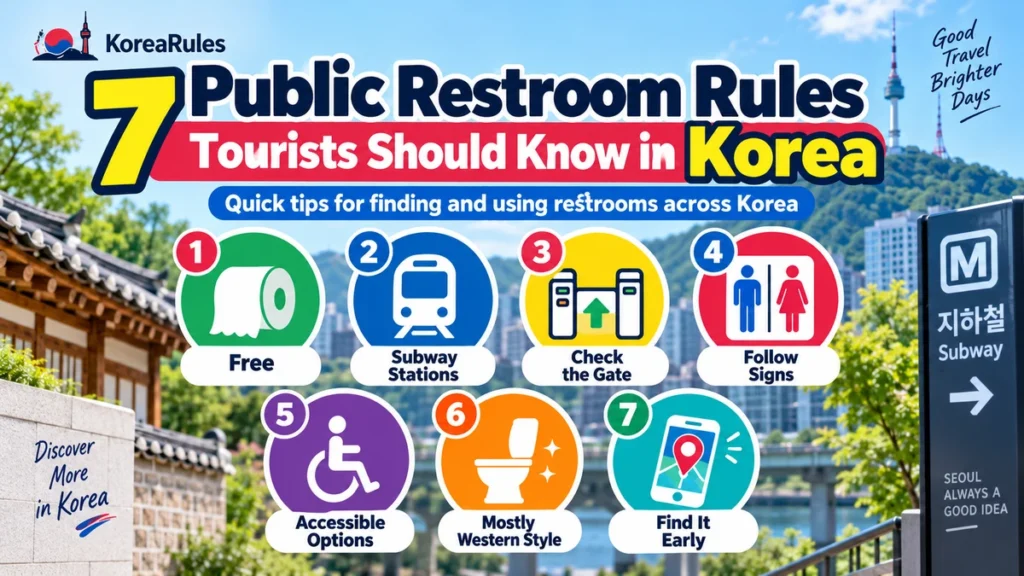
Here are seven practical restroom rules worth knowing before you travel around Korea.
1. Public Restrooms Are Usually Free
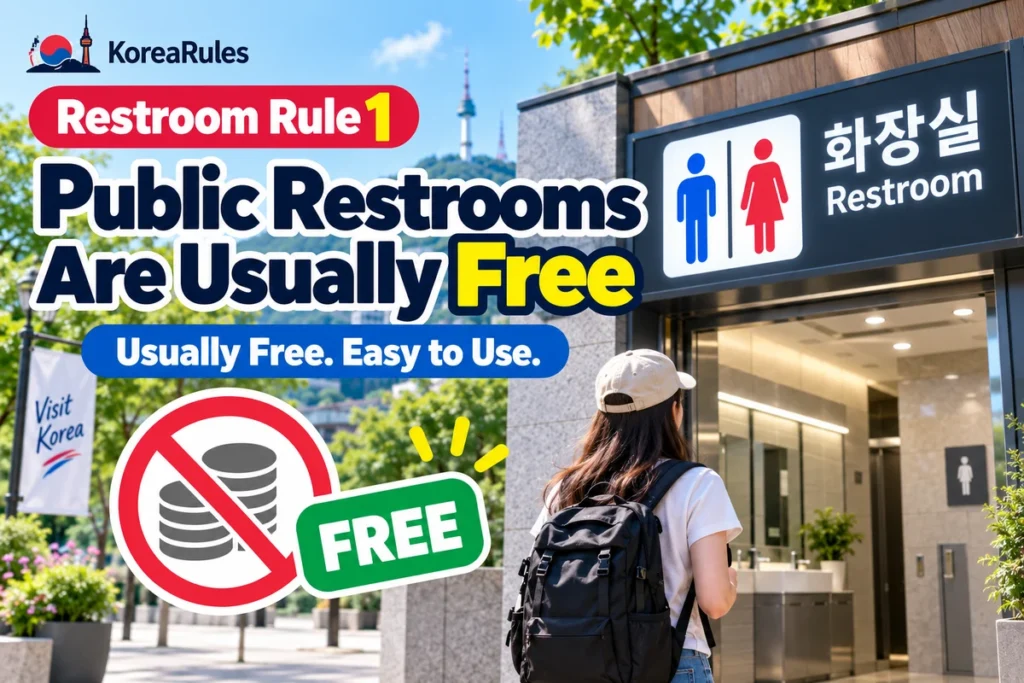
One of the easiest things about using public restrooms in Korea is that you normally do not need to pay.
In Seoul and other major cities, restrooms in subway stations, public facilities, parks, tourist attractions, and transportation hubs are generally available without an entrance fee.
That means you usually do not need to carry coins just to use a restroom.
This can be especially convenient if you are coming from a country where paid public toilets are common.
Of course, a restroom located inside a private business is different from a public restroom. A restaurant, café, or other private establishment may have its own rules about who can use its facilities.
But if you are using a restroom in a subway station or another clearly public facility, you normally will not encounter a payment gate.
Usually free. Easy to use.
2. Subway Stations Are One of Your Best Options
If you are walking around Seoul and suddenly need a restroom, one of the first places worth checking is the nearest subway station.
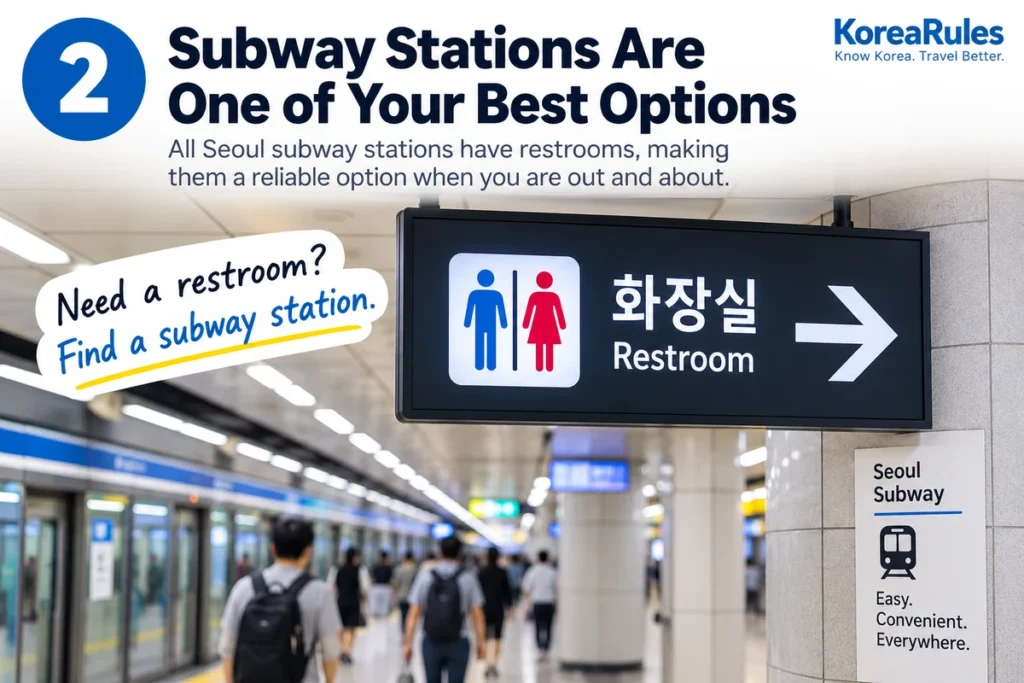
Seoul subway stations are equipped with public restrooms, which makes the subway system useful even when you are not currently on a train.
This can be especially helpful in busy areas where it may not be obvious which nearby shops or cafés have customer restrooms.
Look for the nearest subway entrance, then follow the restroom signs inside the station.
Depending on the size of the station, the restroom may not be immediately visible from the entrance, so check station maps or directional signs if necessary.
Large transfer stations can have several concourses, exits, and platforms, so the restroom may be farther away than you expect.
But when you are unsure where to look, this is a good rule to remember:
Need a restroom? Find a subway station.
If you are new to Seoul’s subway system, see 7 Subway Rules Tourists Should Know in Korea for more practical tips about fares, gates, transfers, and station etiquette.
3. The Restroom May Be Outside the Fare Gates
Finding the restroom is only part of the story.
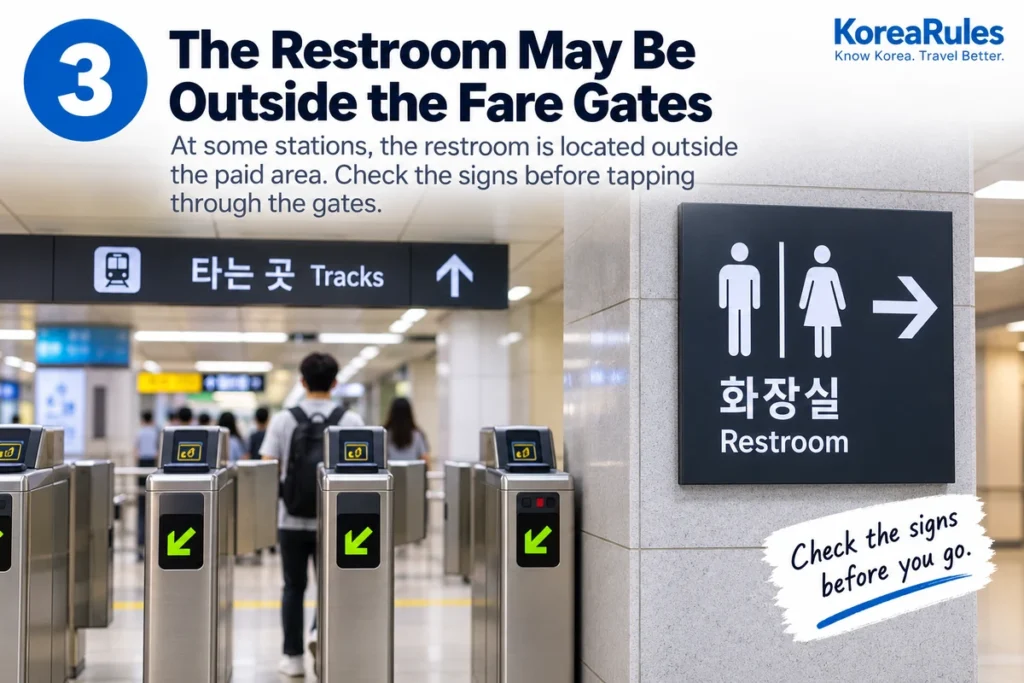
At some subway stations, the restroom may be located outside the paid area.
That means you could be waiting for a train or transferring between lines and discover that the restroom is on the other side of the ticket gate.
This is one reason it helps to check the restroom location before tapping through a gate when you have time.
Seoul also operates a same-station re-entry system on eligible parts of the subway network.
Under the applicable conditions, passengers who exit through the gate and re-enter the same station within a limited period may be treated as continuing their trip rather than beginning an entirely new journey.
Restroom use is one of the situations this system can help with.
However, do not assume this works at every station or on every rail line.
The exact rules and eligible sections can vary, so follow the current station or transit guidance when using the system.
The simple travel rule is:
Check which side of the gate the restroom is on.
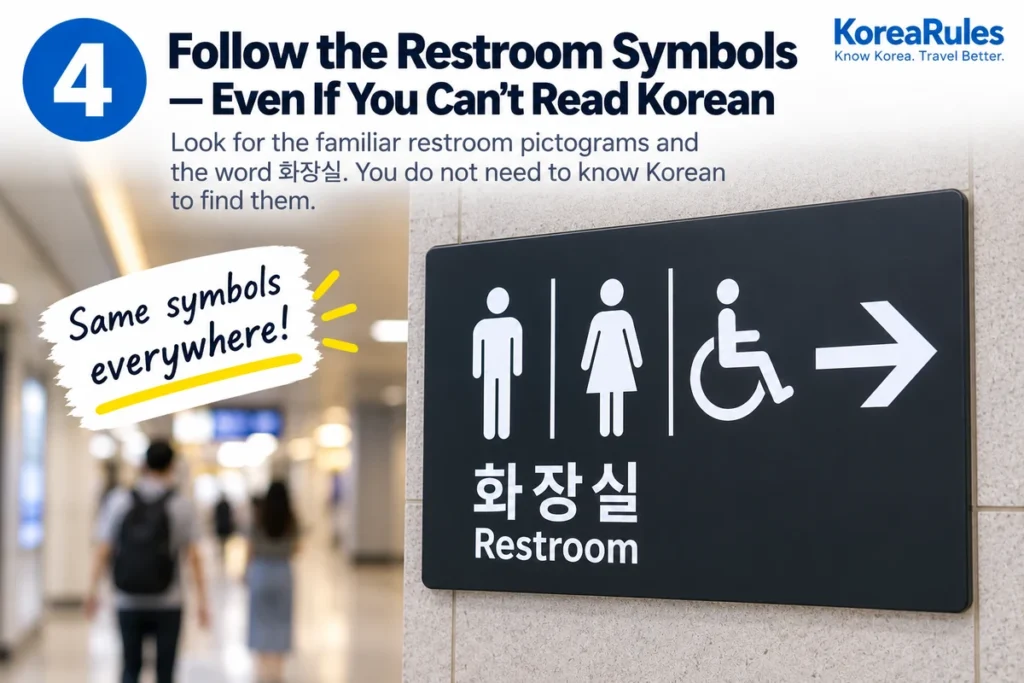
4. Follow the Restroom Symbols — Even If You Can’t Read Korean
You do not need to know Korean to find most public restrooms.
The Korean word for restroom is:
화장실
You may see it together with English words such as:
Restroom / Toilet
But pictograms are often even more useful.
Look for the familiar male and female restroom symbols, as well as accessibility or multipurpose-restroom symbols when needed.
Major transportation facilities and public spaces are generally designed so that people can recognize these facilities without having to read detailed Korean instructions.
This becomes especially useful in large subway stations or underground shopping areas, where signs may point you through several hallways before you actually reach the restroom.
So instead of worrying about translating every sign:
Look for the restroom icon first.
Learning one Korean word can still help:
화장실 = restroom
You will probably recognize it surprisingly quickly after seeing it a few times during your trip.
Follow the signs.
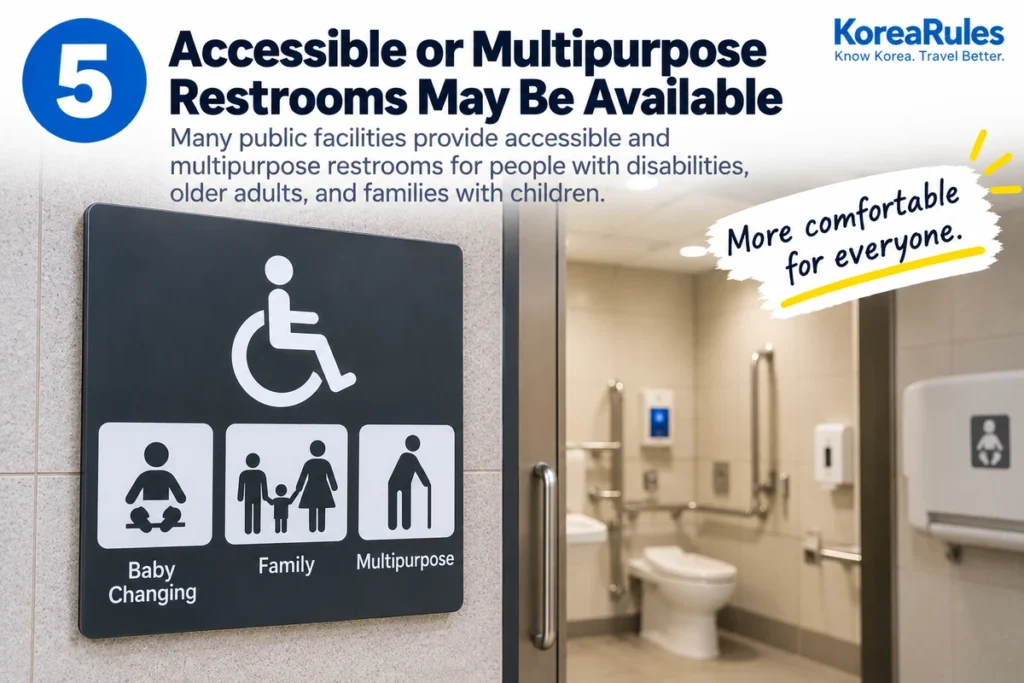
5. Accessible or Multipurpose Restrooms May Be Available
If you need an accessible restroom, a family-friendly facility, or more space than a standard restroom stall provides, look for additional restroom symbols.
Many subway stations and public facilities provide accessible restrooms.
Some newer or larger public facilities may also have multipurpose restrooms designed for people with disabilities, older adults, parents with young children, or others who need additional space or equipment.
Depending on the facility, you may also find features such as:
- Wider entrances
- Handrails
- Baby-changing equipment
- More spacious stalls
- Automatic doors
- Family-oriented facilities
But these facilities are not identical everywhere.
An older station or small public restroom may have fewer features than a large transportation hub or newly renovated tourist facility.
If accessibility is important for your trip, it is better to check the facility information before arriving rather than assuming every restroom has the same equipment.
When you are there, look for the wheelchair, family, baby, or multipurpose restroom symbols.
Look for the right symbol.
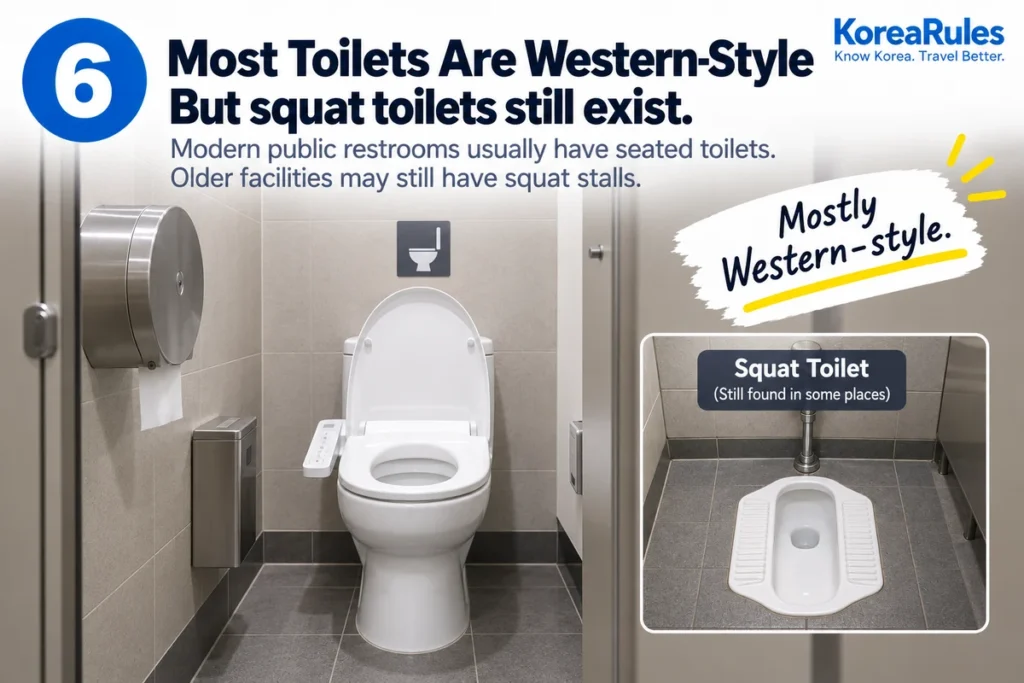
6. Most Toilets Are Western-Style — But Squat Toilets Still Exist
Travelers sometimes wonder what kind of toilet they will find in Korea.
The good news is that Western-style seated toilets are now very common, especially in Seoul, modern buildings, subway stations, airports, hotels, shopping centers, and popular tourist areas.
However, traditional squat toilets still exist in some places.
You are more likely to encounter them in older facilities, older buildings, or occasionally in public restrooms that have a mixture of stall types.
If you open a stall and find a squat toilet, do not assume every toilet in the restroom is the same.
There may be a Western-style toilet in another stall.
This is also a good example of something that can vary significantly by location.
A newly renovated Seoul subway restroom may feel extremely modern, while an older facility in another area can be much more basic.
For most international travelers, however, Western-style toilets will be easy to find during a normal trip.
Mostly Western-style — but not always.
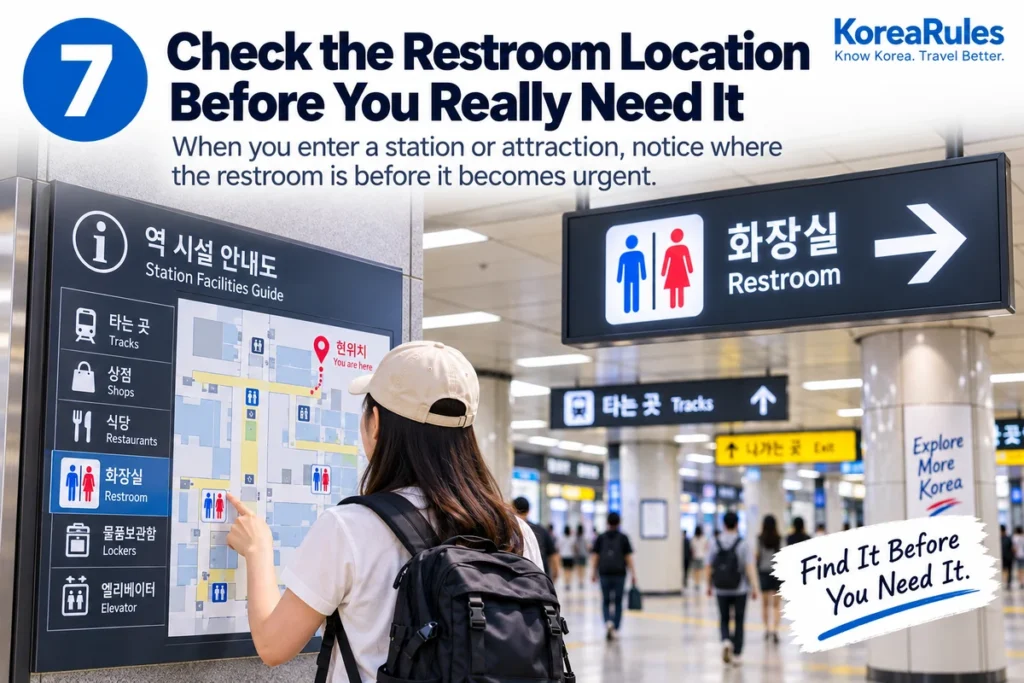
7. Check the Restroom Location Before You Really Need It
The best time to find a restroom is before it becomes urgent.
This sounds obvious, but it can make sightseeing much easier.
If you know you are about to:
- Spend a long time walking around a palace
- Enter a large park
- Take a long bus ride
- Transfer through several subway lines
- Travel with children
- Visit an area with fewer large public facilities
take a moment to notice where the nearest restroom is.
Subway-station information and station maps can often help you locate restroom facilities.
Large tourist attractions also commonly show restroom locations on site maps and directional signs.
This is especially useful in places where the entrance, exit, ticket area, and restrooms are spread across a large site.
You do not need to plan every restroom stop during your trip.
Just build one simple habit:
When you enter a station, attraction, or large public facility, notice where the restroom signs are.
Then if you need one later, you already know where to go.
Find it before you need it.
Before You Need a Restroom
A few simple things are worth remembering:
- Public restrooms are usually free
- Subway stations are one of the most reliable places to look
- The restroom may be outside the fare gates
- Look for restroom pictograms and the word 화장실
- Accessible or multipurpose facilities may have separate symbols
- Most toilets are Western-style, but squat toilets still exist
- Check the restroom location before it becomes urgent
You do not need a special strategy for using restrooms in Korea.
In most tourist areas, finding one is fairly straightforward.
The useful part is knowing where to look first.
And in a city like Seoul, the answer is often simple:
Look for the nearest subway station or public facility.
Frequently Asked Questions
Are public restrooms free in Korea?
Usually, yes.
Public restrooms in subway stations, public facilities, parks, and many tourist attractions are generally free to use.
Private businesses may have different policies.
Do Seoul subway stations have restrooms?
Yes.
Subway stations are one of the most reliable places to find a public restroom while traveling around Seoul.
However, the exact location within the station varies.
Are subway restrooms inside or outside the ticket gates?
It depends on the station.
Some restrooms are located outside the paid area, which means you may need to pass through a ticket gate to reach them.
Check station signs before leaving the paid area whenever possible.
What does “restroom” look like in Korean?
The Korean word is:
화장실
You will also commonly see standard restroom pictograms, and major tourist or transportation facilities may include English signage.
Are there accessible restrooms in Korean subway stations?
Many stations provide accessible restroom facilities.
Availability and equipment vary by station, so travelers who require specific accessibility features should check facility information in advance.
Does Korea still have squat toilets?
Yes, but they are much less common than they once were in major cities and modern facilities.
Most toilets travelers encounter in Seoul are Western-style seated toilets, although squat toilets can still appear in older facilities.
Where should I look first if I urgently need a restroom?
In Seoul, a nearby subway station is often one of your best options.
Large public buildings, parks, tourist attractions, transportation terminals, and shopping facilities can also be good places to check.
Sources
Seoul Metropolitan Government — Public Transportation
Confirms that all Seoul subway stations have public restrooms and that the Seoul Subway app provides restroom and exit locations.
Seoul Metropolitan Government — 15-Minute Turnstile Re-Entry
Explains same-station re-entry within 15 minutes on eligible Seoul subway sections, including cases where passengers need to leave the paid area to use a restroom.
Seoul Metropolitan Government — Universal Design for Public Restrooms
Covers restroom pictograms, multipurpose facilities, accessibility features, automatic doors, baby-changing facilities, and design for non-Korean speakers.
Seoul Metropolitan Government — Subway Accessibility Facilities
Provides station-by-station information on accessible restrooms and other accessibility facilities.
Visit Seoul — Miscellaneous / Restrooms
Confirms that Seoul has many modern public restrooms, most are free, Western-style toilets are the majority, and squat toilets can still be found.