Should You Rent a Car in Korea? 5 Rules for Deciding
Renting a car in Korea can give you much more freedom.
But that doesn’t mean every Korea trip needs one.
For a few days in central Seoul, a rental car can add parking, traffic, tolls, and navigation to a trip that could otherwise be handled by subway, bus, and taxi.
For Jeju Island or a countryside itinerary, the calculation can be completely different.
Korea Tourism Organization specifically notes that driving is particularly useful for smaller cities, islands, and mountainous areas where public transportation may be less convenient.
So don’t start with:
“How much does a rental car cost?”
Start with:
“Will a car actually make my itinerary easier?”
Here are five rules for deciding.
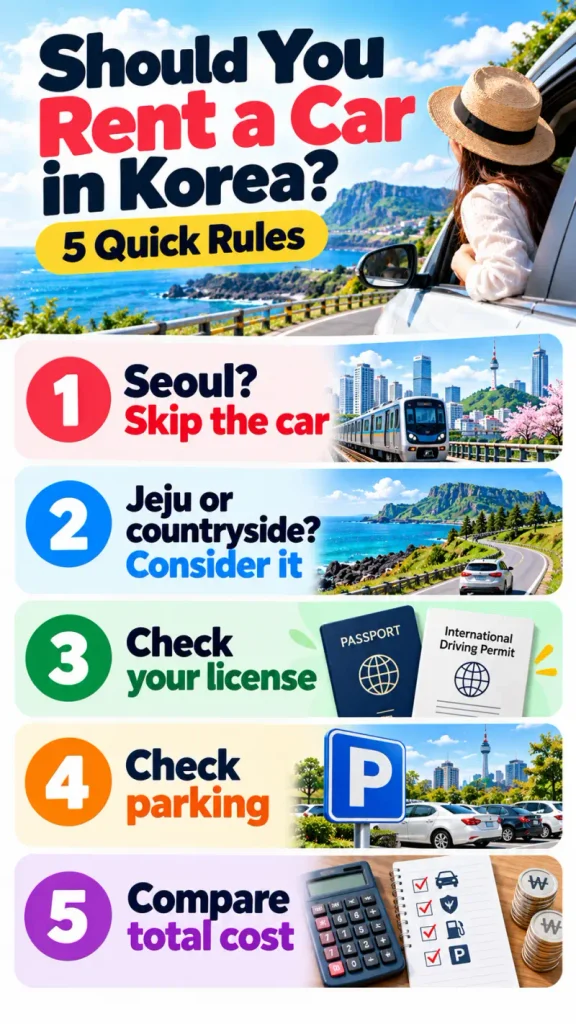
Rule 1 — Skip the Car for Most Seoul-Only Trips
If most of your trip is inside Seoul, start by assuming you do not need a rental car.
Seoul has an extensive subway and bus network connecting tourist areas, residential districts, and other parts of the city, with real-time transportation information available to travelers.
At the same time, parking can become a real consideration.
VISITKOREA notes that parking is especially competitive in Seoul, city centers, and popular tourist destinations, and parking in these areas commonly involves a fee.
That creates a simple decision:
A car probably adds little value if your itinerary looks like:
Myeongdong → Gyeongbokgung → Hongdae → Gangnam → Dongdaemun
All of those areas are already served by public transportation.
A rental car means you also need to think about:
- Traffic
- Parking availability
- Parking fees
- Returning to your parked car
- Navigation
- Fuel
There are exceptions.
A car may make sense if you have limited mobility, unusual luggage needs, several travelers sharing the vehicle, or multiple destinations outside normal transit routes.
But for a standard first-time Seoul sightseeing trip, public transportation should usually be your starting point.
The KoreaRule: Seoul-only trip? Try planning it without a car first.
Rule 2 — Consider a Car for Jeju and Countryside Trips
Once your itinerary moves away from major city centers, a rental car can become much more useful.
Korea Tourism Organization says driving is especially useful when visiting small cities, islands, and mountainous regions where public transportation is inconvenient.
Jeju is the clearest example.
Jeju’s official tourism guide explains that buses are the main public transportation on the island, with no subway or rail system, and notes that many travelers choose rental cars.
A car becomes especially attractive when your day involves several spread-out locations.
For example:
Waterfall → coastal café → hiking trail → beach → countryside restaurant
Trying to connect five distant stops by bus may require much more planning than simply driving between them.
A similar rule can apply to rural areas of the mainland.
Consider renting if:
- Your attractions are far apart
- Bus service is infrequent
- You want to stop at smaller towns
- You are visiting mountain or coastal areas
- You are traveling with several suitcases
- You want flexibility rather than a fixed schedule
But don’t interpret this as “Jeju requires a rental car.”
Buses and taxis still exist, and plenty of travelers use them.
The point is that the value of a car increases as your destinations become more spread out.
The KoreaRule: The farther your itinerary moves from dense city transit, the more useful a car becomes.
Rule 3 — Check Your License Before You Book
Don’t book a non-refundable rental car and figure out the license requirements later.
Do this first.
Under Korean law, eligible visitors may drive in Korea for up to one year after entry using a valid International Driving Permit (IDP) or certain mutually recognized foreign driver’s licenses, depending on the applicable convention or agreement.
For ordinary short-term tourist rentals, VISITKOREA advises travelers to prepare an international driving permit and states that renters generally need to be at least 21 years old. It also says travelers should present a passport or alien registration card, and some rental companies may ask for the original domestic driver’s license as well.
So the safest travel checklist is:
Bring:
International Driving Permit
Passport
Your original home-country driver’s license
Payment card in the driver’s name
And check the rental company’s own rules before payment.
Individual companies may apply additional:
- Minimum driver ages
- Minimum driving-experience requirements
- Vehicle-category restrictions
- Payment requirements
One important detail:
An International Driving Permit is not the same thing as a privately sold “international driving license.”
The Korea Road Traffic Authority warns that unofficial documents sold by unauthorized organizations are not recognized as valid IDPs in Korea.
The KoreaRule: Check your legal driving documents before comparing rental prices.
Rule 4 — Check Parking Before You Check the Car Price
A cheap rental can become inconvenient if your hotel has nowhere to park it.
Before booking the car, check the parking situation at:
Your hotel + every major stop where you expect to leave the car.
This matters especially in Seoul and busy city centers.
VISITKOREA says parking in Seoul, downtown areas, and major tourist destinations can be competitive and commonly requires payment, while parking may be easier in less populated areas.
So when checking accommodation, look for:
Free parking
Paid parking
Reservation required
Parking unavailable
Also remember that street parking is not automatically allowed just because you find an empty space.
Official tourism guidance advises drivers to use designated spaces and notes that roadside parking is subject to restrictions.
This can completely change the decision.
Imagine:
Rental car: ₩50,000
Sounds inexpensive.
But if you spend the day repeatedly searching for parking and paying several parking fees, the car may no longer feel like the convenient option.
On the other hand, if your Jeju hotel offers free parking and every attraction has easy parking, the same rental becomes much more practical.
The KoreaRule: Don’t ask only “Can I rent a car?” Ask “Where will I park it?”
Rule 5 — Compare the Total Cost, Not the Rental Price
The price displayed on a rental website is only part of the trip cost.
Your real calculation should look more like this:
RENTAL PRICE
+ Insurance
+ Fuel
+ Parking
+ Highway tolls
= Real driving cost
Insurance deserves particular attention.
VISITKOREA explains that basic rental pricing typically includes some liability coverage, but coverage for damage to the rental vehicle itself may be included or offered separately depending on the company and policy. Travelers are advised to confirm the coverage and additional cost before renting.
If you drive between cities on Korean expressways, you may also pay tolls.
Korean expressways use toll gates, with payment either through a regular toll lane or the electronic Hi-pass system. Travelers should check whether their rental car includes a Hi-pass device.
Then compare that total with alternatives.
For example:
Seoul → Busan
Compare:
Rental car + fuel + toll + parking
with:
KTX tickets
Jeju countryside day trip
Compare:
Rental car + fuel + insurance
with:
Multiple taxi rides + waiting time
Sometimes the car wins.
Sometimes public transportation wins.
The mistake is deciding based only on the large rental-price number on the booking screen.
The KoreaRule: Compare the entire trip cost—not just the car.
Quick Decision Guide
| Your Trip | Start With |
|---|---|
| Seoul only | Subway / bus / taxi |
| Seoul + one major nearby city | Train or bus first |
| Jeju with several scattered stops | Consider a rental car |
| Rural / mountain road trip | Consider a rental car |
| Mostly major Korean cities | Train + local transit |
| Lots of luggage + several travelers | Compare car vs taxi/train |
| Hotel has no parking | Think twice about renting |
The KoreaRule
SEOUL → PROBABLY NO CAR
JEJU / COUNTRYSIDE → CONSIDER A CAR
CHECK LICENSE → CHECK PARKING → COMPARE TOTAL COST
A rental car is valuable when it gives you more freedom than inconvenience.
That is the decision—not whether driving in Korea is technically possible.
Before You Book a Rental Car
Check these five things first:
- Does your itinerary actually need a car?
- Are your driving documents accepted in Korea?
- Does the rental company accept your age and license?
- Does your hotel provide parking?
- What is the full cost including insurance, fuel, tolls, and parking?
If one of those answers is unclear, solve it before making a non-refundable reservation.
One More Driving Tip
Korea drives on the right side of the road, with the driver’s seat on the left.
VISITKOREA also notes that NAVER Map and KakaoMap provide navigation services useful for driving in Korea.
Need help with Korean map apps?
→ Google Maps in Korea? 5 Rules for Using NAVER Map & KakaoMap
Continue Planning Your Korea Trip
Traveling between major cities instead?
→ KTX vs Bus vs Flight in Korea: 5 Rules for Choosing
Staying in Seoul?
→ Where to Stay in Seoul: 5 Rules for Choosing the Right Area
Planning to use taxis instead of renting?
→ Korea Taxi Rules You Need to Know
FAQ
Do tourists need an International Driving Permit to rent a car in Korea?
For most short-term international tourists, an IDP is the standard document used for driving and renting a car. Korean law also recognizes certain mutually recognized foreign licenses under applicable agreements, so travelers should confirm eligibility for their specific license and rental company before booking.
Can I rent a car in Korea with only my normal driver’s license?
Do not assume so. VISITKOREA recommends an international driving permit for short-term tourist rentals, and some rental companies also request your original home-country license.
How old do I need to be to rent a car in Korea?
VISITKOREA lists 21 years old or older as the general requirement for short-term tourist car rentals, but individual rental companies may impose stricter age or driving-experience rules for certain vehicles.
Do I need a rental car in Seoul?
Usually not for a standard sightseeing itinerary. Seoul has an extensive subway and bus network, while parking in busy city areas can be competitive and paid. Whether a car makes sense depends on your itinerary and personal needs.
Is renting a car useful in Jeju?
It can be. Official Jeju tourism information notes that the island has buses and taxis but no subway or rail system, and rental cars are commonly used for convenient travel around the island.
Is insurance included with Korean rental cars?
Some insurance coverage is commonly included, but vehicle-damage coverage and optional protection vary by company. Check the exact coverage and deductible before paying.
Are there toll roads in Korea?
Yes. Korean expressways can require toll payments. Rental cars may have a Hi-pass electronic toll device, so confirm this with the rental company before departure.
Sources
Korea Tourism Organization — Driving in Korea
Official VISITKOREA guide covering tourist rental requirements, insurance, navigation, tolls and rental-car basics. The page states it was last updated October 2, 2025.
Korea Tourism Organization — Your Guide to Driving in Korea
Official travel guide covering foreign-driver requirements, Korean traffic rules, parking, expressways and driving conditions. Published December 10, 2025.
Easy to Find, Practical Law — Using a Foreign Driver’s License
Official Korean legal-information service explaining when international driving permits and mutually recognized foreign driver’s licenses may be used in Korea.
Visit Jeju — Official Jeju Tourism Guide
Official Jeju tourism information covering buses, taxis and rental cars as ways to travel around the island.
Seoul Metropolitan Government — Public Transportation
Official Seoul guide describing the city’s subway and bus network and traveler-oriented transportation services.