- Korean BBQ Rules Tourists Should Know: 7 Things Before You Grill
- The Unwritten Rules of Korean Restaurants: 7 Things Tourists Should Know
The Unwritten Rules of Korean Restaurants: 7 Things Tourists Should Know
Eating at a restaurant in Korea is usually easy, but the way things work may be different from what you are used to.
Where do you order? How do you call a server? Are the side dishes free? And where do you pay?
Here are seven unwritten restaurant rules that can make dining in Korea much easier.
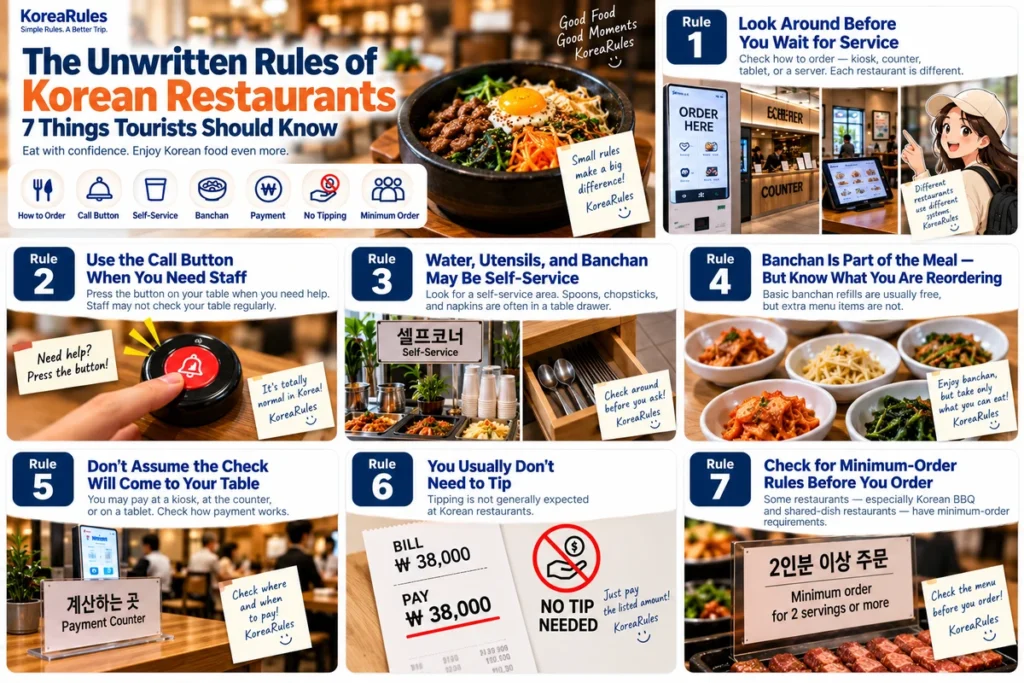
1. Look Around Before You Wait for Service
Not every Korean restaurant uses the same ordering system.
You might order at a kiosk near the entrance, at the counter, from a tablet at your table, or directly from a server.
Before sitting and waiting for someone to come over, take a quick look around for:
- a kiosk
- a counter
- a tablet or QR code
- instructions near the entrance
A few seconds of checking can save a lot of confusion.

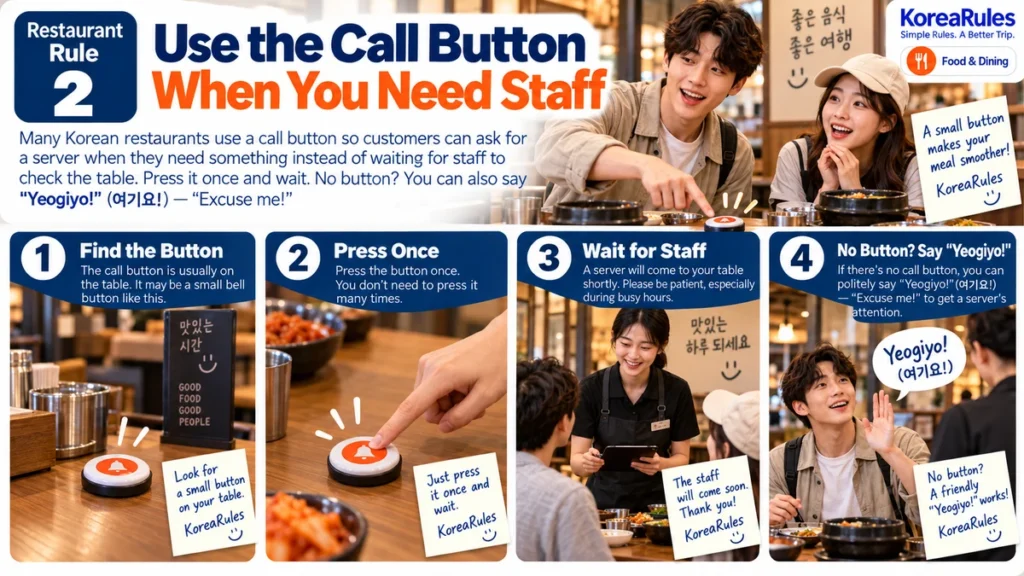
2. Use the Call Button When You Need Staff
If there is a button on your table, it is there for a reason.
Many Korean restaurants use a call bell so customers can ask for a server when they need something instead of waiting for staff to check the table.
Press it once and wait. The sound can sometimes be surprisingly loud.
No button? You can also say:
“Yeogiyo!” (여기요!) — “Excuse me!”
3. Water, Utensils, and Banchan May Be Self-Service
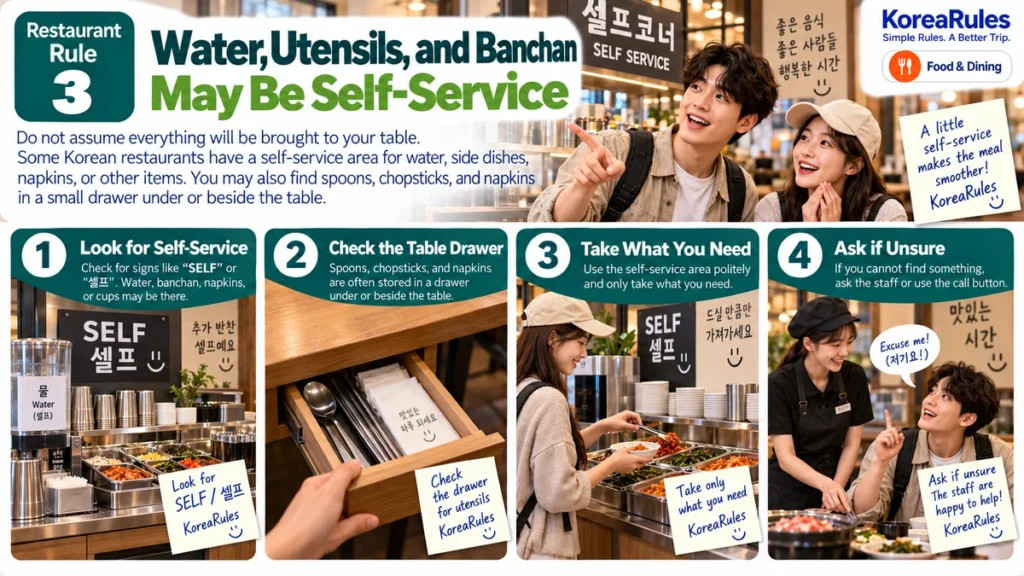
Do not assume someone will automatically bring everything to your table.
Some restaurants have a self-service area for water, side dishes, napkins, or other items. You may see signs saying:
셀프 — Self-Service
Also check the table itself. Spoons, chopsticks, and napkins are often stored in a small drawer under or beside the tabletop.
If you cannot find something, use the call button and ask.
Wondering about restaurant water and self-service dispensers? See Drinking Water in Korea: 7 Things Tourists Should Know.
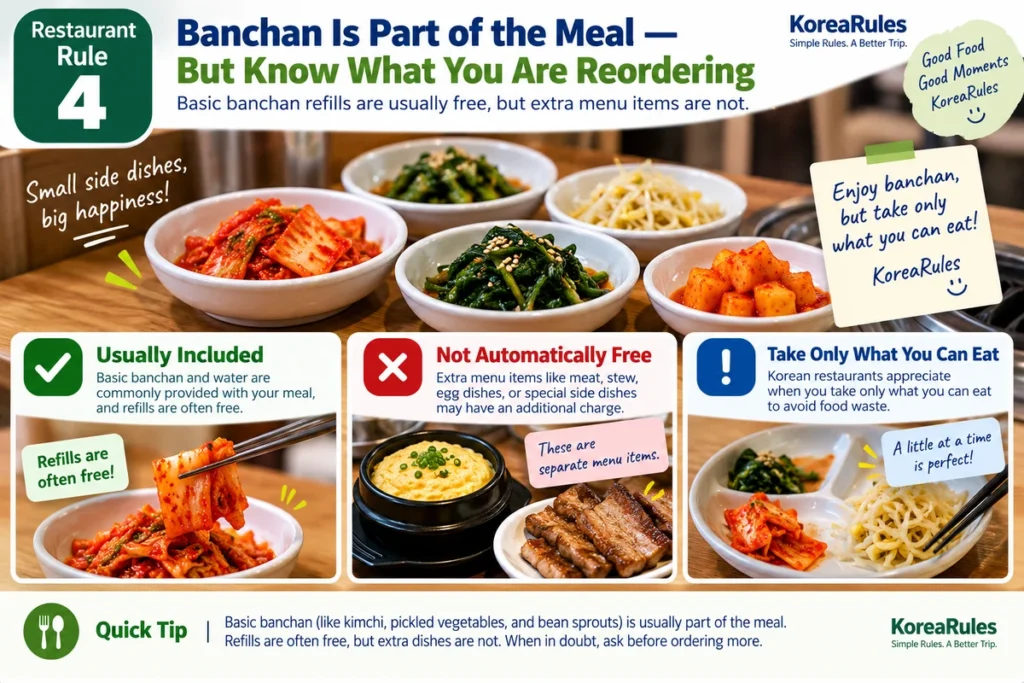
4. Banchan Is Part of the Meal — But Know What You Are Reordering
Small side dishes called banchan are a familiar part of Korean dining.
At many Korean restaurants, basic side dishes and water can be refilled without an extra charge. Some restaurants ask you to get refills yourself from a self-service bar.
But do not assume every extra dish is free.
A refill of kimchi may be different from ordering another portion of meat, egg, stew, or a special side dish.
When in doubt, ask before ordering more.
5. Don’t Assume the Check Will Come to Your Table
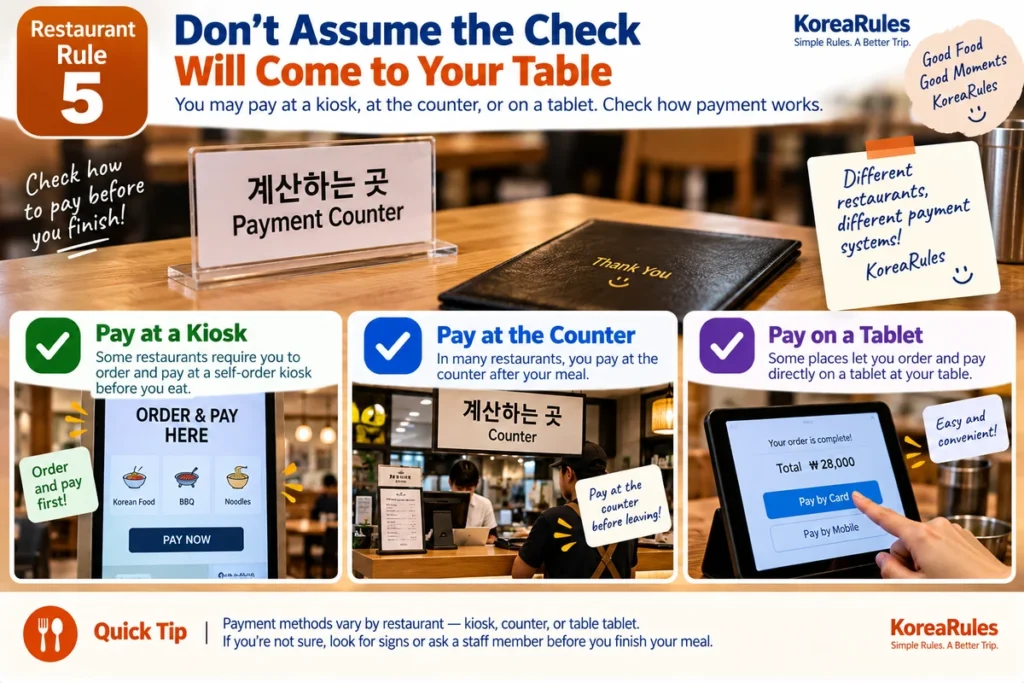
Payment works differently from restaurant to restaurant.
You may have already paid at a kiosk before eating. Some restaurants use table-ordering systems, while others expect customers to pay at a counter.
So when you finish eating, do not sit and wait indefinitely for a bill.
Look for a payment counter, kiosk, or instructions near your table.
Simple rule: Check how the restaurant handles payment.
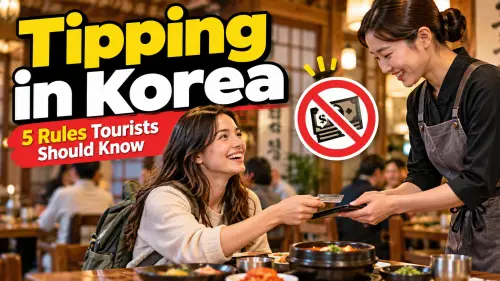
6. You Usually Don’t Need to Tip
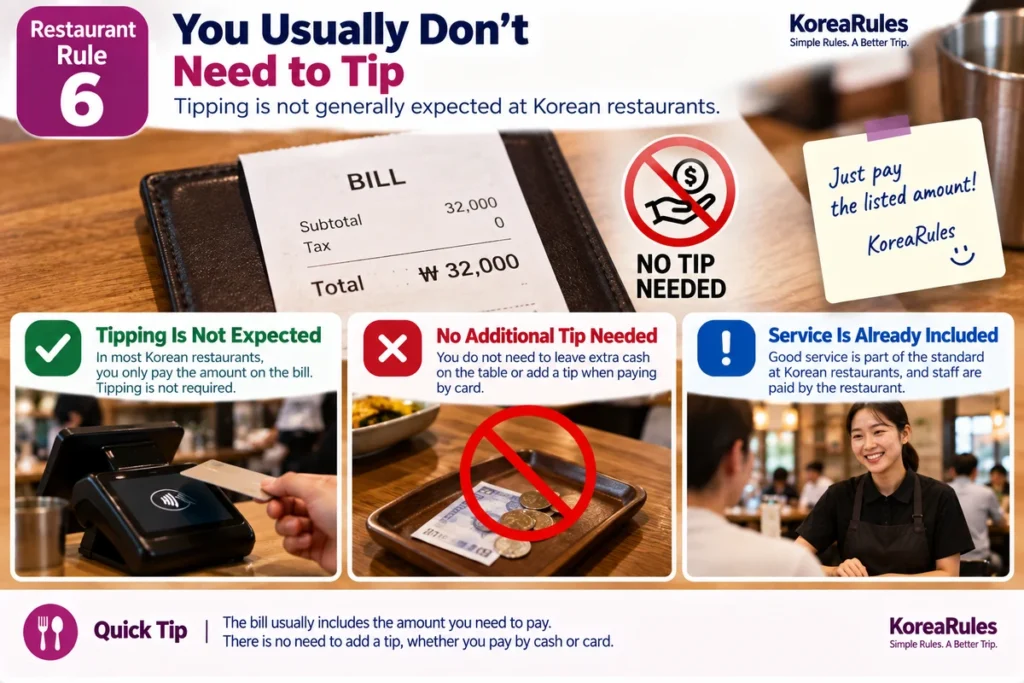
One of the easiest restaurant rules in Korea:
You normally do not need to tip.
Tipping is not generally expected at ordinary Korean restaurants. If your meal costs ₩30,000, paying the listed amount is normally enough.
That means no percentage calculations and no need to leave cash on the table.
Some upscale businesses may have service charges included in the bill, but that is different from voluntarily adding a tip.
7. Check for Minimum-Order Rules
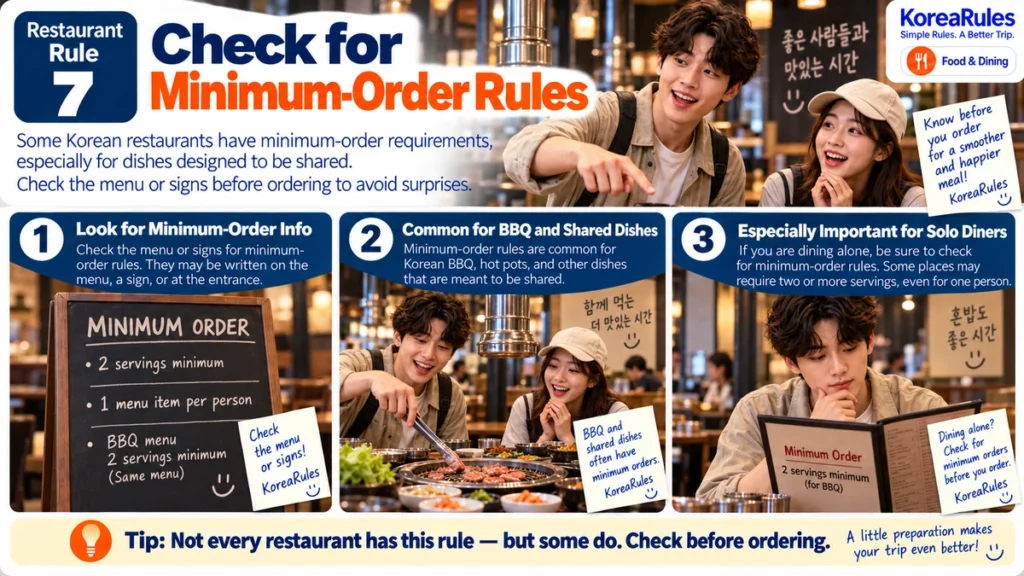
Some Korean restaurants have minimum-order requirements, especially for dishes designed to be shared.
For example, a menu may require:
- at least 2 servings
- one menu item per person
- a minimum order for a barbecue or shared dish
This does not apply to every restaurant, so check the menu before ordering.
If you are dining alone, this is especially useful to know before choosing a Korean BBQ or shared-dish restaurant.
Planning to try Korean BBQ? Read Korean BBQ Rules Tourists Should Know: 7 Things Before You Grill for more ordering and grilling tips.
Before You Eat
Remember these simple rules:
- Check how to order before waiting for a server
- Use the call button when you need help
- Look for self-service water and side dishes
- Check the table drawer for utensils
- Do not assume every extra dish is free
- Check how and where to pay
- Tipping is usually unnecessary
- Look for minimum-order requirements
Once you understand these small differences, eating at Korean restaurants becomes much more relaxed.
Frequently Asked Questions
Do you tip at restaurants in Korea?
Usually, no. Tipping is not generally expected at Korean restaurants.
Are Korean side dishes free?
Basic banchan is commonly included with the meal, and many restaurants allow basic refills without an extra charge. Policies can vary, so do not assume that every additional dish is free.
How do I call a waiter in a Korean restaurant?
If your table has a call button, press it once. If there is no button, saying “Yeogiyo” (여기요) — roughly “Excuse me / over here” — is a common way to get a server’s attention.
Are Korean restaurants self-service?
Some are partly or fully self-service, while others provide traditional table service. Look for signs, kiosks, self-service stations, or instructions when you enter.
Sources
Korea Tourism Organization — About Korean Food
Tipping, banchan and water refills, self-service areas, unmanned ordering, call buttons, and table utensil drawers.
Visit Seoul — Etiquette
General Korean dining etiquette and guidance on tipping customs.
VISITKOREA — Set Menu Filled with the Charm of Steamed Rice, The Essence of Korean Flavors
Real restaurant examples showing that some shared dishes require a minimum order of two servings.