Korean BBQ Rules Tourists Should Know: 7 Things Before You Grill
Korean BBQ is one of the meals many travelers look forward to most.
You sit around a hot grill, cook meat at the table, add sauces and side dishes, and build your own ssam with lettuce and grilled meat.
It is casual and fun, but a few things may be confusing if it is your first Korean BBQ meal.
How much meat should you order? Are you supposed to grill it yourself? Why are there scissors on the table? And how exactly are you supposed to eat that giant lettuce wrap?
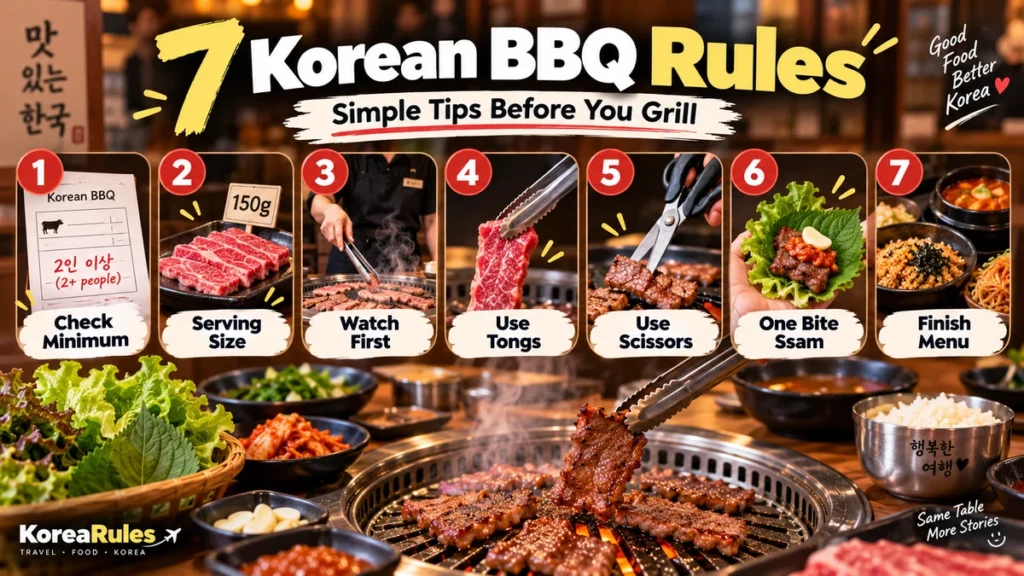
Here are seven Korean BBQ rules worth knowing before you start grilling.
1. Check the Minimum Order Before You Sit Down
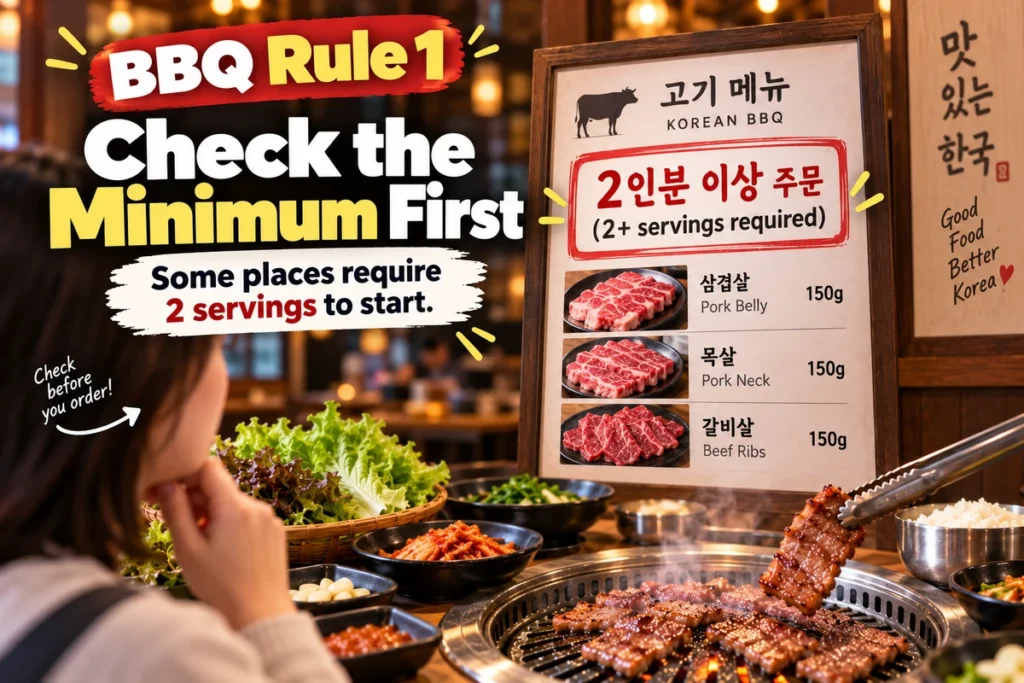
At some Korean BBQ restaurants, certain meat dishes have a minimum first order.
For example, a menu may require two servings of a particular meat for the first order.
That does not mean every Korean BBQ restaurant has the same rule.
The minimum can vary by restaurant, meat type, and menu.
Before ordering, look for wording such as:
2인분 이상
= Two servings or more
If the English menu is unclear, the staff can usually tell you the minimum quantity.
This is especially useful for solo travelers. A restaurant may welcome one person but still require a minimum amount of meat to be ordered.
So before deciding what you want:
Check the minimum first.
First time eating out in Korea? Read The Unwritten Rules of Korean Restaurants: 7 Things Tourists Should Know for more restaurant etiquette and ordering tips.
2. Check What “One Serving” Means
Korean BBQ menus often list meat by serving.
You may see:
1인분
which literally means “one serving.”
But do not automatically assume that one serving represents one complete meal for one person.
Look at the weight in grams, price, and minimum-order requirement shown on the menu.
For example, different meats may have different serving sizes even at the same restaurant.
And because Korean BBQ is often eaten together with side dishes, rice, stew, noodles, or additional meat orders, people frequently order several portions for the table rather than thinking in terms of one plate per person.
The easiest approach is:
Check the serving size before you order.
You can always add more meat later if you are still hungry.

3. Watch Who Is Cooking the Meat
You may have seen Korean BBQ videos where diners grill everything themselves.
That is common — but it is not the only way.
At some restaurants, the staff will come to your table and cook the meat for you.
They may:
- Place the meat on the grill
- Turn it at the right time
- Cut it with scissors
- Move cooked pieces to the side
- Tell you when it is ready
At other restaurants, the grill is completely your responsibility.
So when the raw meat first arrives, you do not need to immediately grab the tongs.
Wait a moment and see what happens.
If the staff starts cooking, let them handle it unless they indicate otherwise.
If nobody does, it is probably your turn.
Staff or you? Watch first.

4. Keep Raw-Meat Tools Separate
Korean BBQ puts raw meat and cooked food on the same table, so basic food safety matters.
If the restaurant gives you separate tongs for handling raw meat, use them.
Try not to pick up raw pork or beef with the same chopsticks you are using to eat.
A simple routine works well:
Tongs → raw meat and grilling
Chopsticks → food you are eating
Once the meat has cooked thoroughly, you can move it to the cooked side of the grill or your plate.
Some restaurants provide several utensils, while others have a simpler setup.
You do not need to become overly complicated about it.
The basic principle is just to avoid unnecessary contact between raw meat and food that is ready to eat.
Raw meat? Use the tongs.

5. Scissors at the Table Are Normal
If someone places a large pair of kitchen scissors next to your grill, nothing has gone wrong.
Table scissors are extremely common at Korean BBQ restaurants.
Instead of cutting large pieces of meat with a knife before cooking, meat is often placed on the grill in larger pieces and cut into bite-sized portions as it cooks.
You may also see scissors used for foods such as kimchi or noodles.
If staff are cooking for you, they may do the cutting themselves.
If you are cooking, use the scissors when the meat is ready to be divided into smaller pieces.
For first-time visitors, it can look unusual.
In Korea, it is completely normal.
Yes, use the scissors.

See scissors next to the grill? Here’s what they’re for.
→ Korean BBQ Scissors Rule: Why Koreans Cut Meat with Scissors
Grill getting dark during your meal?
→ Here’s when to ask for a fresh grill plate.
6. Make Your Ssam Small Enough for One Bite
This is one of the most enjoyable parts of Korean BBQ — and one that first-time visitors sometimes misunderstand.
A ssam is a wrap made with a leafy vegetable such as lettuce or perilla leaf.
You place grilled meat inside and add whatever you like, such as:
- A little ssamjang
- Garlic
- Kimchi
- Green onion
- Another small side dish
Then you wrap it up and eat it.
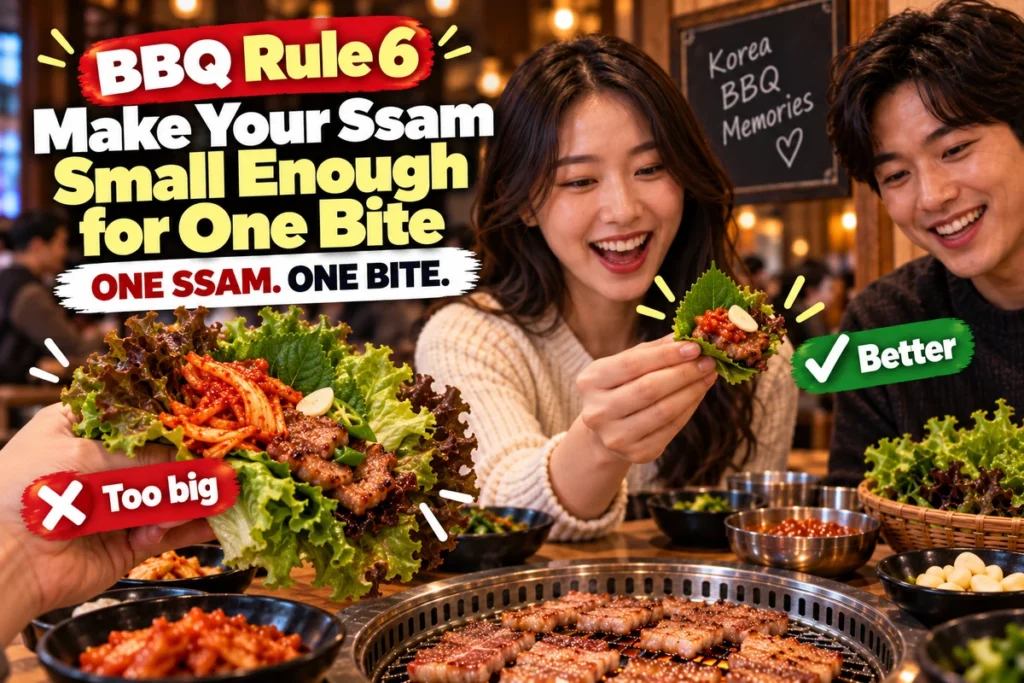
The common mistake is making the ssam enormous.
Some visitors pile in meat, rice, garlic, kimchi, several side dishes, and sauce until the lettuce looks like a hamburger — then take several bites from it.
You can eat it that way, but that is not the typical Korean way to enjoy ssam.
A good ssam is usually bite-sized.
Use one piece of meat, add a small amount of the ingredients you want, fold the leaf around them, and make it small enough to eat comfortably in one bite.
You also do not need to add every side dish on the table.
Try different combinations.
One ssam might be:
Lettuce + pork belly + ssamjang + garlic
The next might be:
Perilla leaf + beef + kimchi
That is part of the fun.
Lettuce, garlic, kimchi, and other side dishes are commonly served with Korean BBQ, although the exact selection and refill policy can vary by restaurant.
The important thing to remember is simple:
ONE SSAM. ONE BITE.
7. Don’t Assume the Meal Ends With the Meat
You may think the meal is finished once the grill is empty.
Not necessarily.
For many Koreans, there is another stage to Korean BBQ.
Restaurants often offer finishing dishes such as:
- Naengmyeon — cold noodles
- Doenjang-jjigae — soybean paste stew
- Bokkeumbap — fried rice
- Rice and soup
- Other noodle dishes
Exactly what is available depends on the restaurant.
These dishes are also usually separate menu items, not automatically included with your meat.
Sometimes people deliberately leave a little room for noodles or fried rice after grilling.
And at certain restaurants, fried rice may even be prepared using flavors and ingredients left from the meal.
You do not have to order a finishing dish.
But before saying you are completely full, take one more look at the menu.
Save room for the finish.

Before You Start Grilling
A quick Korean BBQ checklist:
- Check whether there is a minimum first order.
- Look at the grams as well as the number of servings.
- See whether the staff or customers are expected to grill.
- Use tongs for raw meat when possible.
- Don’t be surprised by the table scissors.
- Make your ssam small enough for one bite.
- Check the menu for noodles, stew, or fried rice before you finish.
Korean BBQ does not require complicated etiquette.
Most of the experience is simply:
Grill → Share → Wrap → Eat → Enjoy.
Once you understand the basic flow, it becomes one of the easiest — and most fun — Korean meals to enjoy.
Frequently Asked Questions
Do Korean BBQ restaurants require two servings?
Some do, especially for certain meat dishes or the first order.
It is not a universal rule, so check the menu or ask the restaurant.
Do I have to grill the meat myself?
It depends.
At some restaurants, customers cook the meat themselves. At others, staff grill and cut the meat for you.
Wait a moment when the meat arrives and watch the restaurant’s flow.
Why are there scissors at Korean BBQ restaurants?
They are commonly used to cut grilled meat into bite-sized pieces.
They may also be used for kimchi, noodles, or other foods.
Should I eat ssam in one bite?
A typical Korean-style ssam is made small enough to eat in one bite.
Instead of building a giant wrap, use a small amount of meat and toppings.
Are Korean BBQ side dishes free to refill?
Some side dishes may be refillable, but the exact selection and refill policy varies by restaurant.
Do not assume every item on the table can be reordered for free.
Is rice or stew included with Korean BBQ?
Sometimes, but not necessarily.
Rice, stew, noodles, and fried rice may be separate menu items, so check before ordering.
Sources
VISITKOREA — Korean BBQ and Grilled Meat Culture
Table grilling, staff-assisted grilling, side dishes, and common finishing dishes such as stew, noodles, and fried rice.
VISITKOREA — Ssam, Korean Wrap Culture
How leafy vegetables, grilled meat, sauces, and other ingredients are combined into bite-sized ssam.
Korea Food Safety Guidance
Food-safety principles for separating utensils used with raw and cooked foods and reducing cross-contamination.