- Traditional Market Rules Tourists Should Know in Korea: 7 Things Before You Shop
Traditional Market Rules Tourists Should Know in Korea: 7 Things Before You Shop
Traditional markets are one of the easiest places to experience everyday Korea.
You can find street food, fresh produce, clothing, souvenirs, kitchenware, snacks, and sometimes things you would never see in a department store.
But Korean traditional markets do not all work the same way.
Some are highly tourist-friendly and accept cards almost everywhere. Others still have small stalls where cash is useful. Opening hours can change from shop to shop, and bargaining is not something you should automatically expect.
Here are seven things worth knowing before you explore a traditional market in Korea.

1. Check the Market Hours — Then Check the Stall
A market may have official opening hours, but individual shops can follow different schedules.
For example, VISITKOREA lists Namdaemun Market’s operating hours as varying by store. At Gwangjang Market, the main market and food street also operate on different schedules: many shops close earlier while the food street stays open later.
That means arriving late does not necessarily mean the entire market will be closed.
But the specific shop you wanted to visit might be.
Before making a special trip, check:
- The market’s official hours
- The individual store if you have a specific destination
- Weekly closing days
- Whether the food section keeps different hours
Market hours ≠ every stall’s hours.

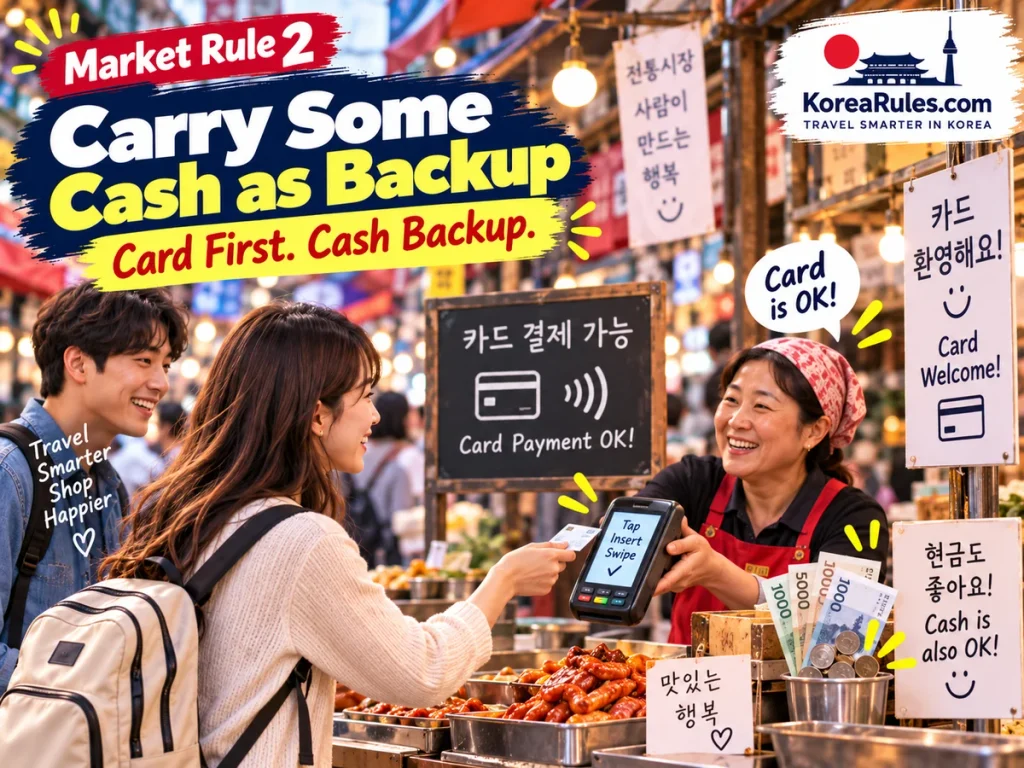
2. Carry Some Cash — Even If You Plan to Use a Card
Korea is extremely card-friendly, and many traditional-market businesses accept cards.
VISITKOREA, for example, lists cards as accepted at both Gwangjang Market and Namdaemun Market.
But that does not mean every tiny stall will accept your foreign card.
Korea Tourism Organization’s general shopping guidance specifically notes that some traditional markets and street shops may still accept cash only, and recommends carrying some small cash.
So you do not need a wallet full of cash.
Just keep a little as backup.
Card first. Cash backup.
For more about payments, see The Real Rules of Paying in Korea: 7 Things Tourists Should Know.
3. Don’t Start Bargaining Automatically
Many travelers arrive at an Asian traditional market assuming every price is negotiable.
That is not a good rule for Korea.
Some places — particularly flea markets or certain merchandise stalls — may allow negotiation. VISITKOREA even mentions bargaining as common at some flea markets.
But that does not mean you should haggle over everything.
In fact, in 2026 the Ministry of Culture, Sports and Tourism and Korea Tourism Organization launched a service-improvement campaign at eleven major traditional markets that specifically promotes fixed pricing, along with card payments, cleanliness, and friendly service.
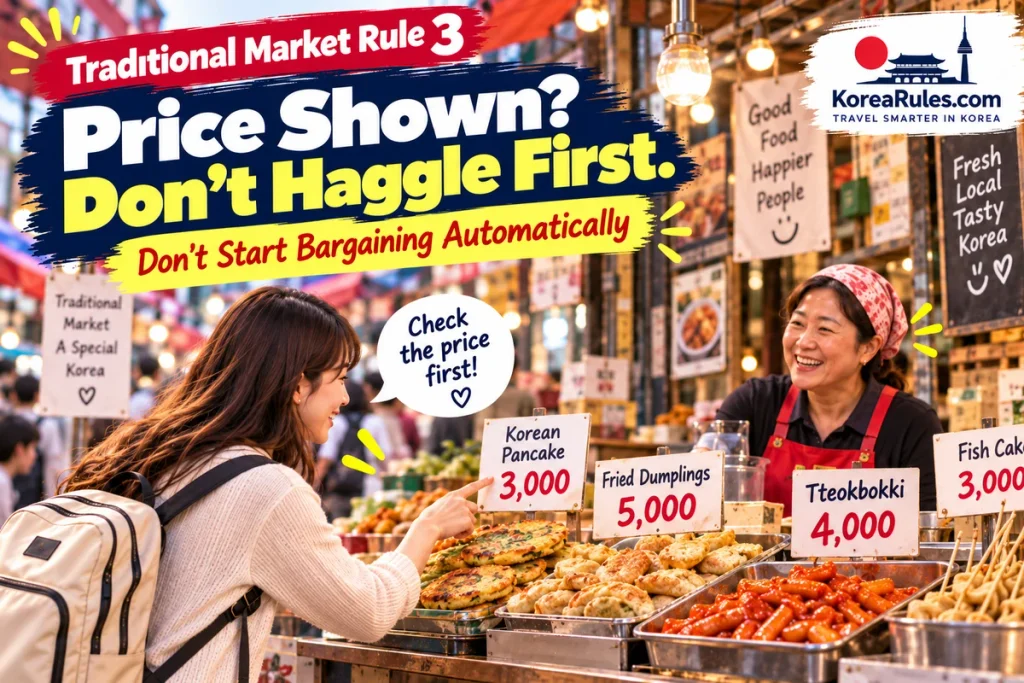
If a price is clearly displayed, treat it as the price.
If you are buying several non-food items and the vendor seems open to negotiation, you can politely ask.
But do not assume bargaining is expected.
Price shown? Don’t haggle first.
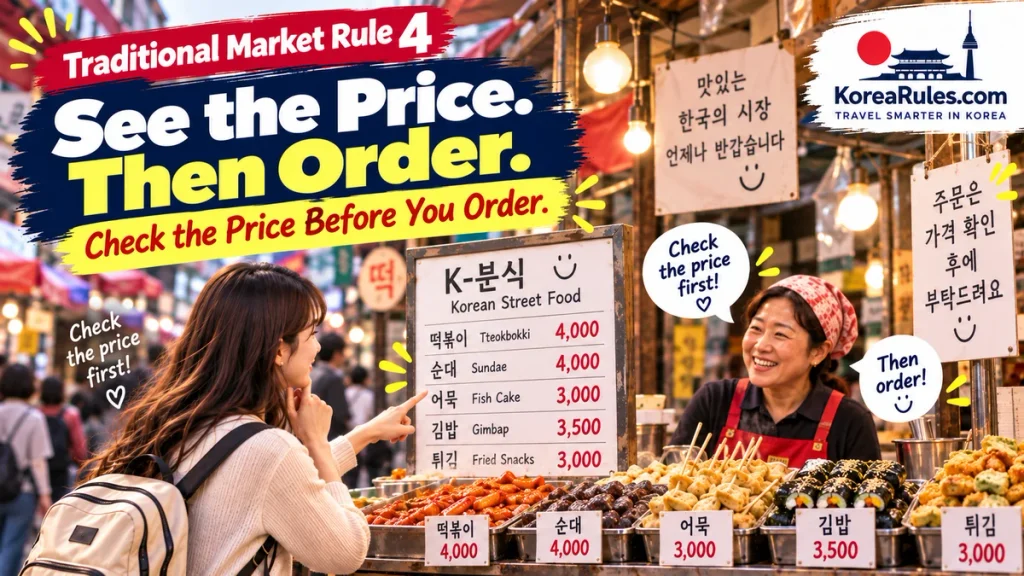
4. Check the Price Before You Order
Traditional-market food can feel informal.
You may see food cooking right in front of you, sit down on a stool, point at something, and start eating within minutes.
That casual atmosphere makes it easy to forget one simple step:
Check the price first.
Look for:
- A menu board
- A price tag
- A price sign near the food
- A displayed portion size
The recent government/KTO traditional-market campaign’s emphasis on fixed pricing is specifically intended to make shopping clearer and more convenient for visitors.
If you cannot see the price, ask before ordering.
A simple:
“How much?”
is enough.
See the price. Then order.
5. The Food Area May Keep Different Hours
Do not treat a traditional market as one single business.
Different sections can have completely different rhythms.
Gwangjang Market is a good example. VISITKOREA lists the general market around 09:00–18:00, while its famous food street operates until 23:00.
So if you visit mainly for food, you may still have plenty to eat even after many merchandise shops have closed.
The reverse can also happen.
A stall you saw online may not be operating simply because that particular vendor keeps different hours.
Market open doesn’t mean every stall is open.

6. Some Markets Have Their Own Way of Doing Things
Not every Korean market works like Gwangjang or Namdaemun.
Some have their own special systems.
Tongin Market, for example, has a well-known lunchbox experience where visitors can purchase traditional yeopjeon-style coins and use them at participating food stalls. The program has its own operating hours and participating shops, and regular payment methods are used when buying the coins.
That is a good reminder not to assume one market’s rules apply everywhere.
When you arrive, look for:
- Information counters
- Market maps
- Special payment programs
- Tourist signs
- QR-code guides
Sometimes figuring out how the market works is part of the experience.
Every market works a little differently.

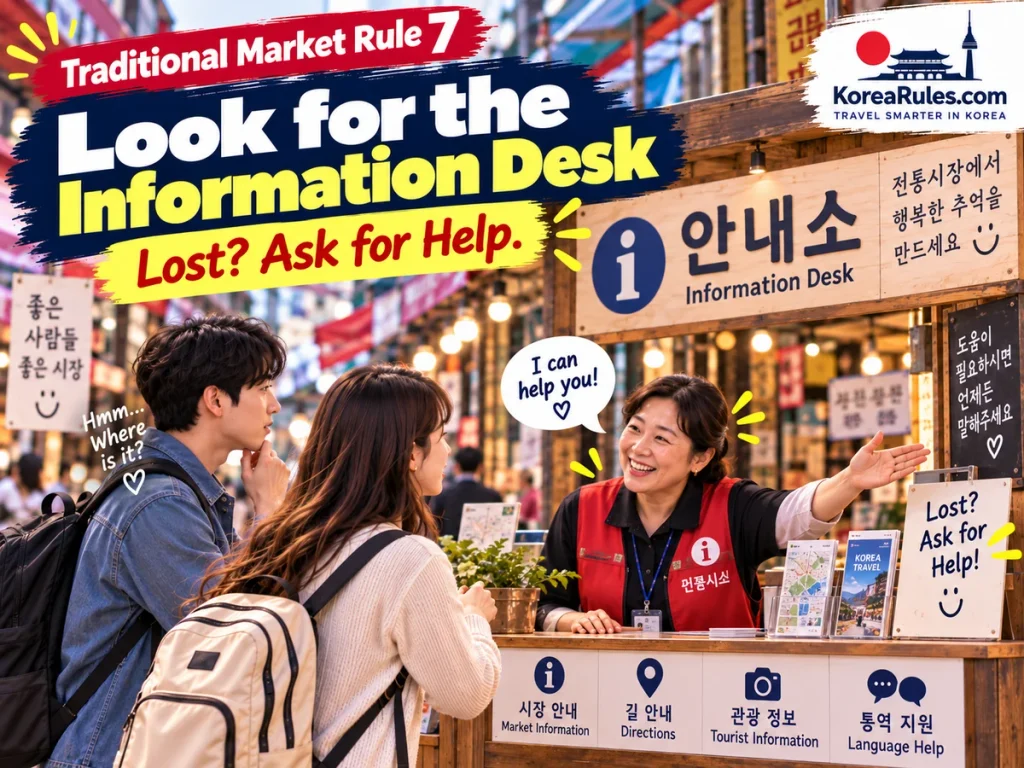
7. If You’re Lost, Look for the Market Information Desk
Traditional markets can be much larger than they appear on a map.
Namdaemun alone contains thousands of products and many specialized shopping areas. VISITKOREA also notes a foreigner-oriented community lounge near Gate 2, offering market information and assistance for international travelers.
Other markets may have customer centers, tourist information booths, maps, or multilingual signs.
And if you need broader travel help, Korea’s 1330 Travel Hotline is listed by VISITKOREA for major markets and supports multiple languages.
So if you cannot find a famous stall or market section, do not just wander indefinitely.
Ask.
Lost? Find the information desk.
Before You Enter the Market
Remember these seven things:
- Check market and stall hours separately.
- Carry a little cash as backup.
- Do not assume every price is negotiable.
- Check prices before ordering.
- Food sections may keep different hours.
- Some markets have their own special systems.
- Use information centers when you need help.
Traditional markets are supposed to feel a little less structured than malls and department stores.
That is part of their charm.
You do not need to know every rule before entering — just understand that each market has its own rhythm.
Look first. Ask when needed. Enjoy the market.
Frequently Asked Questions
Do Korean traditional markets accept credit cards?
Many do.
Major markets such as Gwangjang and Namdaemun are listed by VISITKOREA as accepting cards. However, some small traditional-market and street vendors may still operate on a cash-only basis, so carrying a small amount of cash is useful.
Should I bargain at a Korean market?
Not automatically.
Some flea-market or merchandise vendors may negotiate, but many stores use fixed prices. In 2026, a government/KTO campaign at eleven traditional markets specifically promoted fixed pricing as a visitor-friendly standard.
Are Korean markets open every day?
It depends on the market and individual shop.
For example, VISITKOREA lists Sunday closures for Namdaemun Market, while Gwangjang Market’s food street operates differently from other sections. Always check the specific market before visiting.
Can I eat inside traditional markets?
Absolutely.
Many famous markets have dedicated food streets or food stalls. Gwangjang Market, for instance, is particularly well known for its extensive food-street section.
For more tips, see Korean Street Food Rules Tourists Should Know: 7 Things Before You Order.
Do all traditional markets work the same way?
No.
Some have unique systems or experiences. Tongin Market’s yeopjeon lunchbox program is a good example of a market-specific system that visitors should understand before participating.
Sources
VISITKOREA — Experience Friendly Service at K-tourism and Traditional Korean Markets!
2026 Korea Tourism Organization information on the traditional-market service campaign covering fixed pricing, card payments, hygiene, and visitor service.
VISITKOREA — Shopping in Korea
Official visitor guidance explaining that some traditional markets and street shops may still require cash.
VISITKOREA — Gwangjang Market
Official market information covering operating hours, food-street hours, card acceptance, and visitor services.
VISITKOREA — Namdaemun Market
Official market information covering store-specific operating hours, card acceptance, and market facilities.
VISITKOREA — Tongin Market / Coin Lunchbox Café
Official information explaining Tongin Market’s yeopjeon coin lunchbox system and participating stores.