Trash and Recycling in Korea: 7 Things Tourists Should Know
Throwing away a coffee cup or snack wrapper sounds simple — until you cannot find a trash bin or suddenly face five different recycling containers.
Korea has a well-established waste separation system, but travelers do not need to learn every local recycling rule before their trip.
What matters is knowing a few basic habits: do not litter, check the labels, separate food waste when required, and do not guess when you are unsure.
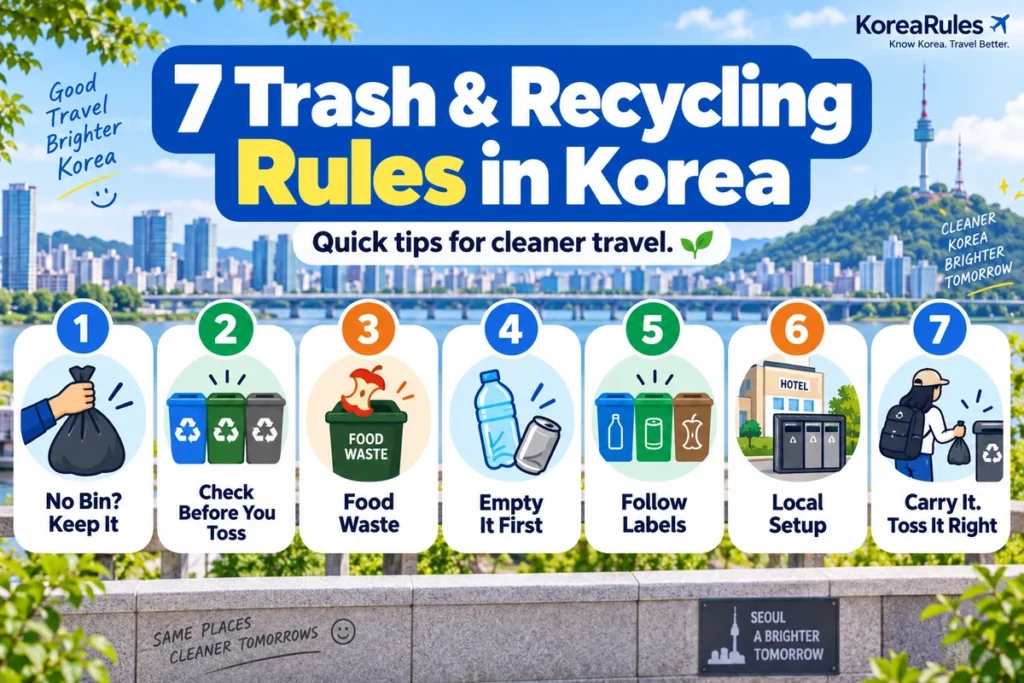
Here are seven practical trash and recycling rules that will make everyday travel in Korea easier.
1. Don’t Litter — Use a Bin or Keep It With You
The simplest rule is also the most important:
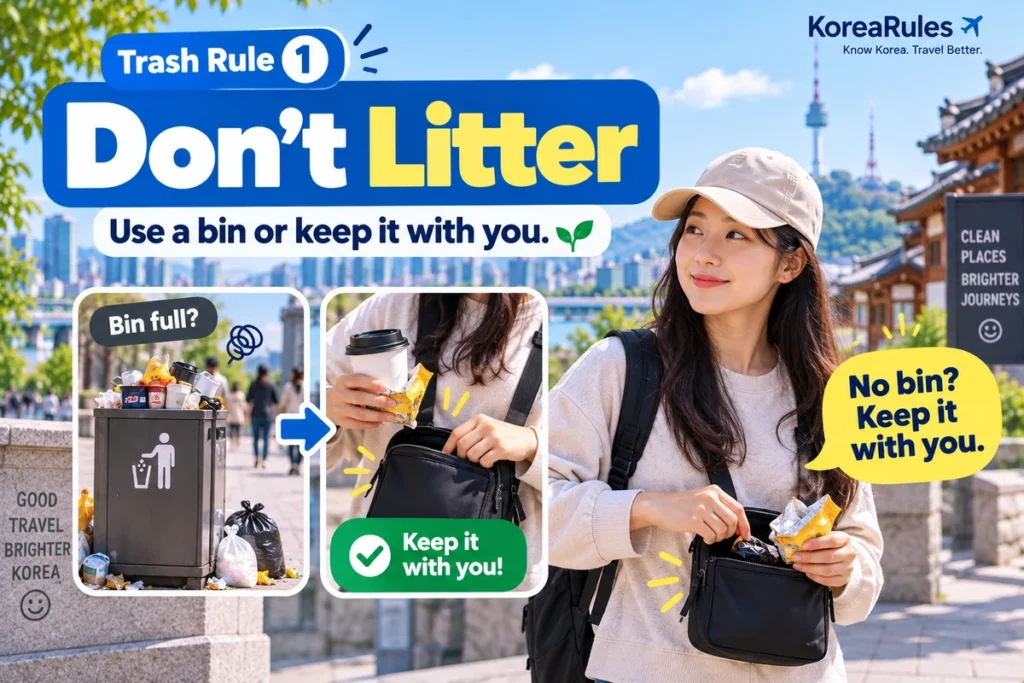
Do not leave your trash on the street, beside a bench, or next to a full trash bin.
While traveling around Korea, you may sometimes notice that public trash bins are not immediately available where you need one.
This can happen after finishing a takeaway coffee, eating a snack while walking, or buying something from a convenience store.
If you cannot find an appropriate bin, the best solution is simple:
Keep the trash with you until you find one.
A small plastic bag inside your backpack can be surprisingly useful for temporarily carrying wrappers, tissues, empty cups, or other small pieces of trash.
Public facilities, transportation areas, tourist attractions, and your accommodation may provide places where you can dispose of them properly later.
A missing trash bin is not an invitation to leave your waste nearby.
And if a bin is already overflowing, putting more trash on the ground beside it is not the right solution either.
No bin? Keep it with you.
2. General Waste and Recycling Are Separate
When you do find a waste station in Korea, you may see more than one bin.
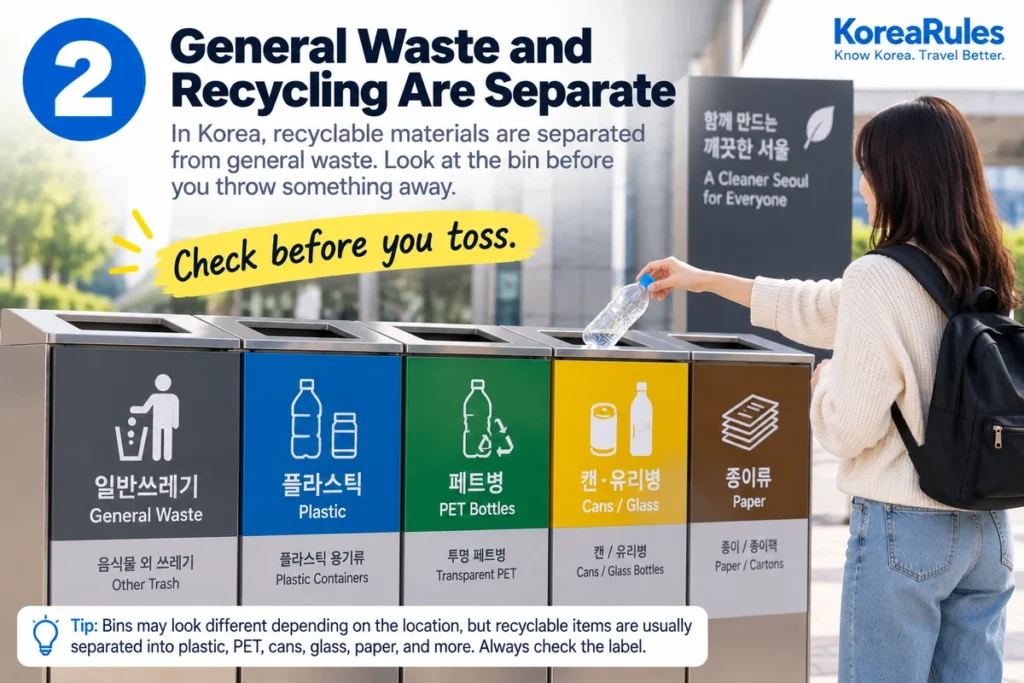
That is because general waste and recyclable materials are commonly separated.
Depending on the location, recycling bins may be labeled for materials such as:
- Plastic
- PET bottles
- Cans
- Glass
- Paper
General waste usually goes somewhere else.
You do not need to memorize Korea’s entire recycling system as a tourist.
Instead, build one simple habit:
Look at the bin before you throw something away.
Many waste stations use words, colors, pictures, or examples to show what belongs in each container.
If there is only one general trash bin, use the system provided there.
If several recycling containers are available, take a few seconds to find the closest match for what you are holding.
Do not assume that every empty container goes into the same recycling bin.
Check before you toss.
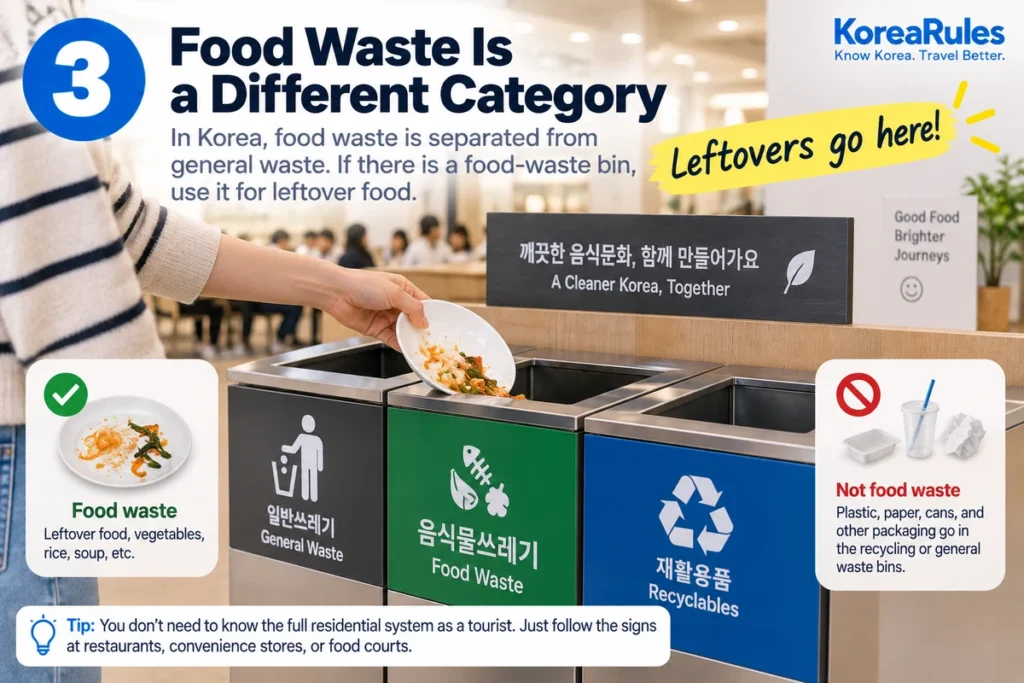
3. Food Waste Is a Different Category
Food waste receives special treatment in Korea.
In homes and many businesses, food waste is separated from ordinary general waste.
As a traveler, however, you usually do not need to learn the detailed residential food-waste system or buy special disposal bags just to finish a meal.
Most of the time, you simply need to follow the system provided by the place you are using.
For example, a convenience store, food court, accommodation, or other eating area may have a bin specifically marked for leftover food.
If it does, put food waste there rather than mixing it with plastic packaging, cans, or general trash.
You may also see a separate place for leftover liquids or soup.
If there is no clearly marked food-waste container, do not invent your own disposal method. Follow the signs or ask staff if necessary.
The important distinction is:
Food waste is not automatically the same as general trash.
Food waste has its own place.
4. Empty and Rinse Containers Before Recycling
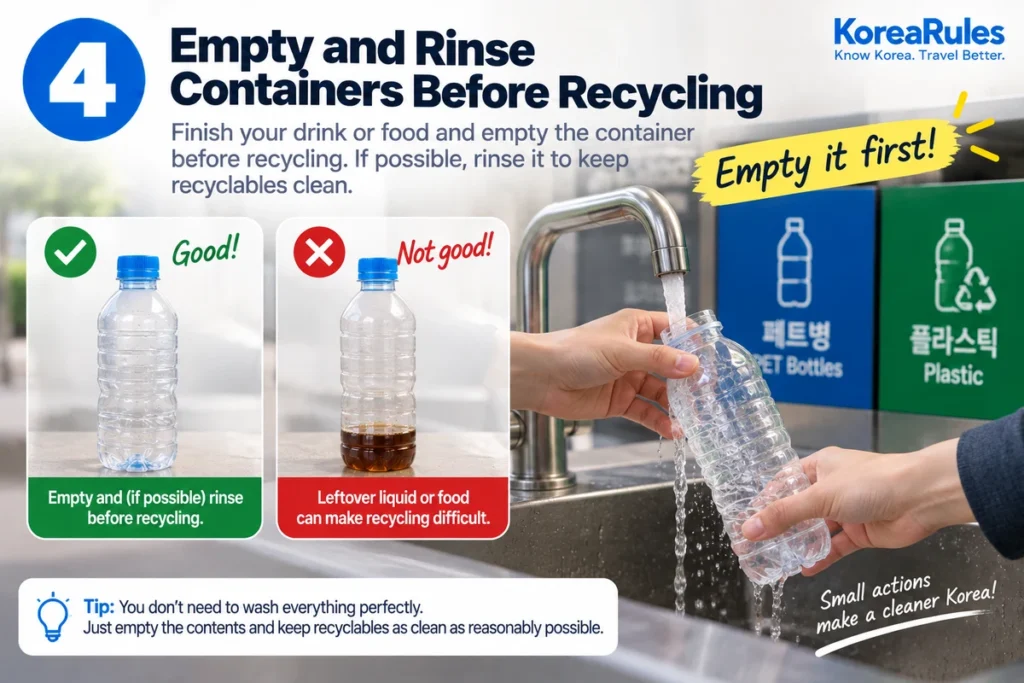
Before putting a bottle, can, or food container into recycling, check whether anything is still inside.
A container filled with leftover liquid or food is not ready to be recycled.
For a drink bottle or can, the first step is simple:
Finish or empty the contents.
If you are somewhere with an appropriate sink or cleanup area, rinsing a dirty recyclable container can also help.
For example, a clean plastic drink bottle is much easier to sort than a bottle containing half a drink.
The same idea applies to containers with food residue.
You do not need to wash every piece of travel trash perfectly.
The practical principle is:
Empty first. Keep recyclables as clean as reasonably possible.
If you are at a public waste station without anywhere appropriate to rinse something, simply follow the instructions provided there.
Do not pour drinks into a recycling bin just because the bottle itself is recyclable.
Empty it first.
5. Follow the Bin Labels — Categories Can Be Separate
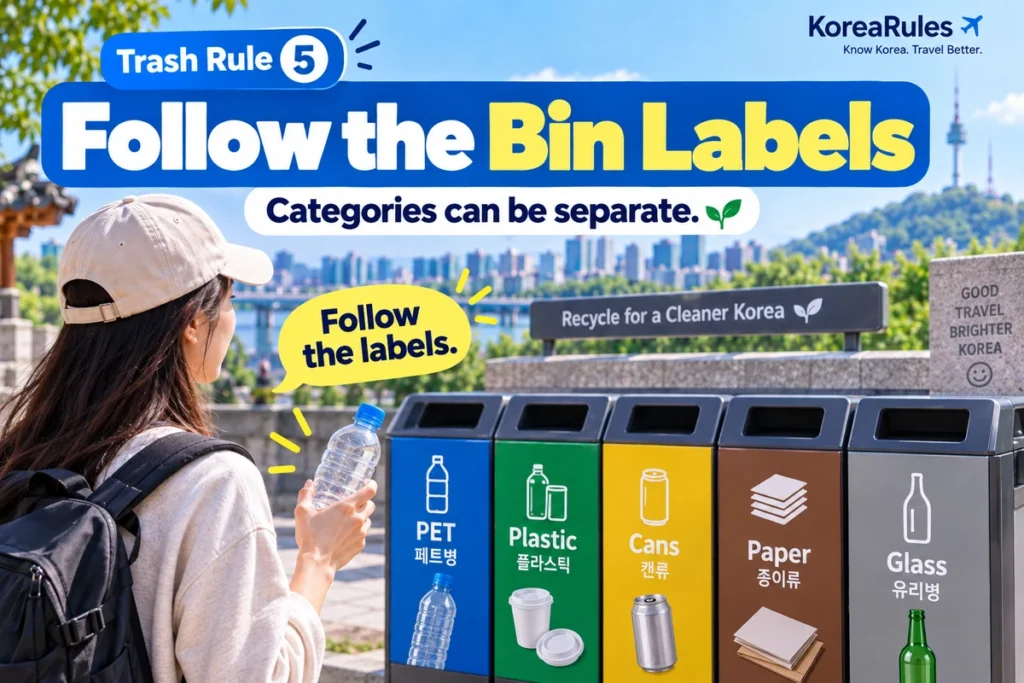
One thing that can confuse visitors is that recycling does not always mean one single container.
At some waste stations, you may see separate bins for:
PET / Plastic / Cans / Glass / Paper
Transparent PET bottles may also be collected separately in some systems.
That means a plastic bottle and a plastic food tray might not necessarily belong in exactly the same place.
Fortunately, travelers do not need to understand all of the technical classifications.
The easiest solution is to follow the label in front of you.
Look for:
- English words
- Recycling symbols
- Pictures of bottles or cans
- Korean labels
- Sample items printed on the bin
Visual symbols are often enough even if you cannot read Korean.
And do not rely entirely on bin color.
Different facilities may use different colors or designs.
The label is more important than the color.
Follow the labels.
6. Trash Rules Can Vary by Location
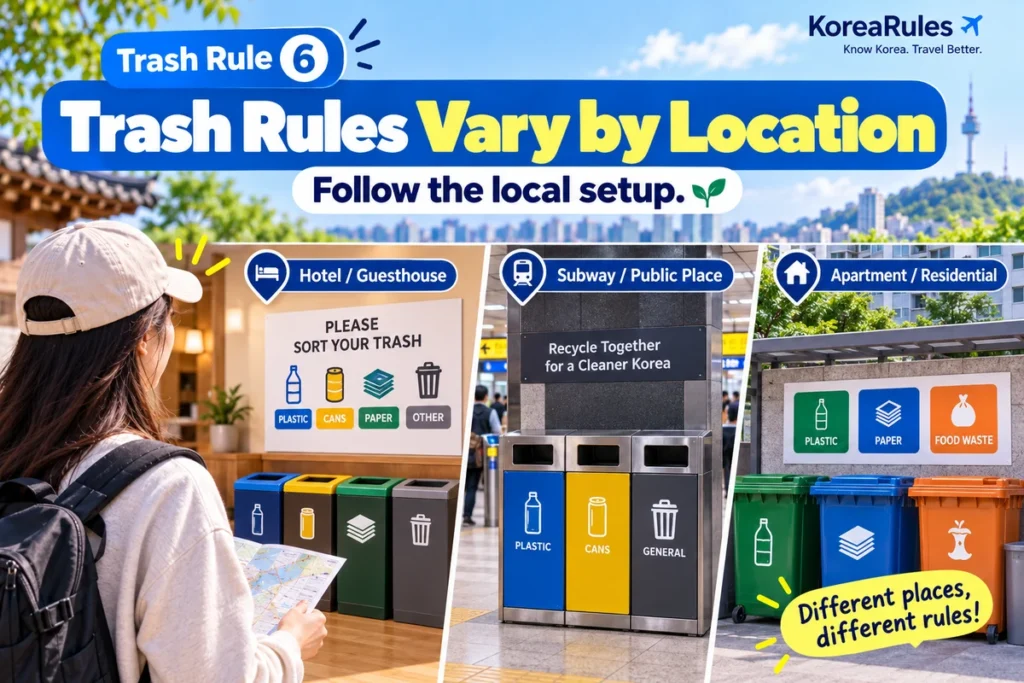
There is no single trash station design that appears everywhere in Korea.
The exact setup can vary depending on:
- City or district
- Building
- Hotel
- Guesthouse
- Apartment
- Restaurant
- Tourist attraction
- Public facility
That is especially important if you are staying in an Airbnb, guesthouse, or another accommodation where you may be responsible for disposing of your own trash.
Your host may provide instructions about:
- General waste
- Recycling
- Food waste
- Where to place trash
- When certain waste can be put outside
Follow those instructions rather than assuming the rules are identical to another place you stayed.
Hotels are usually simpler because housekeeping handles much of the waste for guests, but recycling bins may still be available in rooms or common areas.
Public attractions and transportation facilities can have completely different setups again.
So instead of trying to memorize one nationwide trash routine, remember this:
Use the system provided where you are.
Follow the local setup.
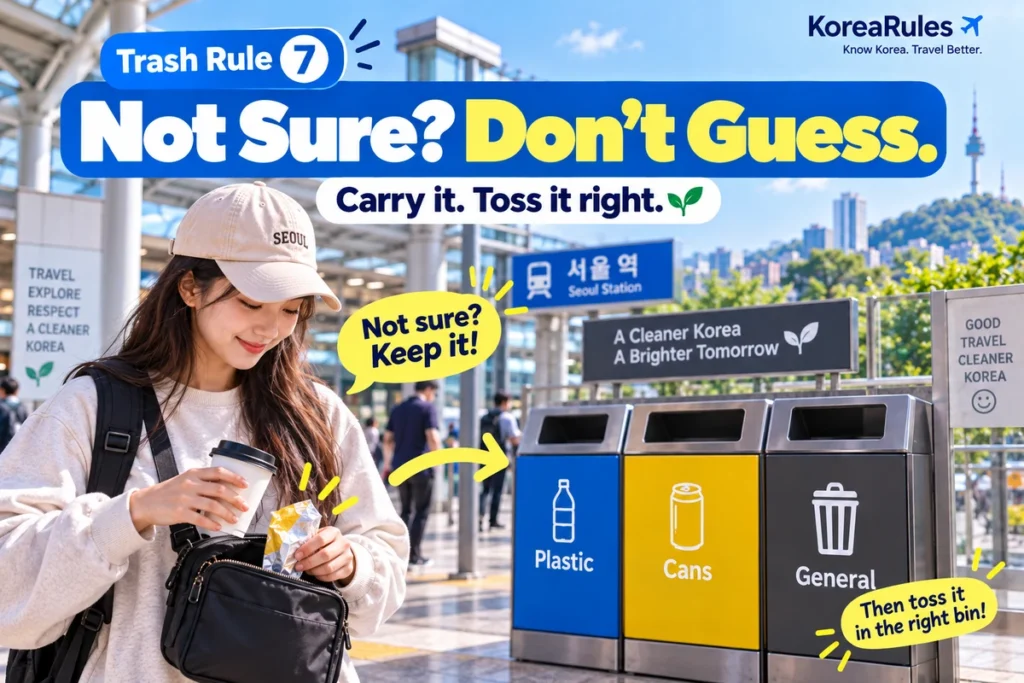
7. If You’re Not Sure, Don’t Guess
Sometimes you will stand in front of several bins holding something that does not seem to fit anywhere.
A coffee cup with a plastic lid.
A takeaway container with sauce inside.
A snack package made from several materials.
Or perhaps there is no trash bin at all.
When that happens, you do not need to make an instant decision.
If you are unsure where something belongs, keep it temporarily and dispose of it when you find a clearer waste station.
This is often better than putting it into the wrong recycling container or leaving it somewhere it does not belong.
The kinds of trash travelers commonly carry for a while include:
- Coffee cups
- Plastic bottles
- Snack wrappers
- Receipts and tissues
- Takeaway containers
A small bag in your backpack can solve the problem until you reach your hotel, a transportation facility, or another appropriate disposal point.
It is a very simple travel habit, but it works almost everywhere.
Carry it. Toss it right.
Before You Toss It
When you are about to throw something away in Korea, do one quick check:
✓ Is there actually a bin?
If not, keep the trash with you for now.
✓ Is it general waste or recyclable?
Check the available containers.
✓ Is there food or liquid left inside?
Empty it before recycling when appropriate.
✓ Is there a separate food-waste bin?
Use it for leftovers if the facility provides one.
✓ Are recycling categories separated?
Follow the labels rather than guessing from the color of the bin.
✓ Are you at your accommodation?
Follow the hotel, guesthouse, or host’s instructions.
✓ Still not sure?
Keep it until you find the right place.
You do not need to become an expert in Korean recycling during your vacation.
The basic habit is enough:
Look → Check → Separate → Dispose.
And when you cannot do that confidently:
Keep it with you until you can.
Frequently Asked Questions
Are public trash bins easy to find in Korea?
Not always.
You will find bins in many public facilities, transportation areas, tourist sites, and other designated places, but there may not be a trash bin exactly where you finish your drink or snack.
If you cannot find one, keep your trash until you reach an appropriate disposal point.
Does Korea separate recycling?
Yes.
Recyclable materials are commonly separated from general waste, and some locations further separate bottles, plastics, cans, glass, paper, and other materials.
Follow the labels on the waste station you are using.
Is food waste separate from normal trash?
Yes, food waste has a separate disposal system in Korea.
Travelers usually do not need to manage the residential system themselves, but if a restaurant, convenience store, accommodation, or public facility provides a food-waste bin, use it for leftover food as directed.
Should I rinse bottles before recycling them?
Containers should generally be emptied before recycling.
If the facility has an appropriate place to rinse a dirty recyclable container, doing so can help. At public locations, simply follow the waste-station instructions available to you.
Can I put all recycling into one bin?
Not necessarily.
Some locations separate PET bottles, other plastics, cans, glass, and paper.
Always check the labels before throwing something away.
Are trash rules the same everywhere in Korea?
The basic principles are similar, but detailed disposal methods can vary by location, district, building, and accommodation.
If you are staying in a guesthouse or Airbnb, follow the waste instructions provided by your host.
What should I do if I cannot figure out which bin to use?
Do not guess if you are unsure.
Keep the item temporarily and dispose of it later when you find a clearly labeled waste station or can ask someone for help.
Sources
Seoul Foreign Resident Portal — Waste Disposal
General waste, food waste, recyclable materials, and the fact that detailed disposal methods can vary by district and housing type.
Seoul Metropolitan Government — Food Waste Disposal Standard
Official guidance on separating food waste, designated food-waste containers or bags, and items that should not be mixed with food waste.
Yeonsu-gu — Recycling Disposal Guide
Official local-government guidance summarizing the basic recycling principles as Empty → Rinse → Separate → Don’t Mix.
Seoul Metropolitan Government — Transparent PET Bottle Recycling
Explains that transparent PET bottles are collected separately from other plastic waste in applicable systems.
Seoul Metropolitan Government — 2026 Hangang River Festival Guidelines
Current 2026 Hangang guidance tells visitors to clean up after themselves and recycle properly in public park areas.